

This is not simply a beam of light, but the actual image of the solar disk.
I am inside the church of Santa Maria Novella in Florence, a place that contains exceptional masterpieces of art, but there is one astonishing detail that risks going unnoticed if you do not know about it. I am talking about this very ray of light: it is a meridian (sundial) created by the friar, mathematician, and astronomer Ignazio Danti.
But it is not a normal meridian with a panoramic strip; it is a camera-obscura meridian. What does that mean? It means that the dark interior of the church functions exactly like a gigantic pinhole camera (a rudimentary photographic device without lenses in the objective), which uses a tiny hole to capture light and project an image onto the floor.
Where is our hole? Up there, in the rose window, more than 21 meters high. In reality there are two holes, and they are used at different times of the year according to the position of the sun. The hole acts precisely like an objective: the sunlight passes through the aperture and projects onto the floor a real, in-focus, inverted image of the solar disk.
This is amazing, because if, for example, there were a large sunspot on the surface of the sun right now, we could see it projected directly onto the floor.
But what was Danti’s goal? Why did he design this meridian? Because this meridian was not meant only for observing the sun; it was part of a much, much more ambitious scientific project. In the 16th century, it had become clear that the Julian calendar, introduced by Julius Caesar, was accumulating an error of about 11 minutes per year. These 11 minutes added up every year until, over the centuries, the calendar was a full 10 days behind.
So Danti, commissioned by Grand Duke Cosimo I de’ Medici—who wanted to demonstrate the scientific power of Florence—created this extraordinary instrument. Astronomical observations conducted through meridians like this one contributed to the studies that led to the reform of the calendar and the introduction of the Gregorian calendar, which is currently the most widely used calendar in the world.
However, when Cosimo I died, his successor did not share his father’s passion, so Danti was forced to leave Florence, leaving his meridians incomplete. The blocked holes were reopened only in the 1980s, while the meridians set into the floor of the basilica were made in 2016, based on Danti’s own studies.
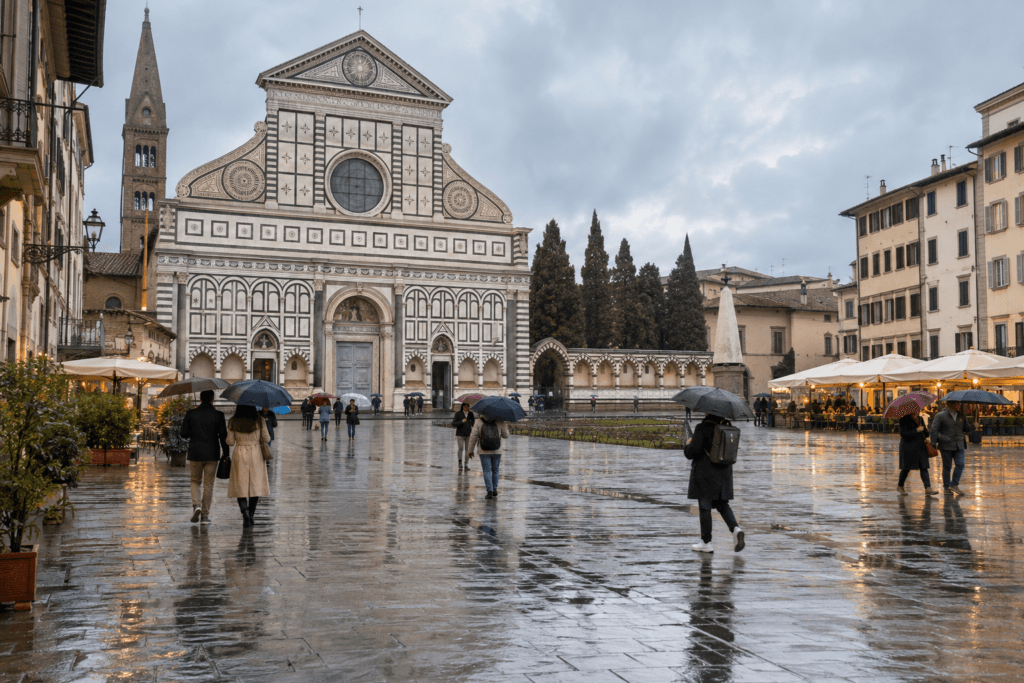
One last curiosity: on the façade of the church there are other installations applied by Danti, such as this armillary sphere, formed of metal circles representing the celestial orbits and the terrestrial equator, as well as this solar meridian, which allowed the time to be measured with sunlight. In short, the façade of Santa Maria Novella was a true open-air astronomical laboratory.