
Introduction — The Roman Pyramid Mystery
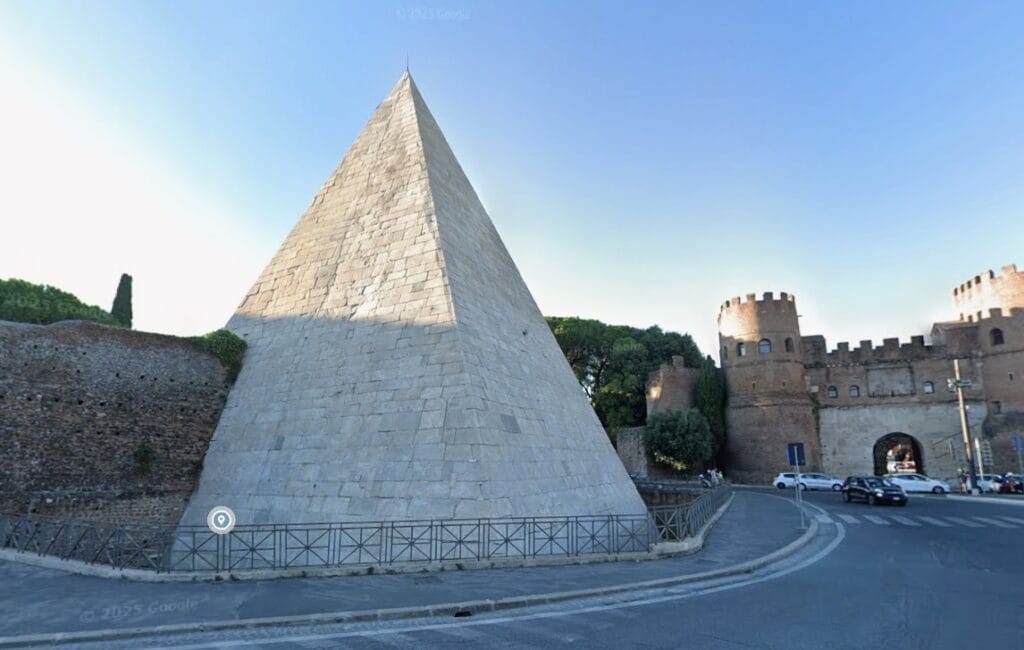
Yes, there is a pyramid in Rome. Not only is it real, but it stands an impressive 37 meters high. While an ordinary tomb in ancient Rome could look quite humble—almost like a simple pit—this monument was something entirely different. It was the result of a grand idea, a unique architectural project that had to be completed in less than a year. And so, the Pyramid of Cestius was born. But why is there a pyramid in Rome at all? To understand this unusual story, let’s explore The Roman Pyramid Mystery step by step.
A Tomb That Became a Landmark
The Roman Pyramid Mystery
Originally, the structure was conceived as the monumental tomb of Gaius Cestius, a Roman magistrate and member of the wealthy elite. Although the typical Roman burial monument was rather modest, Cestius wanted something extraordinary—something inspired by the exotic allure of Egypt, which fascinated Roman society at the time.
Moreover, according to the inscription found inside, the pyramid had to be completed within 330 days, less than one year, a tight timeframe that explains its precise and angular form.
From Tomb to Defensive Structure
The Roman Pyramid Mystery
Later, around 270 AD, Rome built a massive system of defensive walls: the Aurelian Walls. During this expansion, the pyramid was incorporated directly into the fortifications.
Consequently, Porta Ostiense—today known as Porta San Paolo—was built right next to it. The pyramid sat on the ancient Via Ostiense, the road that connected Rome to its port city, Ostia.
For more context on the Aurelian Walls, see:
- Aurelian Walls – History Overview (external link)
Thirteen Pyramids in Ancient Rome?
The Roman Pyramid Mystery
Historical documents and maps reveal something surprising: Rome once had around thirteen pyramids scattered across the city.
However, all of them were gradually destroyed during the Middle Ages and the Renaissance, either for building materials or because they were considered pagan structures.
Today, only one pyramid survives—the Pyramid of Cestius.
To learn more about Rome’s ancient topography:
- Ancient Rome Maps Archive (external link)
Why a Pyramid in Rome?
The Roman Pyramid Mystery
So, why does a pyramid stand in Rome at all?
In short, the Romans were deeply fascinated by Egyptian culture, especially after the conquest of Egypt. Pyramids were symbols of prestige, eternity, and power—qualities the Roman elite wanted to be associated with. Creating an Egyptian-style tomb became a fashionable trend among high-ranking Romans, especially those who wished to display wealth and status.
For more on Roman–Egyptian cultural influence:
- Rome and Egypt Cultural Exchange (external link)
And for detailed background on Gaius Cestius:
- Cestius Biography – Classical Sources (external link)
Conclusion
The Pyramid of Cestius stands today as one of the most unusual and iconic monuments in Rome. Blending Egyptian inspiration with Roman ambition, it is a rare survivor of a forgotten architectural trend—an extraordinary reminder of a time when Rome looked outward, borrowed ideas, and reshaped them in its own image.
If you’re exploring unusual things to see in the Eternal City, The Roman Pyramid Mystery is a story you shouldn’t miss.
Pyramid of Cestius – Official Info
https://www.sovraintendenzaroma.it/en/luoghi/pyramid_cestius
Aurelian Walls (Encyclopaedia Britannica)
https://www.britannica.com/topic/Aurelian-Walls
Rome and Egypt – Met Museum Essay
https://www.metmuseum.org/toah/hd/roeg/hd_roeg.htm
Ostia Antica – Official Archaeological Park
https://ostiaantica.beniculturali.it/en/
High-Authority Cultural Resources
- Metropolitan Museum of Art – Rome & Egypt Essay
https://www.metmuseum.org/toah/hd/roeg/hd_roeg.htm
British Museum – Ancient Rome Collection
https://www.britishmuseum.org/collection/galleries/rome
UNESCO – Historic Centre of Rome
https://whc.unesco.org/en/list/91/
Encyclopaedia Britannica – Aurelian Walls
https://www.britannica.com/topic/Aurelian-Walls