

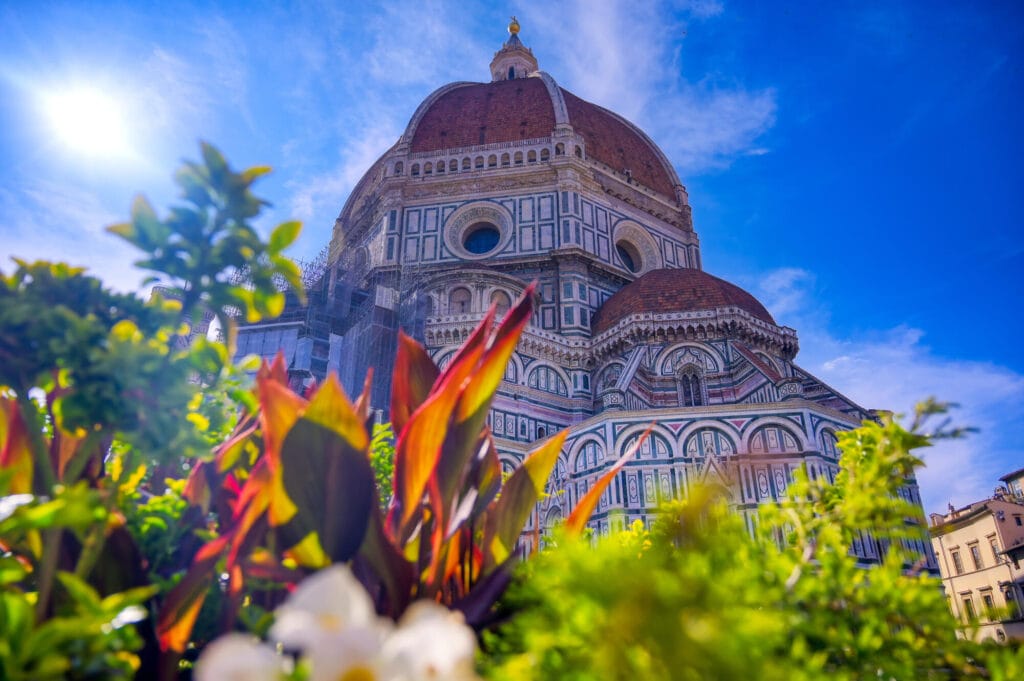
Brunelleschi’s Impossible Renaissance Masterpiece
When people visit Florence, they often admire the magnificent dome of the Cathedral of Santa Maria del Fiore without realizing that they are looking at one of the greatest engineering achievements in human history. Brunelleschi’s Impossible Renaissance Masterpiece is not just a beautiful monument; it is a story of creativity, courage, and innovation that changed architecture forever.
Today, the dome dominates Florence’s skyline, but in the early 15th century, many believed it could never be built. The challenge seemed impossible. Nevertheless, one man was willing to try: Filippo Brunelleschi.
The Problem Nobody Could Solve
In 1418, the powerful Florentine guild known as the Arte della Lana organized a competition to solve a problem that had remained unanswered for more than fifty years. The Cathedral of Santa Maria del Fiore had been standing without a dome, leaving a huge open space above the crossing.
The requirements were extraordinary. The dome had to be approximately 45 meters (148 feet) wide and 45 meters high. Moreover, it would rise more than 55 meters above the ground, creating a structure that reached nearly 100 meters in total height.
However, there was a major problem. Traditional Gothic solutions such as flying buttresses and external supports were not acceptable in Florence. At the same time, the ancient Roman concrete used in the Pantheon had been forgotten. To make matters worse, there was not enough timber available to build the enormous wooden scaffolding that would normally be required.
As a result, many experts believed the project was impossible.
The Genius of Filippo Brunelleschi
Surprisingly, the winner of the competition was not an experienced architect but a 40-year-old goldsmith named Filippo Brunelleschi. Despite having never constructed a building of this scale, he convinced the judges with detailed drawings, a wooden model, and an extraordinary vision.
According to legend, Brunelleschi challenged the judges to make an egg stand upright on a table. When nobody succeeded, he gently cracked the bottom and stood it up himself. His message was simple: once someone shows the solution, it appears obvious.
In many ways, that story perfectly describes Brunelleschi’s Impossible Renaissance Masterpiece.
A Dome Unlike Any Other
Instead of building a single dome, Brunelleschi designed two concentric domes: an inner shell and an outer shell. These were connected by eight massive ribs and reinforced by additional structural elements.
Furthermore, he introduced iron chains embedded within the structure to prevent the dome from spreading outward. In many respects, these chains worked like modern reinforced engineering systems.
The most revolutionary innovation, however, was the famous herringbone brick pattern. Rather than placing bricks in traditional horizontal rows, Brunelleschi arranged them in a special interlocking design known as “spina di pesce” or herringbone.
Consequently, the bricks supported each other as construction progressed, allowing workers to build upward without massive wooden centering.
Even today, engineers continue to study this remarkable solution.
The Mystery That Remains
Although modern researchers can examine the dome and understand much of its construction, one mystery remains unsolved: how did Brunelleschi design it?
At the time, the mathematical methods necessary to calculate the forces acting on such a structure simply did not exist. Yet somehow, Brunelleschi anticipated solutions that would not be fully understood for centuries.
Adding to the mystery, he left almost no detailed plans. He guarded his methods carefully and took many of his secrets to the grave.
For this reason, Brunelleschi’s Impossible Renaissance Masterpiece remains one of the most fascinating puzzles in architectural history.
Was Brunelleschi Ahead of His Time?
Some historians believe Brunelleschi may have intuitively discovered principles similar to the catenary curve, a shape later studied by engineers and famously used by architects such as Antoni Gaudí.
In other words, he may have found the most efficient self-supporting form without having access to modern engineering science.
While we cannot know for certain, the idea highlights just how extraordinary his achievement truly was.
Why You Should Visit the Dome
If you ever visit Florence, step inside the Cathedral of Santa Maria del Fiore and stand beneath the crossing. Then look up.
Above you rises a structure that should not exist according to the knowledge of its time. Yet it has stood for more than six centuries.
That is why many people consider Brunelleschi’s Impossible Renaissance Masterpiece not only a symbol of Florence but also one of the most modern buildings ever created.
Useful Links
Learn more about the cathedral on the official website:
https://www.duomo.firenze.it
Explore the history of Filippo Brunelleschi:
https://www.britannica.com/biography/Filippo-Brunelleschi
Discover Florence’s UNESCO heritage:
https://whc.unesco.org/en/list/174
Read more about the dome’s architecture:
https://smarthistory.org/florence-cathedral/
Internal Resource:
https://www.bestfreetour.com/free-tour-florence/
Final Thoughts
Ultimately, Brunelleschi’s dome represents much more than a construction project. It symbolizes the beginning of the Renaissance, the triumph of human imagination, and the power of innovation.
More than 600 years later, visitors still stand beneath it in amazement, wondering the same thing that Florence’s citizens wondered in 1418: how was this even possible?