
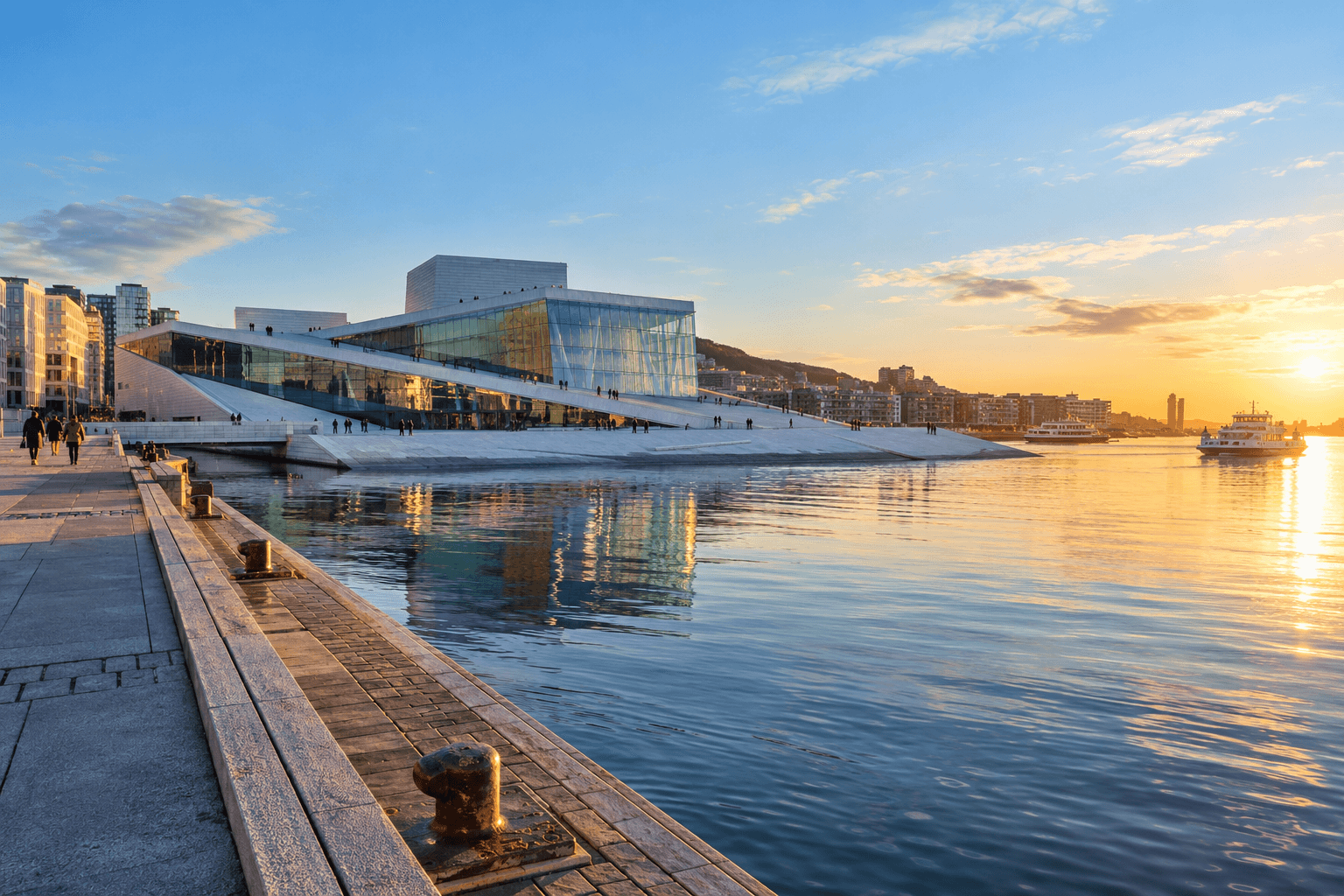
Oslo makes more sense from the water. Along the inner fjord, medieval walls, civic buildings and bold contemporary architecture sit within one continuous public landscape. This walk begins on the roof of the Opera House and ends among the piers of Aker Brygge, showing how the Norwegian capital has turned its working harbour into a place for culture, swimming, food and everyday city life.
A half-day walk along Oslo’s harbour promenade
Set aside three to four hours, not counting museum visits. The route is mostly flat and follows the waterfront from Bjørvika to Aker Brygge, with a detour through Akershus Fortress. Visit Norway describes Oslo’s harbour promenade as a walk rich in architecture, food and culture; the pleasure comes from leaving space for the changing fjord light rather than racing between landmarks.
Start by walking onto the Opera House
The sloping roof is designed as public ground, so the first viewpoint is part of the building itself. Climb slowly, notice how white stone meets glass, and look back towards the station and Barcode skyline. On wet or icy days, follow signs and avoid exposed sloping surfaces.
Bjørvika: a new district beside old water
From the Opera, move past the waterfront cultural buildings and keep the fjord on your left. This is Oslo at its newest: broad pedestrian spaces, sea baths, apartments and public art. Instead of judging the architecture from one angle, walk around it; reflections and sightlines shift every few metres.
Akershus Fortress and the old city
The stone walls of Akershus provide the route’s historical counterweight. Enter through an open public gate and follow the paths for views across the harbour. Nearby Kvadraturen preserves the grid of Christiania, with Christiania torv and some of the city’s oldest buildings. Check access hours because sections of the fortress may close for ceremonies or events.
City Hall, Nobel history and the open fjord
Continue towards Oslo City Hall. Its brick towers are intentionally monumental, but the waterfront side feels open and public. The Nobel Peace Prize ceremony takes place inside each December. From the quay, ferries and working boats keep the harbour from becoming a static postcard.
Finish at Aker Brygge and Tjuvholmen
Aker Brygge combines former industrial structures with promenades, restaurants and docks. If time and weather allow, continue to Tjuvholmen for art, small beaches and wider fjord views. Sunset can be beautiful, but winter daylight disappears quickly, so plan the return before dark.
Food and weather: two Oslo realities
For a local pause, consider seafood, a simple open sandwich or a cinnamon bun with coffee. Prices can be high, so lunch specials and bakeries are useful. Carry a windproof layer even on bright days: conditions along the fjord change faster than in sheltered streets.
Practical tips
- Wear shoes with grip for stone, ramps and potentially wet quays.
- Check official opening hours for the fortress and museums.
- Use public transport to shorten the route if weather turns.
- In winter, begin early; in summer, use the long evening light.
Build the route around your interests with the AI Tour Matcher. Compare local guides on the free walking tour platform and add compatible experiences and activities.
Frequently asked questions
Is Oslo’s waterfront walk free?
The promenade, Opera roof and many fortress grounds are free; museums and exhibitions may charge admission.
How long is the route?
Allow roughly three hours at a comfortable pace, or half a day with stops and a museum.
Can I walk it in winter?
Yes, but daylight is limited and surfaces may be icy. Check conditions and choose footwear carefully.