
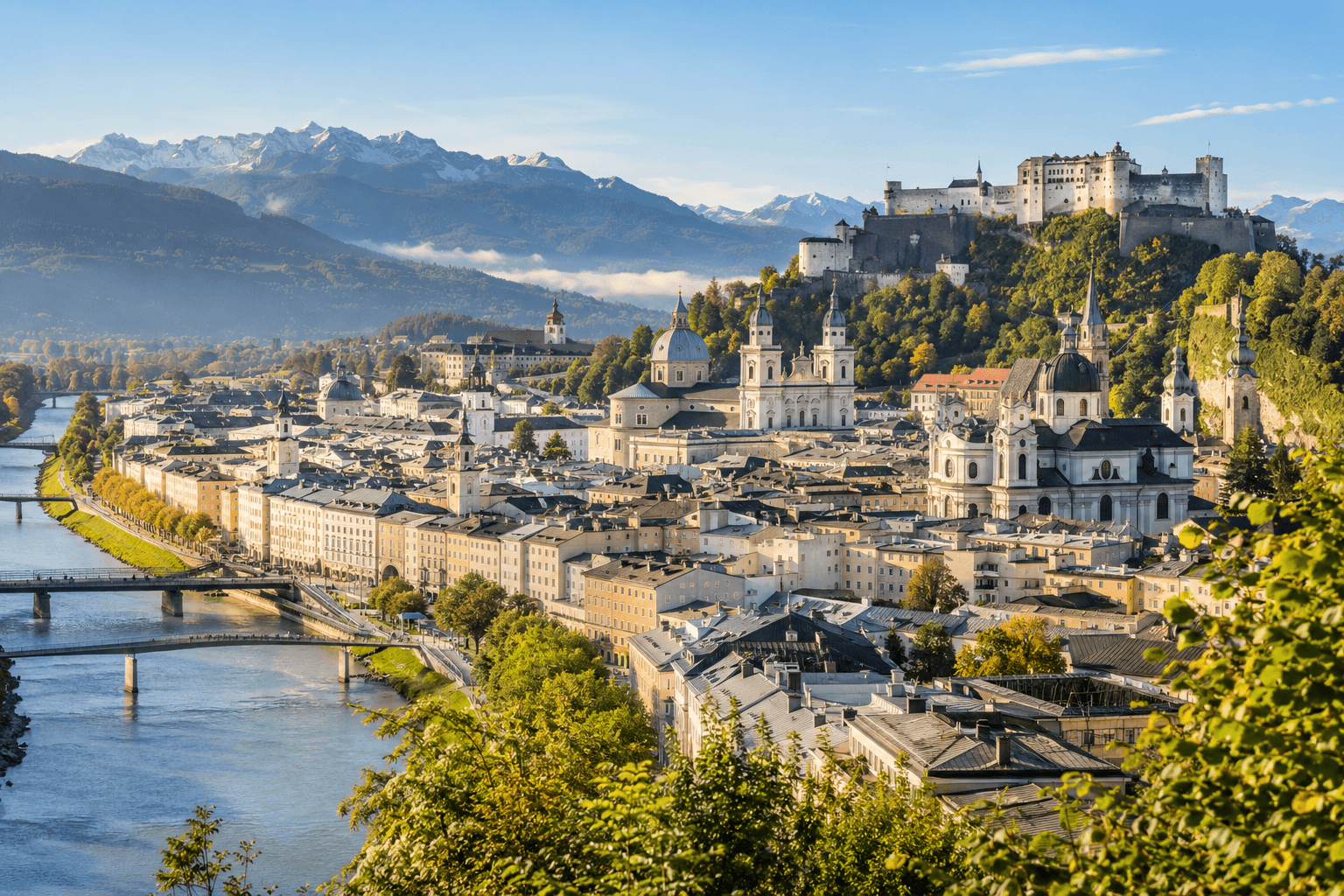
Salzburg is often introduced through Mozart and The Sound of Music, but the city becomes more interesting when you let its geography lead the day. The baroque centre sits between the Salzach and steep green hills; passages cut through old merchant houses, church towers appear unexpectedly, and a short climb changes the whole scale of the place. This route is designed for travellers who want the famous sights without turning the visit into a checklist.
A Salzburg route that follows the city’s natural rhythm
Allow four to five hours, longer if you enter museums or stop for lunch. Begin in Mirabell Gardens early, cross the river into the historic centre, explore the lanes around Getreidegasse and the cathedral district, then finish with a Mönchsberg viewpoint. The official UNESCO walk is about 7.2 kilometres and takes roughly two and a half hours without long stops, so the plan is compact but not rushed.
Mirabell Gardens and the first view of the fortress
Start on the right bank in Mirabell Gardens. The formal axes, marble figures and Pegasus Fountain frame the fortress across the river, but the best reason to begin here is orientation: in a few minutes you understand how the old town, the river and the city mountains fit together. Walk through the garden rather than photographing it from one spot, then continue towards Makartsteg.
Cross the Salzach slowly
The river is not merely a way between attractions. Pause on the bridge and look upstream: the domes and spires form a theatrical skyline, while Mönchsberg closes the scene behind them. On the left bank, avoid rushing straight into Getreidegasse. First follow the riverside for a short stretch and enter the old town through one of its narrow passages.
Getreidegasse, hidden courtyards and quieter lanes
Getreidegasse is busy, yet its most revealing details are above and behind eye level: wrought-iron signs, old façades and through-passages connecting parallel streets. Step into publicly accessible courtyards, then drift towards Universitätsplatz and the market area. This makes the famous street feel like part of a living neighbourhood rather than a shopping corridor.
Residenzplatz, the cathedral and St Peter’s quarter
The cathedral district shows why Salzburg’s historic centre is UNESCO-listed. Prince-archbishops shaped the city as an ecclesiastical state, and Italian architects helped define its baroque appearance. Move from Residenzplatz to Domplatz, then into the lanes around St Peter’s Abbey and cemetery. The contrast between monumental squares and the intimate cliff-side quarter is one of the walk’s strongest moments.
Finish above the rooftops on Mönchsberg
If you still have energy, climb by the paths near the old walls; otherwise take the Mönchsberg lift from Anton-Neumayr-Platz. The lift rises about 60 metres in around 30 seconds. From the terrace near the Museum der Moderne, the old town reads as a single composition of domes, roofs, river and mountains. Continue only as far as daylight and weather allow, then descend for dinner.
What to eat without losing the afternoon
For a quick savoury stop, look for Bosna, a spiced sausage in a crisp roll. At a traditional inn, consider dumplings, schnitzel or seasonal dishes; for dessert, Salzburger Nockerl is best shared. Café culture rewards a slower pause, but choose a side street if the central terraces are full.
Practical tips
- Wear shoes with grip: old paving and hill paths can be slippery.
- Check opening hours directly before entering churches, museums or the lift.
- Use the riverbanks and covered passages to shorten the route in rain.
- Early morning and late afternoon give calmer streets and softer light.
To personalise the route, use the AI Tour Matcher. Compare local options on the free walking tour platform, then browse compatible experiences and activities.
Frequently asked questions
Can Salzburg’s centre be explored in one day?
Yes. The principal old-town sights, the river and one viewpoint fit comfortably into a well-paced day.
Is the Mönchsberg climb difficult?
The walking paths involve slopes and steps, but the lift provides an easy alternative to the panoramic terrace.
When is the old town quietest?
Before 9 a.m. and towards evening, especially outside festival and peak summer dates.