
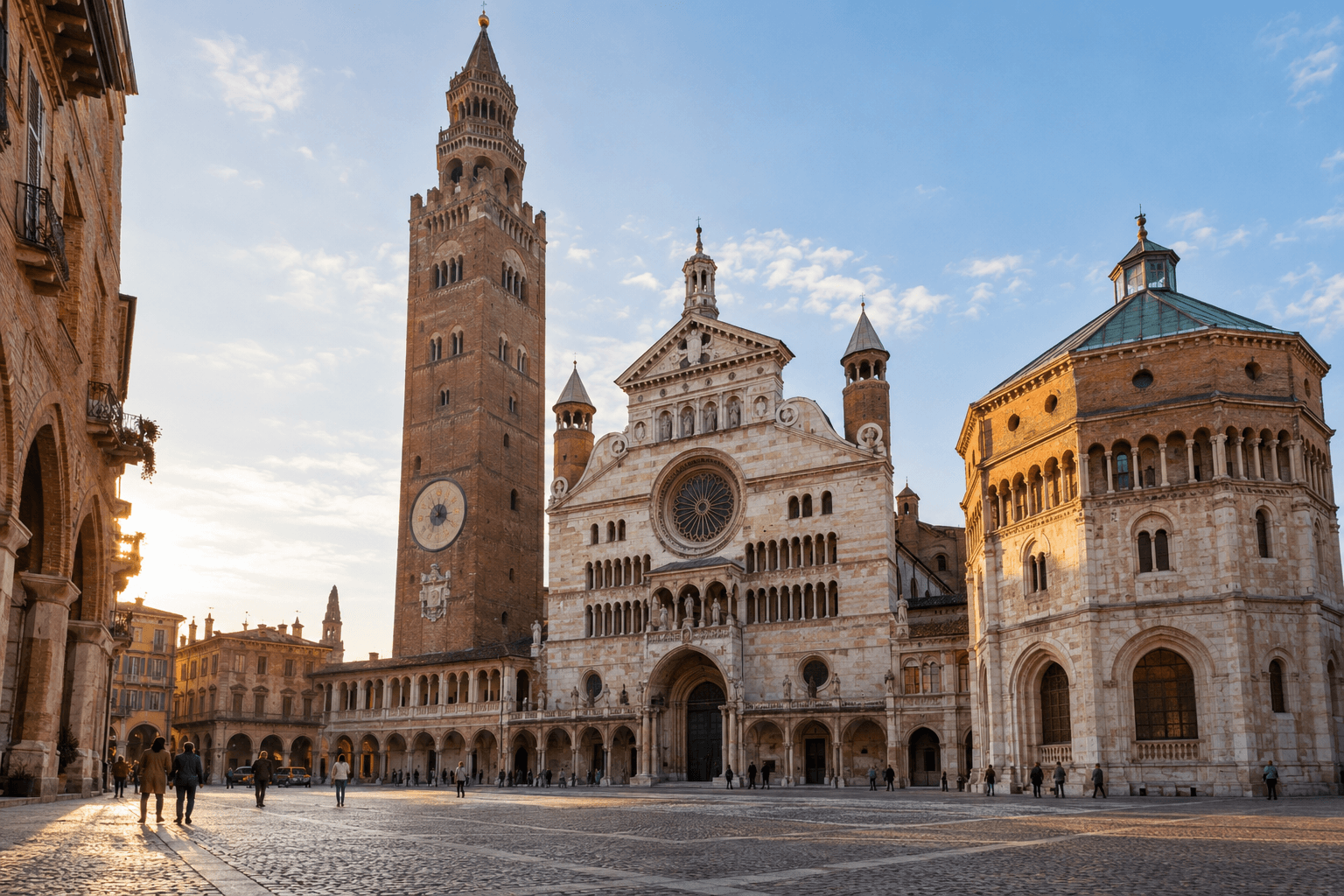
Cremona is compact enough for an unhurried day on foot, yet its identity reaches far beyond its size. The city’s central square brings together medieval civic power, religious architecture and an astronomical clock; a few streets away, violin makers continue a craft recognised by UNESCO. This route connects both worlds without reducing Cremona to a checklist.
Why choose Cremona for a walking day?
The historic centre is level, readable and rich in detail. Distances are short, so you can alternate monuments with workshops, cafés and quieter streets. Before leaving, use the AI Tour Matcher to compare this self-guided plan with available guided options.
Stage 1: Piazza del Comune
Start with the Torrazzo and Cathedral
Begin in Piazza del Comune, where the Cathedral, Baptistery, Palazzo Comunale and Torrazzo create one of Lombardy’s most coherent ensembles. Look at the Torrazzo’s astronomical dial before considering the climb. The tower contains a vertical museum devoted to measuring time, but its many steps require comfortable shoes and a realistic pace.
Pause before moving on
Rather than rushing away, walk around the square and notice how brick, marble and painted surfaces change with the light. Check official opening hours: religious services and seasonal schedules can affect access.
Stage 2: the city of violin making
Continue toward Piazza Marconi and the Museo del Violino. The museum explains five centuries of Cremonese craftsmanship and displays historic instruments, while scheduled auditions can reveal why these objects were made to be heard, not only seen.
In surrounding streets, workshops remain active workplaces. Cremonese violin making was inscribed on UNESCO’s Representative List of Intangible Cultural Heritage in 2012. Workshop visits should be arranged through official contacts; do not treat artisans’ windows as an invitation to enter unannounced.
Stage 3: courtyards, churches and local rhythm
Return slowly through secondary streets, looking for courtyards and small architectural details. This final section is deliberately flexible: choose the Ala Ponzone Museum, an additional church or a coffee break rather than forcing every attraction into one day.
For local storytelling, compare the free walking tours. For museum, food and cultural options, browse the compatible experiences.
Practical planning
- Time: three to five hours, depending on museums and the tower.
- Best light: morning in Piazza del Comune; afternoon in the smaller streets.
- Tickets: verify museum, audition and Torrazzo schedules in advance.
- Accessibility: the centre is mostly easy, but the tower climb is demanding.
Frequently asked questions
Is Cremona only for classical music lovers?
No. Music gives the city a distinctive identity, but its architecture, museums and calm urban scale appeal to many travellers.
Can I visit a violin workshop?
Yes, when arranged through official channels or participating workshops. Advance booking is the respectful option.
Is one day enough?
Yes for the historic core, Torrazzo area and violin heritage. Stay longer if you want several museums or the Po landscape.
Information checked against Cremona’s official tourism portal, Comune di Cremona and UNESCO resources on 5 October 2026.