
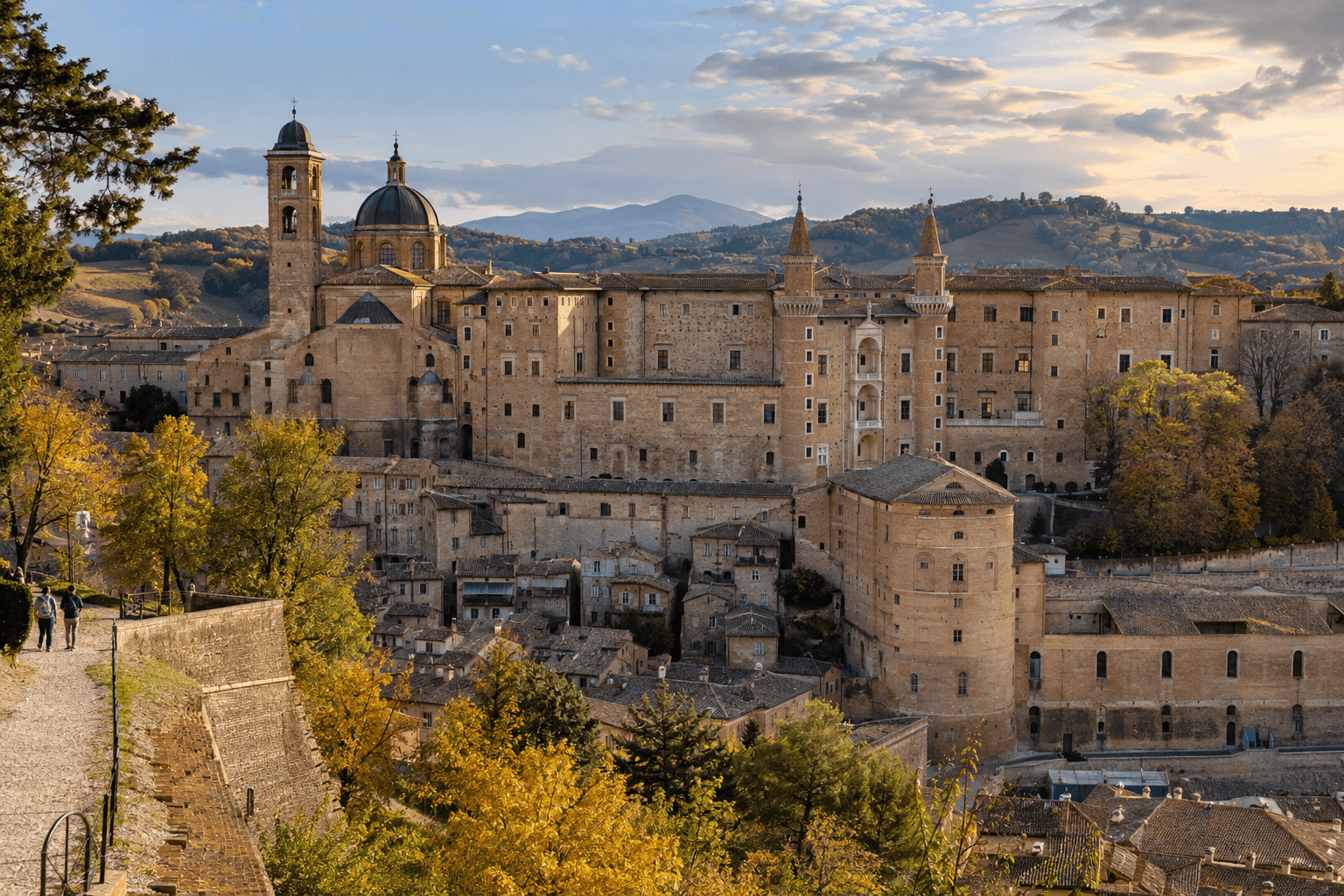
Urbino rewards visitors who slow down. Its brick lanes rise and fall between two hills, opening without warning onto courtyards, towers and the soft landscape of the Marche. The historic centre has been on UNESCO’s World Heritage List since 1998, recognised as an exceptionally complete Renaissance town shaped by the court of Federico da Montefeltro.
Why Urbino is more than a museum city
In the fifteenth century, artists, architects and humanists gathered here and transformed a medieval hill town without erasing its earlier fabric. The result is compact, coherent and still lived in by students. Start by using the AI Tour Matcher to compare the kind of local introduction that suits your timing.
A Renaissance route through Urbino
Porta Valbona and Palazzo Ducale
Enter through Porta Valbona and climb towards Piazza della Repubblica before reaching Piazza Duca Federico. Palazzo Ducale is the route’s essential interior: its measured courtyard, twin towers and rooms reveal how geometry became political language. The Galleria Nazionale delle Marche holds works connected with Piero della Francesca and Raphael, while the Duke’s Studiolo compresses an entire humanist world into intricate wood inlay. Check current opening hours on the official museum website before visiting.
The cathedral and the hidden oratories
Beside the palace, Urbino Cathedral offers a neoclassical contrast to the Renaissance ensemble. Continue to the Oratory of San Giovanni Battista, where the Salimbeni brothers’ vivid early-fifteenth-century frescoes reward close looking. Nearby, the Oratory of San Giuseppe preserves Federico Brandani’s sculpted Nativity. These small interiors are easy to miss, so allow time rather than treating them as quick stops.
Raphael’s street and the Albornoz viewpoint
Walk uphill along Via Raffaello to Casa Natale di Raffaello, then continue to the Albornoz Fortress. From the lawn, the palace towers align with tiled roofs and cultivated hills: the clearest view of how Urbino fits its terrain. Browse the main free walking tour directory for a guided option, or combine the route with compatible activities in the experiences collection.
Practical tips for the hills
Wear shoes with grip: gradients are steep and polished paving can be slippery after rain. The centre is small, but a relaxed circuit with one major museum takes most of a day. Arrive early for quieter streets, confirm individual opening times, and remember that some religious sites may close at midday.
Frequently asked questions
How long do you need in Urbino?
One full day covers the main route and Palazzo Ducale. Add a second day for more museums, churches and a slower exploration of the university streets.
Is Urbino easy to explore on foot?
Distances are short, but slopes and steps are frequent. Visitors with limited mobility should check accessible entrances and use local transport for the steepest approaches.
What is the best viewpoint?
The grounds by the Albornoz Fortress offer the classic panorama of Palazzo Ducale and the surrounding hills, especially in soft morning or late-afternoon light.