
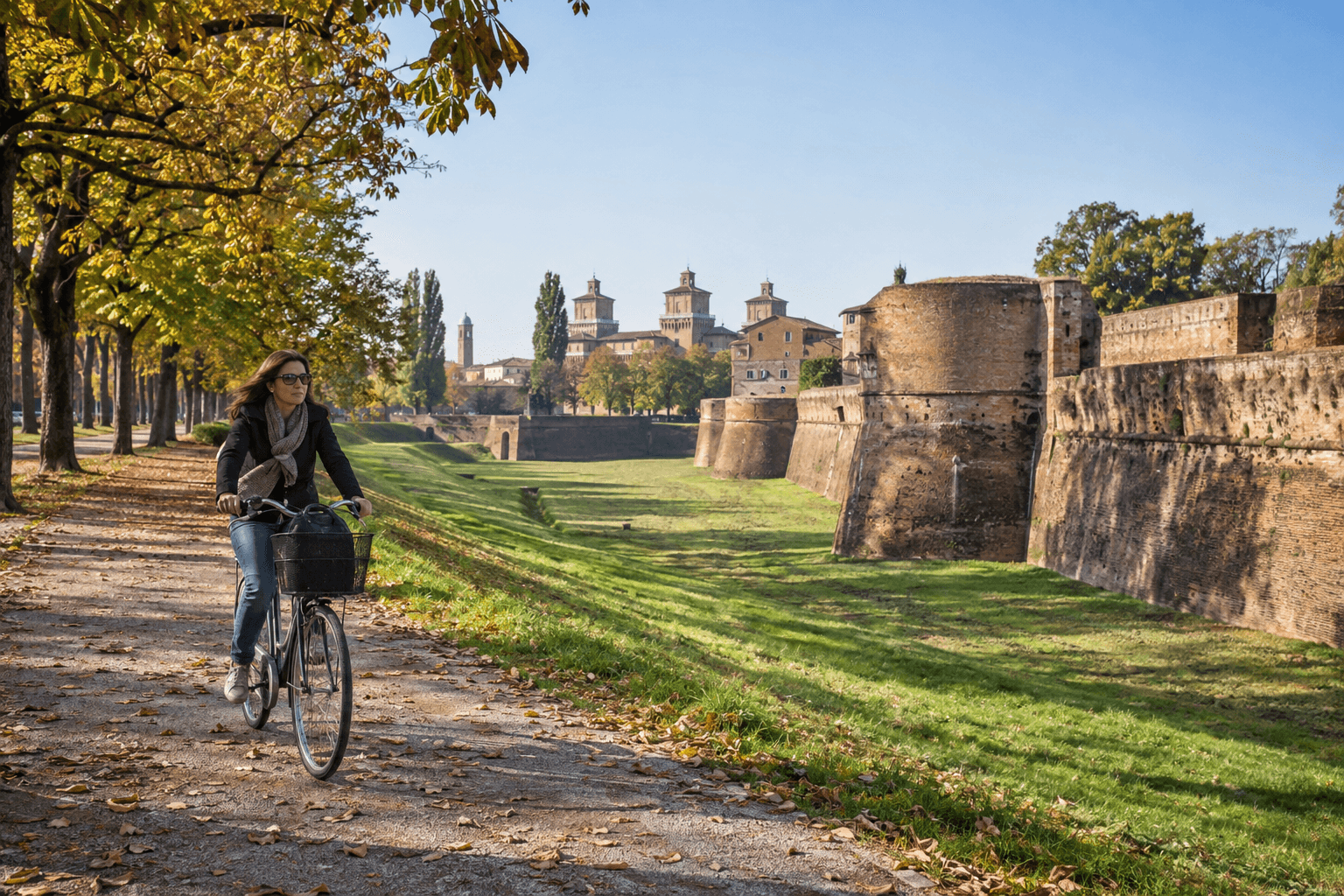
Ferrara is one of Italy’s most natural cycling cities: flat, compact and framed by nine kilometres of historic walls. The bicycle is not merely transport here; it is the best way to understand how the medieval core, the Este court and the planned Renaissance expansion fit together.
Why explore Ferrara by bicycle
UNESCO recognises Ferrara as an exceptional example of Renaissance urban planning. From 1492, Biagio Rossetti’s Addizione Erculea introduced long perspectives, generous intersections and palaces into a coherent design. A bike lets you read those distances without rushing. Before setting out, use the AI Tour Matcher to compare a local introduction or an independent audio-led option.
A half-day cycling route through Ferrara
Castello Estense and the medieval centre
Begin at the moated Castello Estense, built after the revolt of 1385 and later transformed from fortress into court residence. Walk your bicycle through the busiest pedestrian stretches, then pass the Cathedral and the lanes around Via delle Volte. This covered, cobbled street preserves the denser scale of medieval Ferrara and contrasts sharply with the avenues ahead.
Corso Ercole I d’Este and Palazzo dei Diamanti
Ride north along Corso Ercole I d’Este, the ceremonial axis of the Renaissance addition. At the Quadrivio degli Angeli, stop at Palazzo dei Diamanti, whose stone façade changes with the light. The wide street and carefully placed buildings reveal the humanist idea of an “ideal city” more clearly from a bicycle than through a sequence of isolated monuments.
Porta degli Angeli and the city walls
Continue to Porta degli Angeli and join the tree-lined ramparts. Ferrara’s official tourism service describes an almost continuous nine-kilometre circuit, manageable in roughly ninety minutes by bike. You can ride above the walls for views or beside them through the green embankments. If time is limited, follow the northern and eastern sectors before returning towards the centre.
Palazzo Schifanoia and the Salone dei Mesi
Leave the walls near the eastern quarter and finish at Palazzo Schifanoia. Its celebrated Hall of the Months turns astrology, court life and seasonal work into an extraordinary fresco cycle. Check official opening times and reserve when recommended. Find a guided orientation in the free walking tour directory, then add museum tickets or compatible activities from the experiences collection.
Practical cycling advice
Use a city bike with working lights and a lock. Slow down on cobbles, dismount in crowded pedestrian zones and respect current signs. Spring and early autumn are comfortable, while summer rides are best early or late. The complete route takes about four hours with short stops; allow a full day if entering the castle and Palazzo Schifanoia.
Frequently asked questions
Is Ferrara suitable for inexperienced cyclists?
Yes. The terrain is flat and the walls are largely separated from traffic, although cobbles and shared central streets require attention.
Can you cycle the entire wall circuit?
The walls form an almost uninterrupted nine-kilometre green ring. Temporary works may affect individual stretches, so check local notices before departure.
Where should you spend the most time?
Prioritise Castello Estense, the perspective of Corso Ercole I d’Este and Palazzo Schifanoia. Together they explain the city’s medieval, courtly and planned Renaissance identities.