
Porto’s blue-and-white façades are more than a photogenic backdrop: they turn streets, stations and churches into public history books. This self-guided walk links three very different uses of azulejos—an exterior chapel, a railway concourse and a monumental church façade—without trying to catalogue every tiled building in the city. Allow about two hours for a route of roughly 3 kilometres, longer if you enter monuments or stop for details.
What makes this azulejo route useful?
The stops are close enough to walk, but each answers a different question. At Capela das Almas, tiles wrap architecture at street level. At São Bento, narrative panels organise history inside a working station. At Carmo, a vast lateral composition changes the scale of an urban square. The route also passes lively commercial streets, so it works well as a morning introduction to central Porto.
Stop 1: Capela das Almas
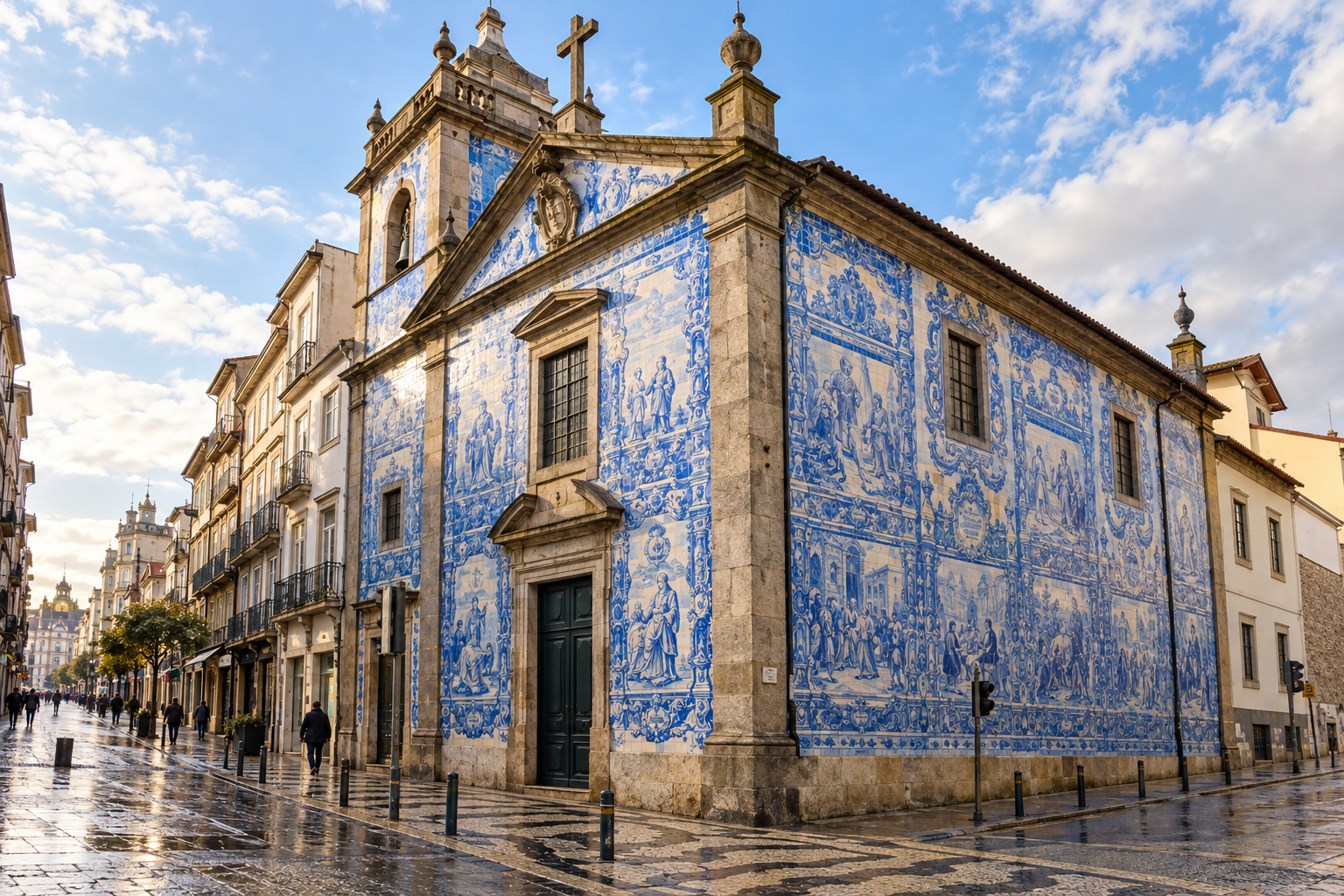
Begin beside Mercado do Bolhão and Rua de Santa Catarina. The chapel dates from the early eighteenth century; according to Porto’s official tourism portal, its exterior was covered in 1929 with panels showing episodes from the lives of Saint Francis of Assisi and Saint Catherine, later restored in 1982.
How to look before taking a photo
Walk around the corner before choosing a frame. The tiled skin works across two elevations, and a wider viewpoint explains its relationship with the street better than a tight portrait. Keep doorways open, avoid photographing worshippers at close range and remember that this remains an active religious building.
Stop 2: São Bento Railway Station
Continue downhill towards Avenida dos Aliados and São Bento. The station was built in the early twentieth century on the former site of the Convent of São Bento de Avé-Maria. Architect Marques da Silva designed the glass-and-iron structure; the entrance hall contains 20,000 tiles painted by Jorge Colaço, depicting the evolution of transport and scenes from Portuguese history and daily life.
This is a functioning station, not a silent gallery. Stand outside passenger flows, keep luggage close and read the panels from the edges before moving into the centre. A normal or slightly wide lens is more useful than an ultra-wide lens that bends the walls.
Details worth noticing
Look for changes in scale: large historical scenes sit beside smaller bands devoted to transport and rural life. The architecture frames the images, so include arches, stonework and the rhythm of the hall rather than isolating every tile.
Optional detour: tiles in the living city
Between São Bento and Carmo, observe residential and commercial façades without treating them as museum pieces. Porto’s official tile itinerary notes that exterior cladding expanded strongly in the nineteenth century, while mechanical printing increasingly complemented hand painting. Weather, repairs and changing shopfronts are part of the urban story.
Do not enter private courtyards for a better angle. If a façade fronts a narrow pavement, take the picture quickly and leave room for residents.
Stop 3: Igreja do Carmo
Finish at the Carmo and Carmelitas complex near Praça de Gomes Teixeira. The Carmo church was built in the second half of the eighteenth century and is considered an important example of Porto rococo. Its lateral façade received tiles in 1912, based on drawings by Silvestre Silvestri and referring to the cult of Our Lady. The building is a national monument.
Carmo, Carmelitas and the narrow house
Do not compress the complex into a single “blue church.” Compare the adjoining façades and notice the very narrow house between the churches. If you enter, check current admission and worship arrangements on site; opening conditions can change, and services take priority.
Timing, hills and accessibility
Start soon after the morning commute if you want clearer exterior views, or visit late in the afternoon when the light is softer. Porto’s paving can be uneven and slippery in rain. The overall route descends and climbs gently, but kerbs, station crowds and church thresholds can complicate access. The city’s official Accessible Porto material includes updated itineraries for downtown and the historic quarter; consult it when step-free planning matters.
Continue planning with our AI Tour Matcher, compare Porto experiences and self-guided options, or browse the Best Free Tour city guides.
Frequently asked questions
Is the azulejo walk free?
The street views and São Bento concourse are generally free. Individual churches or museum areas may have their own admission rules.
How long does the route take?
About two hours at an unhurried pace. Add time for interiors, market stops or detailed photography.
Can I photograph inside São Bento?
Casual photography is common, but never block passengers or platforms. Rules for tripods or commercial work may differ.
Are all Porto azulejos blue and white?
No. Blue-and-white panels are iconic, but Porto also has polychrome, relief and mechanically printed tiles from different periods.
Official sources checked: Visit Porto: Capela das Almas; Visit Porto: São Bento Station; Visit Porto: Carmo Church.