
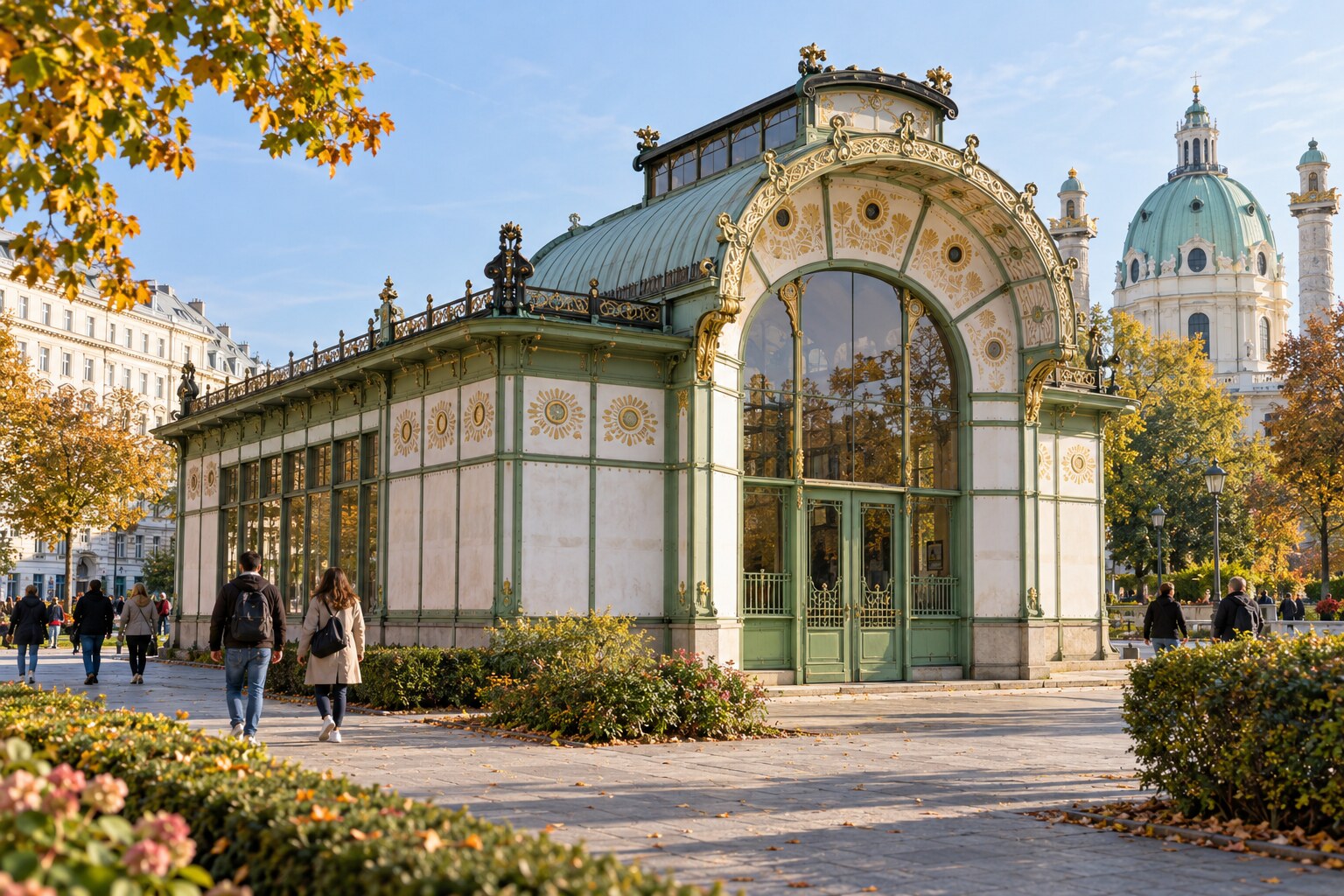
Vienna’s modern identity can be read in green iron, white marble and gold ornament. This self-guided Otto Wagner walk links the elegant Karlsplatz pavilions with the Secession, the Wienzeile houses and surviving details of the former Stadtbahn. It is a compact route for travellers interested in architecture, design and the way public transport reshaped the imperial capital.
Why Otto Wagner changed Vienna
Around 1900, Otto Wagner treated the new Stadtbahn as a complete work of design. Stations, bridges, railings, lamps and signs shared a recognisable visual language. Several sections later became parts of today’s U4 and U6, while restored station buildings still reveal how infrastructure could be both practical and beautiful.
A 3-kilometre architecture walk
1. Start at the Karlsplatz Stadtbahn pavilions
Begin in Resselpark beside Karlsplatz. Study the marble panels, green metal frame and gilded sunflower motifs of the two pavilions. One contains a Wien Museum exhibition in the warmer season; official information lists a winter pause from 1 October to 1 May, so check opening hours before planning an interior visit. The façades remain the essential first stop.
2. Cross to the Secession
Walk toward Friedrichstraße for the Secession building, designed by Joseph Maria Olbrich rather than Wagner. Its geometric mass and gilded dome provide useful context: Vienna’s modernists shared ideas, but not a single style. Continue around the Naschmarkt rather than through its busiest central aisle if you want clearer views of the architecture.
3. Compare the Majolica House and Musenhaus
At Linke Wienzeile 38 and 40, Wagner turned apartment façades into an urban lesson. The Majolica House uses floral ceramic tiles that could be cleaned easily; next door, the Musenhaus is more restrained, with golden ornament by Koloman Moser. Step back across the street to compare the rhythm of the windows and decoration.
4. Follow the traces of the old Stadtbahn
Continue west along the Wien River corridor toward Kettenbrückengasse. Even without entering the U-Bahn, look for green railings, viaduct elements and the repeated details that made the transport system feel coherent. You can finish here, or ride the U4 to Schönbrunn or Hietzing to see additional preserved Wagner stations and the imperial Court Pavilion from outside.
Practical planning
- Distance: about 3 km to Kettenbrückengasse; allow 75–100 minutes.
- Best light: morning for the Karlsplatz pavilions, late afternoon for the Wienzeile façades.
- Accessibility: the outdoor route is mostly level; museum interiors and historic pavilions may have steps or limited access.
- Tickets: the outdoor walk is free. Public transport and museum admission are separate.
For a broader overview, compare the activities on the Vienna city page. You can combine an autonomous audio-led visit with a free walking tour and bookable experiences, or use the one-day Vienna guide to connect this architecture route with the historic centre.
Frequently asked questions
Can I do the walk when the pavilion exhibition is closed?
Yes. The key façades and most Stadtbahn details are outdoors. Treat interior access as an optional addition and check the Wien Museum’s current schedule.
Is this route suitable for children?
Yes, especially as a visual scavenger hunt for sunflowers, green railings and gold details. The route runs through busy urban areas, so supervise closely at crossings.
Do I need a transport pass?
Not for the central 3-kilometre walk. A pass is useful only if you extend the route to Schönbrunn, Hietzing or other surviving U4 and U6 stations.
Information checked against official Vienna Tourist Board, Wien Museum and Austrian Federal Monuments Office resources in October 2026. Opening hours and transport works can change.