
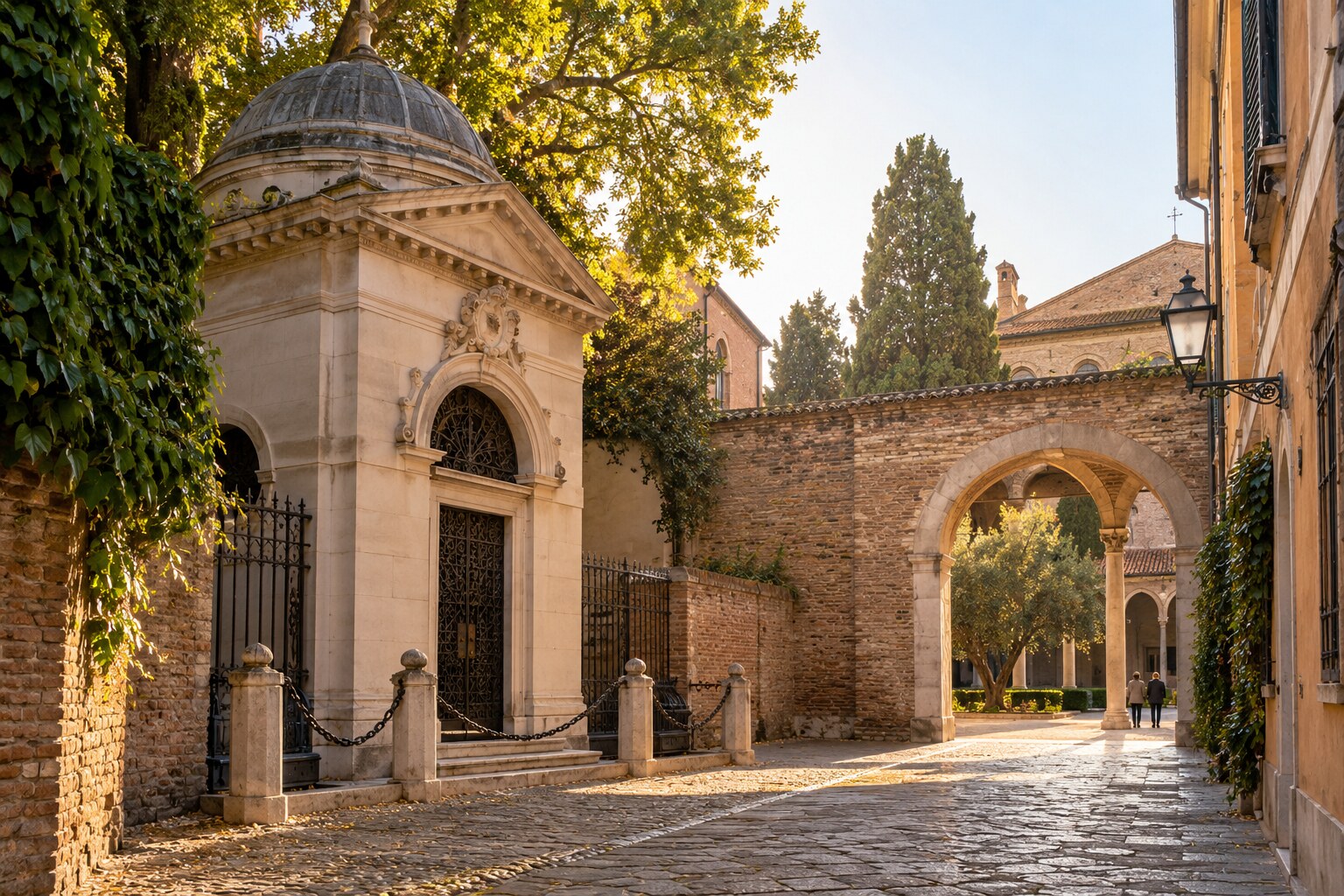
Ravenna is famous for mosaics, yet one of its most moving walks is almost monochrome: pale stone, brick, ivy and deliberate quiet. The compact Zone of Silence gathers the places connected with Dante Alighieri, who spent his final years in Ravenna and died here in 1321. This self-guided route is short enough for an hour, but it rewards a slower pace and combines naturally with the city’s UNESCO monuments.
Why walk Ravenna’s Dante district?
The official tourism board describes the Zone of Silence as a group formed by Dante’s Tomb, the Quadrarco di Braccioforte, the Old Franciscan Cloisters, Museo Dante, Casa Dante and the Basilica of San Francesco. Most stops sit within a few hundred metres, in a pedestrian-friendly part of the historic centre. The value of the route is not distance but atmosphere: Ravenna’s imperial and medieval layers meet around a poet whose exile ended here.
A self-guided route through the Zone of Silence
1. Piazza del Popolo to Piazza Garibaldi
Begin in Piazza del Popolo, then walk towards Piazza Garibaldi. This short approach moves from Ravenna’s civic centre into quieter streets. If you want broader context before starting, open the Ravenna city page and save the stops that interest you.
2. Dante’s Tomb
The small neoclassical tomb stands in a traffic-restricted pedestrian area. Its restrained exterior suits the mood better than a monumental memorial would. Pause outside before entering and notice how the surrounding lane funnels visitors into a pocket of stillness. The official Ravenna tourism page was last updated on 16 March 2026 and confirms that the site is a short walk from the railway station.
3. Quadrarco di Braccioforte
Beside the tomb, this ancient oratory and courtyard is the route’s most intimate stop. A small ivy-covered mound recalls the place where Dante’s remains were hidden from bombing between March 1944 and December 1945. Read the memorial stone, then look back towards the tomb: the relationship between the two spaces explains why this is more than a checklist attraction.
4. Old Franciscan Cloisters and Museo Dante
The former cloisters introduce Dante’s life, works and changing public image. The museum displays objects linked to the long history of his remains, while the cloister itself offers a quiet architectural pause. Opening times and ticket conditions can change, so check the official Museo Dante page on the day of your visit rather than relying on an old timetable.
5. Basilica of San Francesco
Cross into the basilica associated with Dante’s funeral. The building feels austere at first; its calm interior is a useful counterpoint to Ravenna’s glittering mosaics. Respect services and silence, and do not treat the church as merely a photo stop.
6. Add one mosaic monument
Finish by walking to Sant’Apollinare Nuovo or another central monument. UNESCO lists eight Early Christian buildings in Ravenna, constructed mainly in the fifth and sixth centuries. Pairing one of them with the Dante district connects the city Dante saw with the artistic legacy that shaped his final home. For a thematic introduction, read our guide to Ravenna’s mosaics.
How to make the walk work
- Best time: early morning or late afternoon, when the small lanes feel genuinely quiet.
- Duration: allow 60–90 minutes for the Dante stops, longer if you enter the museum or a mosaic monument.
- Dress: shoulders and knees covered for churches; comfortable shoes are enough because the route is flat.
- Accessibility: the central area is compact, but historic paving can be uneven. The official tourism pages list accessibility details for individual sites.
- Tickets: the outdoor route is free; museum and monument admissions vary.
Continue exploring Ravenna
Prefer a guide and conversation? Compare the free walking tour in Ravenna. For an independent visit, start from Best Free Tour’s self-guided audio-tour matcher. You can also browse bookable experiences to combine the walk with museums, workshops or nearby excursions.
Frequently asked questions
Is the Zone of Silence free?
The lanes, tomb surroundings and Quadrarco can be experienced without a tour. Museo Dante and other interiors may have separate admission conditions.
Can I walk there from Ravenna station?
Yes. The official tourism board describes Dante’s Tomb as an easy, short walk from the railway station through the historic centre.
Is this route only for literature lovers?
No. It works equally well as an introduction to Ravenna’s urban history, architecture and relationship between medieval memory and Early Christian art.
Can I combine it with the UNESCO mosaics?
Yes. Several central UNESCO monuments are close enough to add before or after the Dante district.
Official sources
Ravenna Tourism: Dante’s Tomb · Ravenna Tourism: Zone of Silence · RavennAntica: Museo Dante and Casa Dante · UNESCO: Early Christian Monuments of Ravenna