
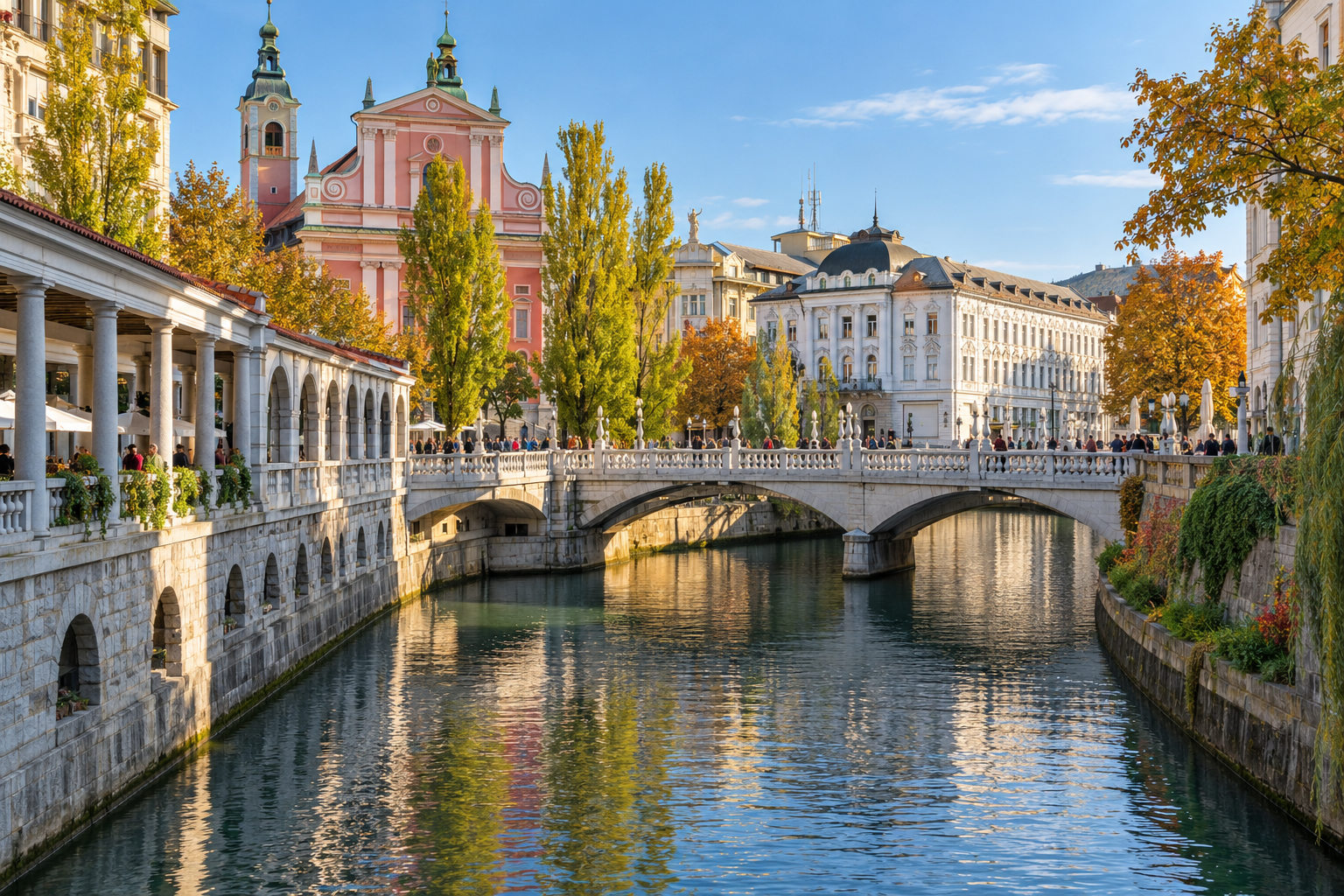
Ljubljana is one of the rare capitals where a single architect’s ideas can be read in bridges, markets, streets, parks and a library. Jože Plečnik did not erase the older city: between the world wars he connected it with a land axis and a river axis, creating public spaces at a human scale. UNESCO inscribed the serial property in 2021.
Plečnik architecture walk: route and timing
This self-guided route runs for roughly 3 kilometres from Trnovo to the Central Market. Allow three hours, or four if you enter Plečnik House or the National and University Library. Before starting, browse our Slovenia destination page and save the longer Ljubljana riverside walk.
1. Begin at Plečnik House and Trnovo Bridge
Plečnik House preserves the architect’s home, furniture, tools, models and garden. Guided visits are limited in size, so check the museum’s official hours and reserve if an interior visit matters to you. Outside, Trnovo Bridge shows his instinct for treating infrastructure as civic space: trees, stone details and the church form a small urban room rather than a mere crossing.
2. Follow the green axis to Vegova Street
Walk north past the Gradaščica and toward the Roman walls at Mirje, which Plečnik restored with deliberately modern additions. Continue along the green promenade of Vegova Street. Benches, trees and monuments give the street a measured rhythm and lead toward his most imposing Slovenian building.
3. Read the National and University Library façade
The library, built between 1936 and 1941, mixes brick, stone and reused-looking fragments. Its dark entrance and rising internal route turn access to knowledge into an architectural journey. Interior access depends on opening hours and events; even from outside, compare the irregular façade with the carefully framed windows.
4. Cross Cobblers’ Bridge and the Triple Bridge
Cobblers’ Bridge uses rows of different-sized columns to turn a crossing into an open-air square. Farther north, Plečnik added two pedestrian bridges to an existing 1842 stone bridge between 1929 and 1932, creating the Triple Bridge. Walk all three branches to notice how each directs movement toward Prešeren Square, the river and the market.
5. Finish at Plečnik’s Market
The riverside market halls, built between 1940 and 1944, follow the curve of the Ljubljanica. In autumn 2026, the city is renovating the first arcade and first loggia; work began on 3 August and was expected to continue until mid-November. The broader market area remains a useful final stop, but follow barriers and check current municipal notices before relying on a specific passage.
Why UNESCO calls it human-centred design
The UNESCO listing is not one monument but a network: promenades, bridges, squares, markets, libraries, churches and gardens. Plečnik worked with the river, older streets and everyday habits, improving the city through connected interventions rather than rebuilding it from scratch. That is why the walk feels coherent even when individual buildings differ.
Practical and accessible planning
- Most exterior spaces are free and best explored in daylight.
- Historic paving, bridge slopes and construction diversions can affect step-free routes.
- Plečnik House lists accessible facilities, but its guided interior visits have limited capacity.
- For a narrated experience, compare a local free walking tour; independent visitors can combine the self-guided route with bookable cultural experiences.
FAQ
Is the Plečnik walk free?
The outdoor route is free. Plečnik House, exhibitions and some interiors require tickets or timed access.
Can I do it in two hours?
Yes, if you remain outside and walk directly from Trnovo to the market. Allow longer for interiors and photography.
Is the Central Market open during renovation?
The city’s notice concerns the first arcade and first loggia. Access can change around the works, so check on-site signs and the latest municipal update.
What is the best addition?
Architecture enthusiasts should visit Plečnik House; first-time visitors may prefer to continue along the river to Ljubljana Castle.
Information checked on 28 October 2026 against UNESCO, Visit Ljubljana, Plečnik House and the City of Ljubljana.