
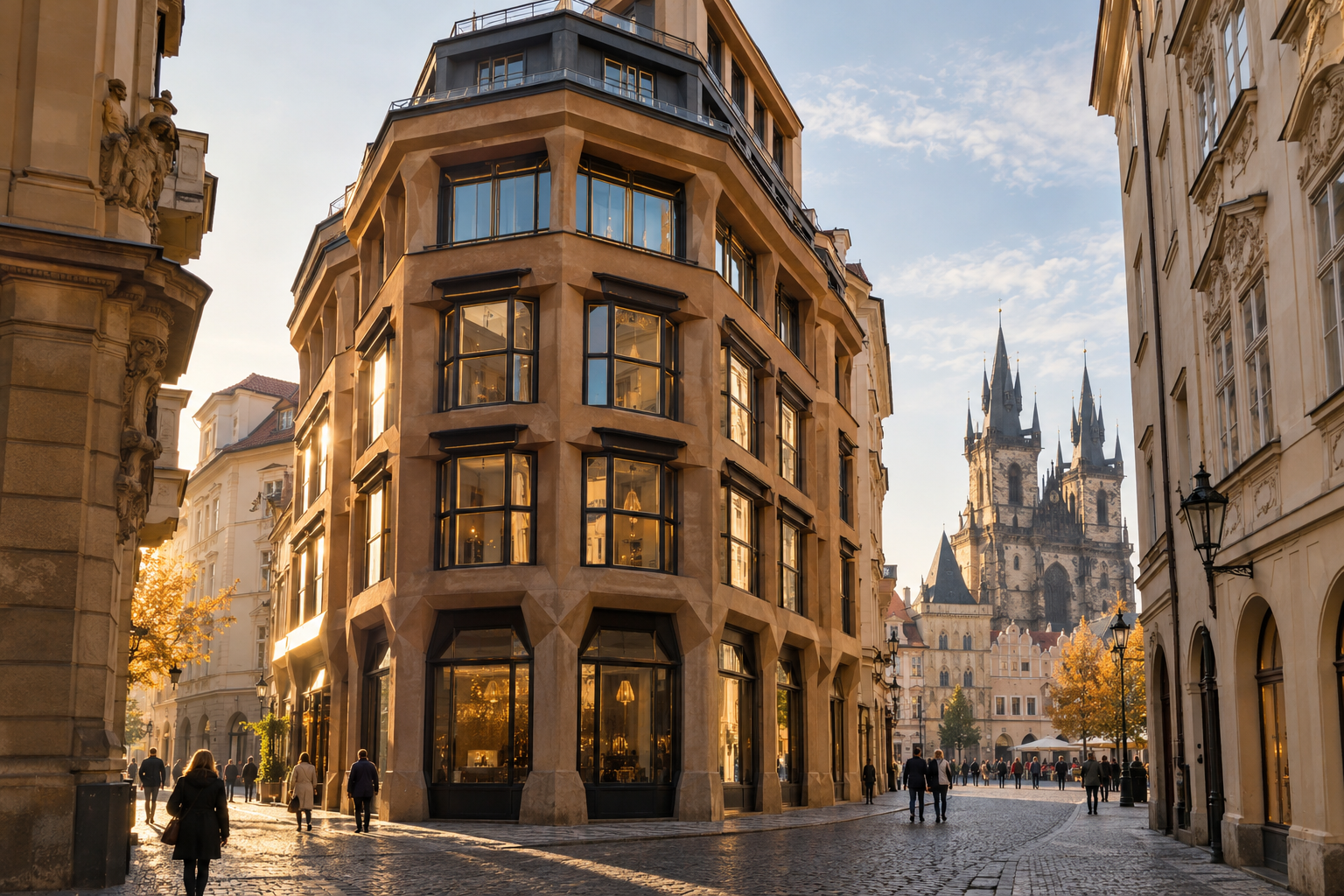
Prague is famous for Gothic spires and Baroque façades, but one of its most original architectural stories belongs to the early twentieth century. Czech architects did something rare: they translated Cubism from painting into buildings, furniture, ceramics and even street furniture. This self-guided walk begins in the Old Town, passes a one-of-a-kind lamp post and finishes beside the Vltava below Vyšehrad.
Allow about three hours for the complete route, including a tram ride and time in the museum. If you only have one hour, follow the central section from the House at the Black Madonna to Jungmann Square.
Why Prague’s Cubism is different
In Prague, Cubism became more than a gallery movement. Architects used angled planes, crystalline bays and sharp shadows to make façades feel as if they were shifting. The official Czech tourism board describes Cubist architecture as a specifically Czech phenomenon, while the Museum of Decorative Arts presents it as a complete design language spanning fine and applied art.
Prague Cubist architecture route
1. House at the Black Madonna
Start at Ovocný trh 19. Josef Gočár designed this former department store in 1911–1912, carefully fitting its faceted geometry into the Old Town. Look up at the angular portal, dormers, iron grille and the Baroque Madonna on the corner. Inside, the permanent Czech Cubism exhibition connects architecture with furniture, glass, ceramics and metalwork. The museum is normally closed on Mondays; check the official opening-hours page before visiting.
The staircase is part of the experience: its balustrade and changing angles make the building’s Cubist idea visible from within. The first-floor Grand Café Orient recreates Gočár’s historic café concept, so it works well as a pause rather than a separate destination.
2. Celetná Street to the Cubist lamp
Walk west through the Old Town, then continue toward Jungmannovo náměstí. Here stands Prague’s functioning Cubist lamp post, designed by Emil Králíček and installed in 1913. Notice how the base, shaft and lantern all share the same faceted vocabulary. It is a small object, but it makes the movement easy to understand: Cubism was meant to shape everyday urban life.
3. Diamant House
Continue toward Spálená Street and the Diamant building. Its chiselled frame and pointed details show how Cubist architects played with the tension between a flat wall and a sculptural surface. View it from the opposite pavement, then look for the unusual Baroque statue framed by a Cubist arch.
4. Tram to Výtoň and the Vyšehrad houses
Take a tram south to Výtoň to avoid turning the route into a long traffic walk. On Rašínovo nábřeží and in Libušina and Neklanova streets, Josef Chochol’s buildings push the style into dramatic riverside villas and apartment houses. The Kovařovic Villa, built in 1912–1913, is the highlight. Its garden, fence and exterior staircase were designed as one geometric composition. It is private and not open to visitors, so admire it respectfully from public space.
How to plan the walk
- Best light: morning for the Old Town façades; late afternoon for the riverfront.
- Distance: roughly 3 km on foot, plus a short tram connection.
- Accessibility: the central section is mostly level; cobbles and tram boarding may be challenging.
- Respect: the Vyšehrad villas are homes. Do not enter gardens or block doorways.
For a wider introduction, read our Prague travel guide. You can also compare free walking tours, use the AI Tour Matcher to find an independent audio-style route, or browse compatible Prague experiences.
FAQ
Is the House at the Black Madonna open every day?
No. The official museum schedule lists Monday as the regular closing day, with longer hours on Tuesday. Recheck the official page because holiday hours can change.
Can I enter the Kovařovic Villa?
No. Prague City Tourism identifies it as private and closed to the public. The exterior can be viewed from public streets.
Is the route suitable in rain?
Yes, but cobbles can be slippery. The museum provides an excellent indoor anchor, and the central section can be shortened easily.
Do I need a guide?
No. The route works independently, but a guided architecture walk can help identify smaller façade details and explain the transition from Cubism to Rondocubism.
Official sources
Facts and practical details were checked against Prague City Tourism, the Museum of Decorative Arts and the official page for the Kovařovic Villa.