
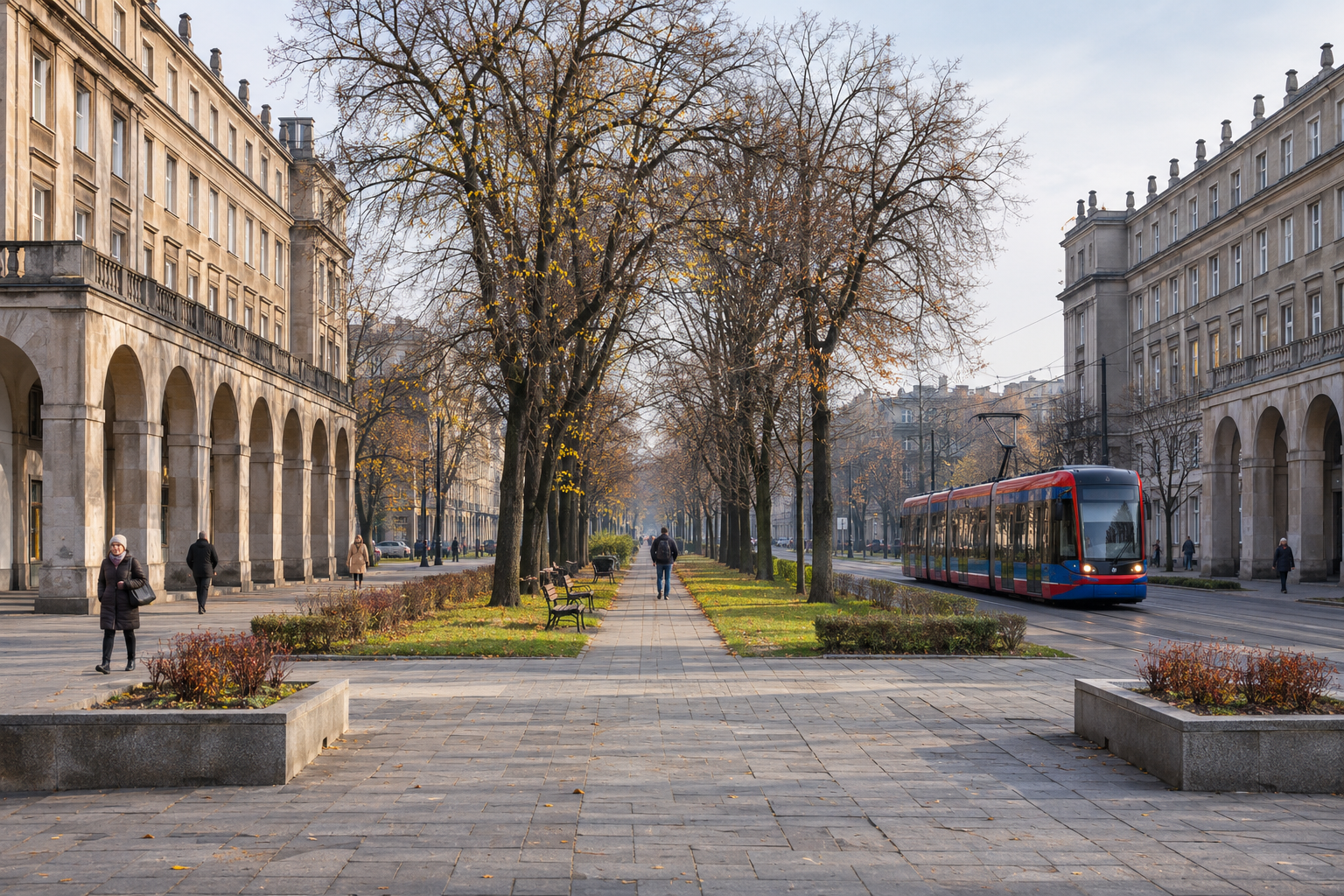
Most visitors know Kraków through the Main Market Square and Wawel, but a tram ride east reveals a completely different city. Nowa Huta was planned from 1949 as a new industrial town: monumental façades, broad avenues and green residential courtyards formed a carefully staged socialist-realist landscape. This self-guided walk connects its clearest urban ideas with the district’s everyday life and the story of the Arka Pana church.
Route at a glance: Plac Centralny → Aleja Róż → Ratuszowy Park and Teatr Ludowy → osiedle Szkolne → Arka Pana. Allow 2–2.5 hours, or about 3 hours with the underground exhibition. The core walk is roughly 4 km and mostly flat.
Why Nowa Huta is worth the tram ride
Nowa Huta is not an open-air museum frozen in the 1950s. It is a lived-in district where trams, shops and schools occupy an unusually legible plan. According to Kraków’s official city guide, the historic layout was entered in the city’s heritage register in 2004 as a representative example of socialist-realist town planning. Its wide streets and greenery also borrow from garden-city and “neighbourhood unit” ideas.
If this is your first stay, combine this route with our three-day Kraków guide. For less obvious places nearer the old centre, save our Kraków hidden-gems guide.
A step-by-step Nowa Huta walking route
1. Read the plan at Plac Centralny
Begin at Plac Centralny im. Ronalda Reagana. Built in the 1950s, the pentagonal square sends five avenues outward and anchors four original residential sectors. Stand near the tram stop and look for the arcades, balconies, tall windows and classical proportions. The design is monumental, yet the shops beneath the arcades keep the space human in scale. The square’s unfinished southern side is also part of the story: a theatre and cultural complex planned here were never completed.
2. Walk up Aleja Róż
Continue north along Aleja Róż, the district’s principal ceremonial axis. The spacious median, mature trees and continuous façades show how architecture and landscape were designed together. Look up for surviving neon signs around the centre buildings, but stay alert when crossing tram tracks. A statue of Lenin once stood on this avenue; its absence now says as much about the district as the original plan.
3. Detour to Teatr Ludowy
Cross Ratuszowy Park toward Teatr Ludowy, opened in 1955. The walk passes early housing estates whose semi-enclosed courtyards provided light, greenery and social facilities. This is the best section for noticing the difference between the ceremonial avenue and quieter residential interiors.
4. Add the Cold War layer
Continue toward osiedle Szkolne. The main Nowa Huta Museum building in the former Światowid cinema is currently closed for renovation, but Museum of Kraków operates the Nowa Huta Underground at os. Szkolne 22. As of November 2026, the official timetable lists Wednesday–Sunday, 10:00–17:00; always recheck before travelling. The exhibition explores shelters and civil defence beneath the district.
5. Finish at Arka Pana
Walk west to the Church of Our Lady Queen of Poland, universally known as Arka Pana. Designed by Wojciech Pietrzyk, built from 1967 and consecrated in 1977, its sweeping roof recalls both an ark and Le Corbusier’s chapel at Ronchamp. The church grew out of a long local campaign for a place of worship and later became a focus of opposition during the martial-law era. Its expressive modernism is a striking counterpoint to the ordered classicism of Plac Centralny.
Practical planning
- Getting there: frequent trams connect central Kraków with the Plac Centralny area. Check the live city transport planner on the day.
- Best time: morning gives clearer views of façades; late afternoon is atmospheric but museum hours are limited.
- Accessibility: the outdoor route is mostly level, although some crossings and older pavements may be uneven.
- Respect: this is a residential district and Arka Pana is an active church. Keep voices low and avoid photographing worshippers.
Explore more destinations on the Poland city page, browse free walking tours in Europe, or use Best Free Tour to compare compatible guided experiences. This article also works as a standalone, audio-friendly route: save the page and read each stop when you arrive.
Frequently asked questions
Is Nowa Huta safe to visit independently?
Yes. It is a normal residential part of Kraków. Use the same city awareness you would elsewhere, especially after dark and around tram crossings.
How long does the walk take?
The outdoor route takes about 2–2.5 hours. Add at least 45–60 minutes for the underground exhibition and extra time for transport.
Is the Nowa Huta Museum open?
The former Światowid cinema building is temporarily closed for renovation. The separate Nowa Huta Underground exhibition at os. Szkolne 22 remains the practical museum option; confirm hours on the official site.
Can I combine Nowa Huta with Kraków Old Town?
Yes. Start in Nowa Huta in the morning, return by tram, and explore the historic centre later. The contrast makes both areas easier to understand.