
Lyon’s historic centre is easier to enjoy when gravity works in your favour. This route takes the F2 funicular to Fourvière, then descends through viewpoints, Renaissance Vieux Lyon, discreet traboule passageways and the Saône riverfront. It suits travellers who want a rich half-day walk without beginning with the city’s steepest climb.
Start with the F2 funicular
From Vieux-Lyon–Cathédrale Saint-Jean station, take funicular F2 to Fourvière. Official TCL information lists the line as operating normally, but check live traffic and accessibility equipment on the day. Before travelling, use the AI Tour Matcher to compare a self-guided route with available walking tours.
Fourvière: panorama before the descent
Basilica and esplanade
The Basilica of Notre-Dame de Fourvière was begun in 1872 and consecrated in 1896. Its mosaics, stained glass and eclectic architecture deserve time, but the esplanade is the key to understanding the route: from here you can identify Saint-Jean Cathedral, the Presqu’île and the modern skyline before walking down into them.
Choose the descent that matches your legs
The Montée du Gourguillon is historic and atmospheric but steep, uneven and demanding after rain. A gentler alternative uses paved streets and terraces toward Vieux Lyon. Neither option is fully step-free; visitors with reduced mobility should return by funicular and continue from Saint-Jean.
Vieux Lyon and its Renaissance passages
Saint-Jean Cathedral and Rue du Bœuf
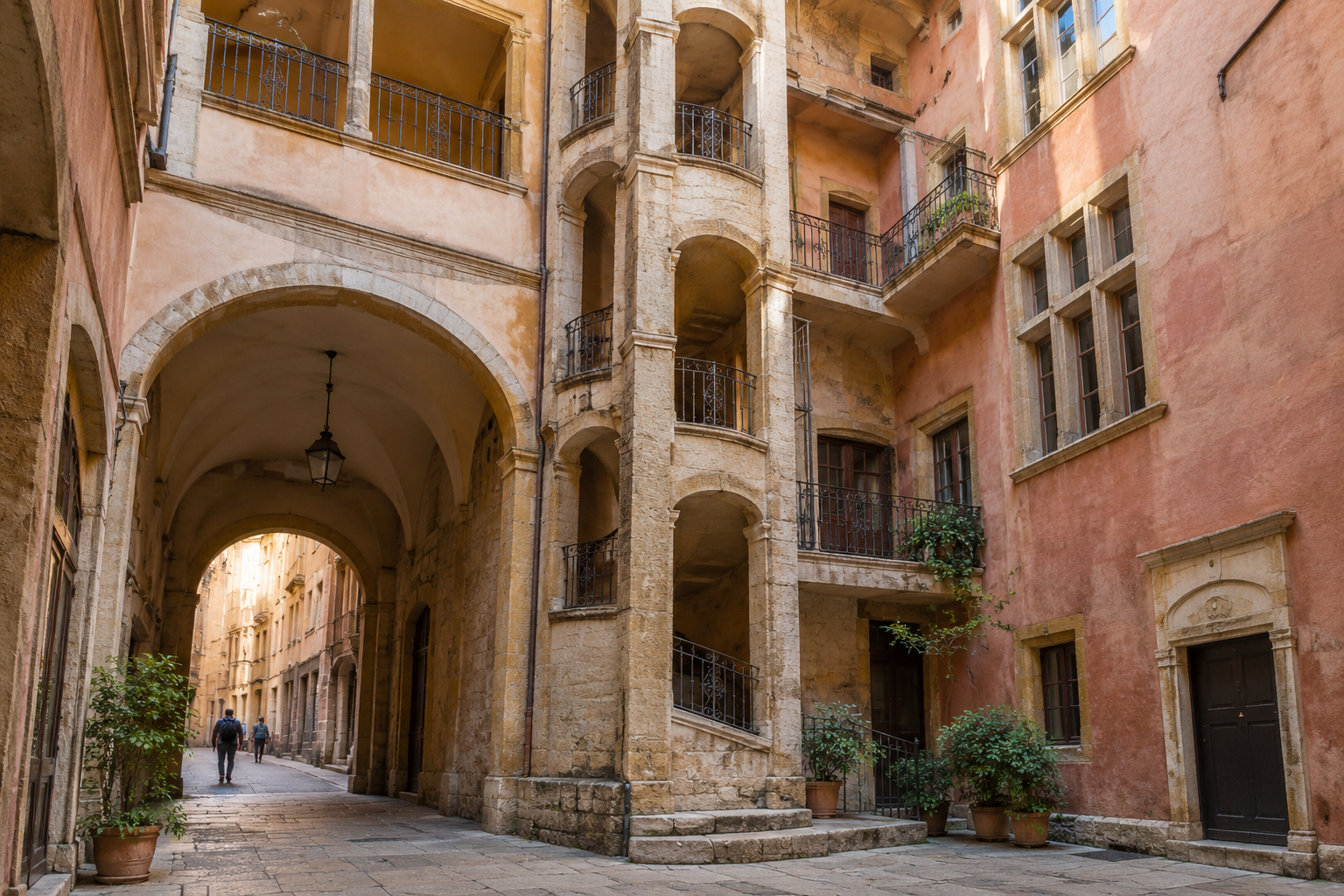
At the foot of the hill, pause by Saint-Jean Cathedral and continue through the narrow streets between Saint-Georges and Saint-Paul. Vieux Lyon covers about 24 hectares and is one of Europe’s largest Renaissance ensembles, with inner courtyards, staircase towers and Italian-style galleries.
How to visit traboules respectfully
Traboules are shortcuts that pass through one or more buildings to connect parallel streets. Many remain private residential spaces, and only a limited number are officially open. Use signed entrances, visit during posted daytime hours, speak quietly, never force a door and wait if a courtyard is crowded. A reliable example links 40 Rue Saint-Jean with 5 Place Neuve Saint-Jean, though access can change.
Cross the Saône to Presqu’île
Finish by crossing the river toward Presqu’île. The view back to Vieux Lyon and Fourvière reveals the full vertical route. Continue to Place Bellecour or remain along the quays for a quieter ending. Browse compatible experiences for food walks, museums or an evening cruise.
Practical tips
- Allow three to four hours, excluding a long basilica or museum visit.
- Wear shoes with grip; stone slopes can be slippery.
- Check F2 service and lift availability shortly before departure.
- Visit traboules in daylight and protect residents’ privacy.
- Use the funicular in both directions if steep descents are unsuitable.
For more city pages, self-guided audio inspiration and free walking tours, explore Best Free Tour.
Frequently asked questions
Is the F2 funicular included in normal transport tickets?
TCL states that zone 1 tickets can cover the funicular; a dedicated same-day return ticket is also sold. Check current fares before travel.
Are all Lyon traboules open?
No. Many are private or closed. Follow official signs and current visitor information rather than maps that assume every door is accessible.
Is this route accessible?
The funicular helps with the main climb, but the downhill walk includes slopes, cobbles and sometimes steps. Returning by funicular is the safer option for step-free planning.