
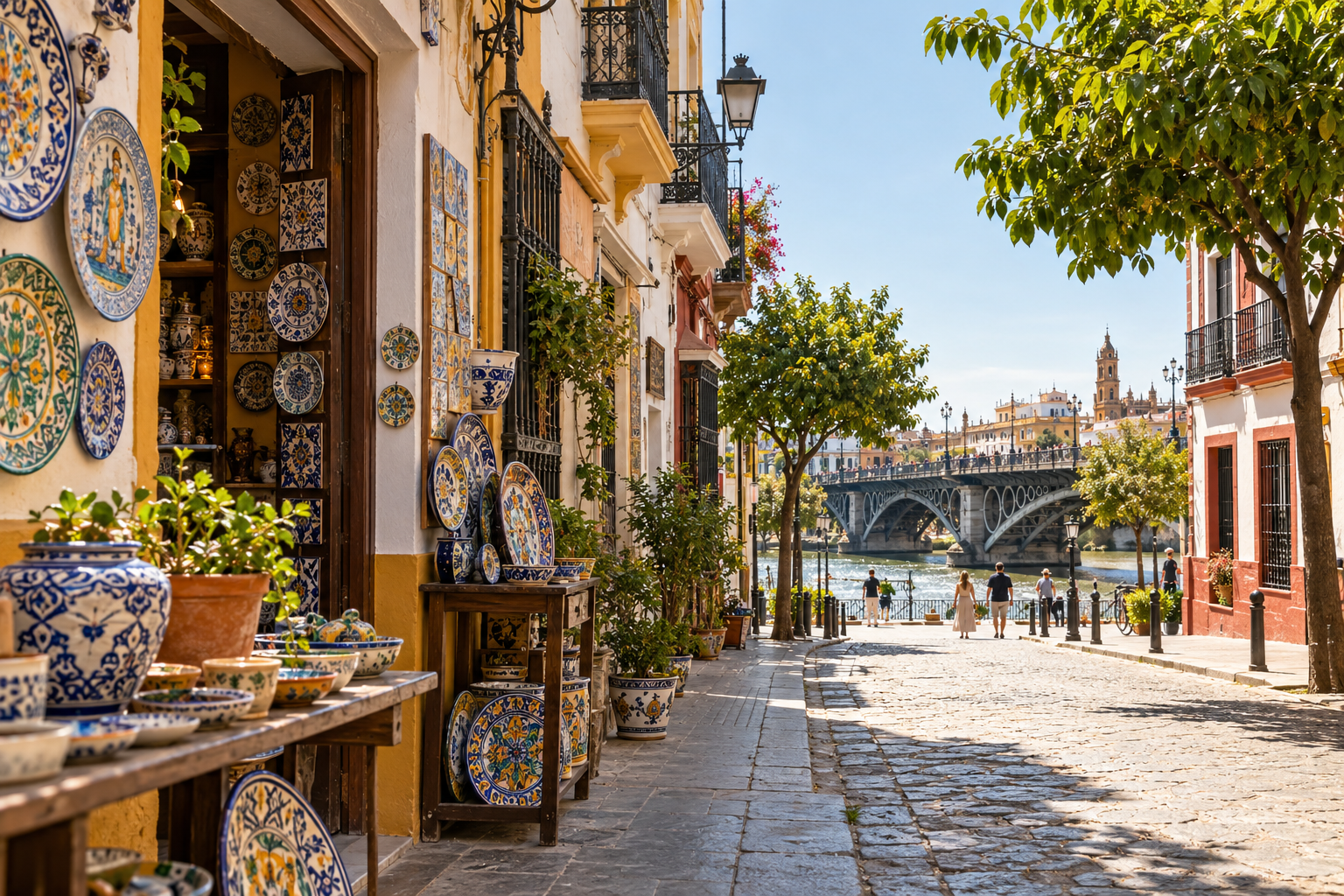
Triana is often described as “the other side” of Seville, but that phrase understates its identity. Across the Guadalquivir, pottery kilns, market life, flamenco traditions and river trades shaped a neighbourhood with its own rhythm. This self-guided walk begins on the historic centre side, crosses the Isabel II Bridge, visits the market and ceramic quarter, and returns along Calle Betis. Allow 2½ to 3 hours for roughly 5 kilometres.
Why explore Triana as a complete route?
The neighbourhood works best as a sequence rather than a single photo stop. The bridge explains its connection with Seville, the market reveals layers beneath everyday life, the pottery centre preserves industrial memory, and the riverside reconnects the route with the Guadalquivir. Start on a weekday morning if you want to see the market active and avoid the strongest afternoon heat.
Stage 1: cross the Triana Bridge
The official name is Puente de Isabel II. Completed in 1852, it replaced the centuries-old pontoon bridge and became Seville’s first permanent metal bridge. Its design drew inspiration from Paris’s Pont du Carrousel. From the centre, pause only where the footway is wide enough and compare the Giralda, Torre del Oro and both banks.
Two directions, two views
The city tourism portal recommends crossing in both directions because the perspective changes. On the outward leg, look towards Triana’s colourful riverfront; on the return, the historic skyline takes over. Sunrise and late afternoon offer softer reflections, but morning is more practical for the market.
Stage 2: Plaza del Altozano and Triana Market
At the western end, Plaza del Altozano introduces the neighbourhood through public art and daily movement. The nearby market dates to 1823 and stands over the remains of San Jorge Castle, an Almohad fortress later associated with the Inquisition. Archaeological remains discovered during renovation are integrated into the market complex.
The market has around 100 stalls, food bars and courtyards. Treat it as a working place: ask before photographing traders or close-up displays, keep aisles clear and consider buying a small item rather than using the hall only as scenery. Current hours can change around holidays; check the official listing on the day.
Stage 3: read Triana through ceramics
Continue towards Calle Callao and the Centro Cerámica Triana. The centre preserves kilns and archaeological, anthropological and architectural elements in their original context. Its ground floor interprets Sevillian ceramics, while the upper level includes documentation and orientation for neighbourhood routes.
Workshops are not souvenir sets
Nearby streets such as Callao and Alfarería retain links to traditional ceramic work. Look for variations in glaze, relief and geometric borders rather than assuming every blue-and-white surface is ancient. Studios set their own opening times; enter only when invited or during posted hours, and never photograph active work without permission.
Stage 4: Santa Ana and Calle Pureza
Walk towards the Real Parroquia de Santa Ana, traditionally regarded as Triana’s oldest purpose-built church after the Christian conquest. The building has changed over centuries, particularly after the 1755 Lisbon earthquake. Continue along Calle Pureza, keeping voices low around churches and residential doorways.
This part of the route adds context to Triana beyond ceramics: religious brotherhoods, flamenco culture and everyday neighbourhood life overlap in a small area. Avoid reducing living traditions to performance props.
Stage 5: Calle Betis and the river
Return to the Guadalquivir via Calle Betis. Its façades frame wide views towards Seville, while bars and terraces become busier later in the day. Continue south if you want to leave Triana by San Telmo Bridge, or loop back to the Isabel II Bridge for a compact circuit.
Heat, paving and accessibility
Seville can be extremely hot. Carry water, seek shade and avoid midday in warm months. The bridge and riverside are mostly straightforward, but market thresholds, archaeological spaces and narrow pavements may require adapted planning. Confirm step-free access directly with each venue.
Plan more with our AI Tour Matcher, compare Seville experiences and self-guided options, or browse the Best Free Tour city guides.
Frequently asked questions
Is Triana safe to explore on foot?
It is a busy residential and visitor area. Use normal city precautions, especially in crowds and late at night.
Is the route free?
Streets, bridge and riverside are free. The ceramics centre or interpretation spaces may charge admission.
When is the best time for the market?
A weekday morning gives the clearest sense of its daily function. Verify hours around Sundays and public holidays.
Can I buy authentic ceramics?
Yes, but compare workshops, ask about production and origin, and choose pieces for craftsmanship rather than only price.
Official sources checked: Visita Sevilla: Triana Bridge; Visita Sevilla: Triana Market; Visita Sevilla: Triana Ceramic Center.