
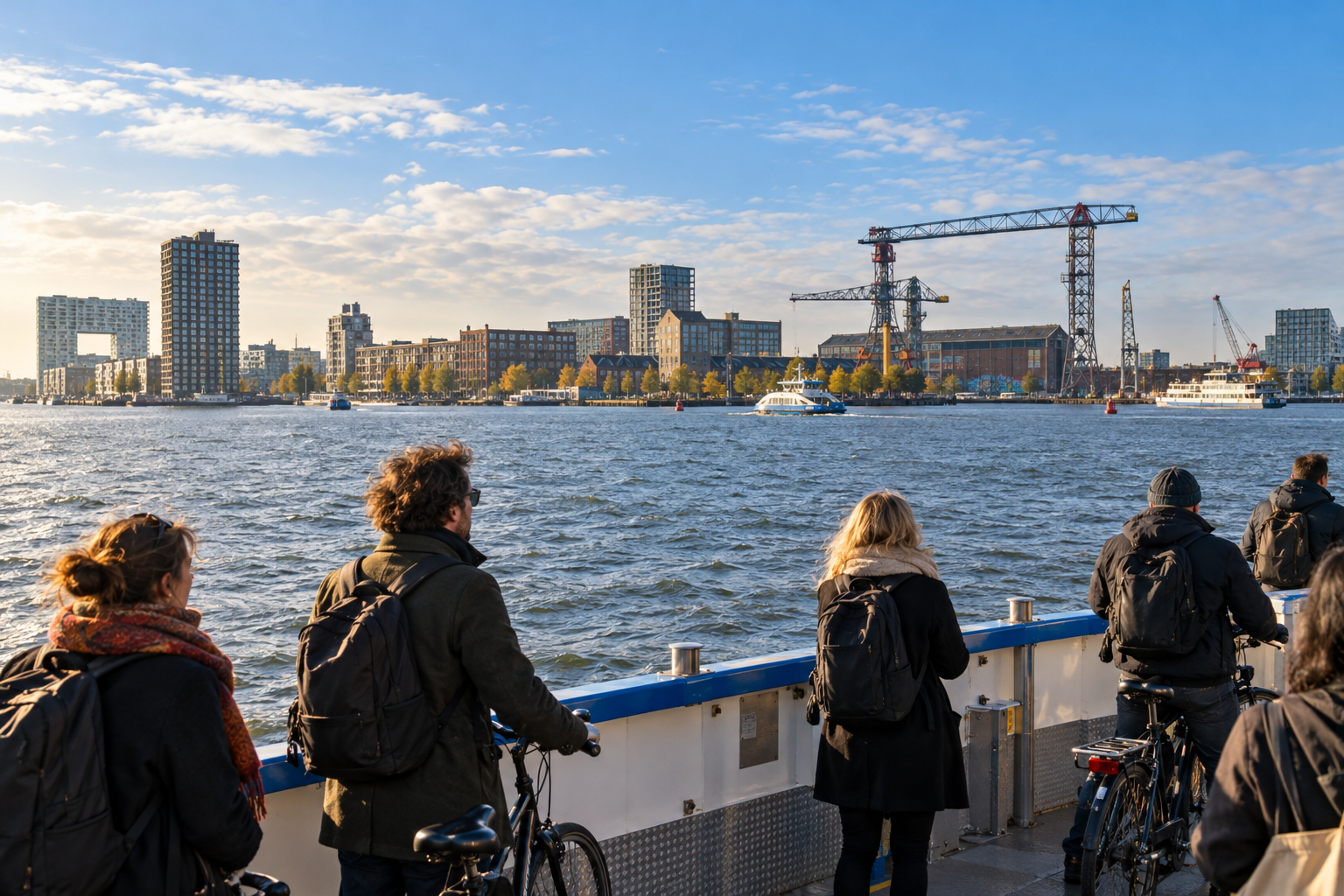
Amsterdam’s most revealing low-cost journey begins behind Centraal Station. The ferries across the IJ are free for pedestrians and cyclists, and they turn the river into part of the sightseeing. This route combines two different faces of Noord: the polished cultural waterfront around Eye and the vast former NDSM shipyard.
Why cross the IJ?
Noord feels close but visually distinct from the canal belt. You get open water, post-industrial architecture, public art and broad horizons. Official transport information identifies F3 to Buiksloterweg and F4 to NDSM as free IJ crossings; always check the live GVB board because routes and frequencies can change.
A practical half-day route
1. Centraal Station to Buiksloterweg
Leave through the station’s IJ-side passage and follow the ferry signs. Board the F3 and keep clear of cycle lanes and docking ramps. The short crossing frames the station roof and skyline. On arrival, pause outside Eye Filmmuseum: the angular white building makes a strong visual counterpoint to the water. Continue along the promenade toward Tolhuistuin and the modern towers.
2. Read the waterfront slowly
Rather than collecting attractions, notice how warehouses, offices, gardens and residential blocks share the bank. Allow 45–60 minutes here. Museum interiors and viewpoints require separate tickets, but the riverside walk is rewarding on its own. For a broader introduction, compare current options with our tour matcher.
3. Continue to NDSM
The two waterfront zones are several kilometres apart. Walk only if you have time and suitable weather; otherwise return by ferry and take F4 directly from Centraal to NDSM. The crossing is longer and delivers the best sense of the IJ as a working urban waterway.
4. Explore the former shipyard
NDSM is an enormous public, post-industrial site. Look for cranes, slipways, temporary installations and murals while respecting studios and event boundaries. The outdoor grounds are generally accessible without a ticket, while museums and events set their own hours and prices. A useful art loop is roughly 4 km and can take 45–90 minutes with stops.
Planning, accessibility and etiquette
Wear shoes for uneven surfaces and bring a windproof layer: the open river feels cooler than the centre. Ferries carry pedestrians, bicycles, mopeds and mobility vehicles, so stand behind markings and let passengers disembark first. NDSM is spacious but its rough paving can be challenging for wheelchairs; check individual venues before travelling. In rain or strong wind, shorten the route to Eye and one ferry crossing.
Make it part of your Amsterdam visit
Reserve three to four hours for both waterfronts, longer with a museum. Early morning is quiet; late afternoon brings warmer light. Pair this self-guided route with a bookable local experience, or browse Best Free Tour city ideas and walking tours for another neighbourhood.
FAQ
Are Amsterdam’s IJ ferries really free?
Yes. GVB lists the central IJ ferry routes, including F3 and F4, as free. No ticket is needed for these crossings.
Which ferry reaches Eye?
Take F3 between Centraal Station and Buiksloterweg. Eye is beside the northern landing.
Which ferry reaches NDSM?
F4 connects Centraal Station with NDSM. Confirm the current departure board before boarding.
Can I do the route on foot?
Yes, but the complete itinerary is easier as two walking loops linked by ferries. This avoids an unnecessarily long transfer between Eye and NDSM.
Checked against official GVB, I amsterdam and NDSM visitor information in October 2026.