
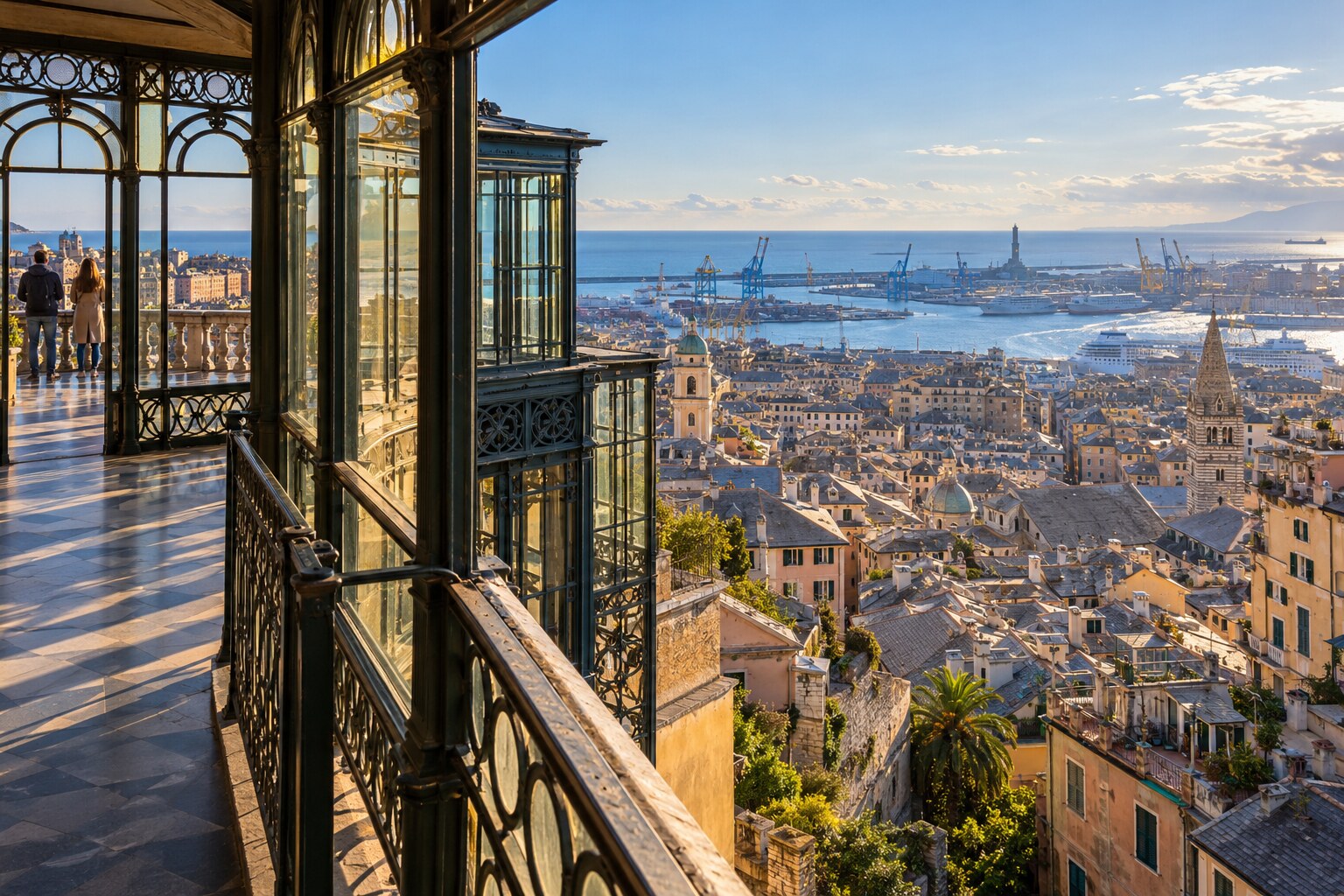
Genoa is not only a city to cross: it is a city to climb. Public lifts, funiculars and brick-paved crêuze connect the port and medieval lanes with panoramic neighbourhoods above. This practical route combines two historic lifts, a viewpoint and an optional funicular extension.
Why Genoa’s vertical transport belongs in your itinerary
Compressed between the Ligurian Sea and steep hills, Genoa developed an unusual network of public lifts, funiculars and a rack railway. These are working parts of the urban transport system, not museum rides. They offer a low-effort way to understand the city’s geography while sharing everyday routes with residents.
A half-day vertical route from the centre
1. Start on Via Garibaldi
Begin among the Rolli palaces, then use the Genoa city page to connect this route with audio guides, free walking tours and bookable experiences. Walk to Piazza Portello; the lower entrances for the Castelletto lifts are close by.
2. Ride the Castelletto Levante lift
The historic lift covers a 57-metre height difference and emerges through a glass Art Nouveau loggia at Spianata Castelletto. From Belvedere Montaldo, read the city in layers: slate roofs, medieval towers, Baroque domes, the Old Port and the hills.
3. Descend on foot through the crêuze
Instead of immediately taking the lift down, follow a marked pedestrian descent toward the centre. The narrow, brick-paved lanes reveal gardens, retaining walls and sudden views. Wear shoes with grip, especially after rain, and avoid steep shortcuts if mobility is limited.
4. Optional: Zecca–Righi funicular
From Largo Zecca, the Zecca–Righi funicular climbs through seven stations to the heights above Genoa. The full journey takes about twelve minutes under normal service. At Righi, choose a short viewpoint stroll or a longer walk toward Peralto and the forts.
Tickets, service checks and timing
Urban network tickets are generally valid on the public lifts and Zecca–Righi funicular, but fares and operating conditions can change. Check AMT on the day of travel. The Sant’Anna funicular may be suspended for scheduled inspection, so never build a tight itinerary around it without verifying current service. Allow three to four hours for the central route and Righi extension.
Add food, history and a guided walk
After descending, continue through the historic centre with our Genoa highlights guide. For a local break, save the classic Genoa food guide. A free walking tour adds stories about the palaces and caruggi; this vertical route then supplies the panoramic overview.
Frequently asked questions
Are Genoa’s public lifts tourist attractions?
They are regular public transport used by residents, although Castelletto and Montegalletto are also notable architectural experiences.
Is the route suitable for limited mobility?
The lift sections reduce climbing, but historic pavements and steep pedestrian links can be difficult. Use the same lift for the return when needed and check accessibility notices.
What is special about Montegalletto?
Its cabin travels horizontally through a tunnel and then vertically in the same integrated system, linking Via Balbi with the area near Castello d’Albertis.
When is the best light at Castelletto?
Late afternoon often gives warm light over the rooftops and port. Early morning is quieter and usually clearer.