
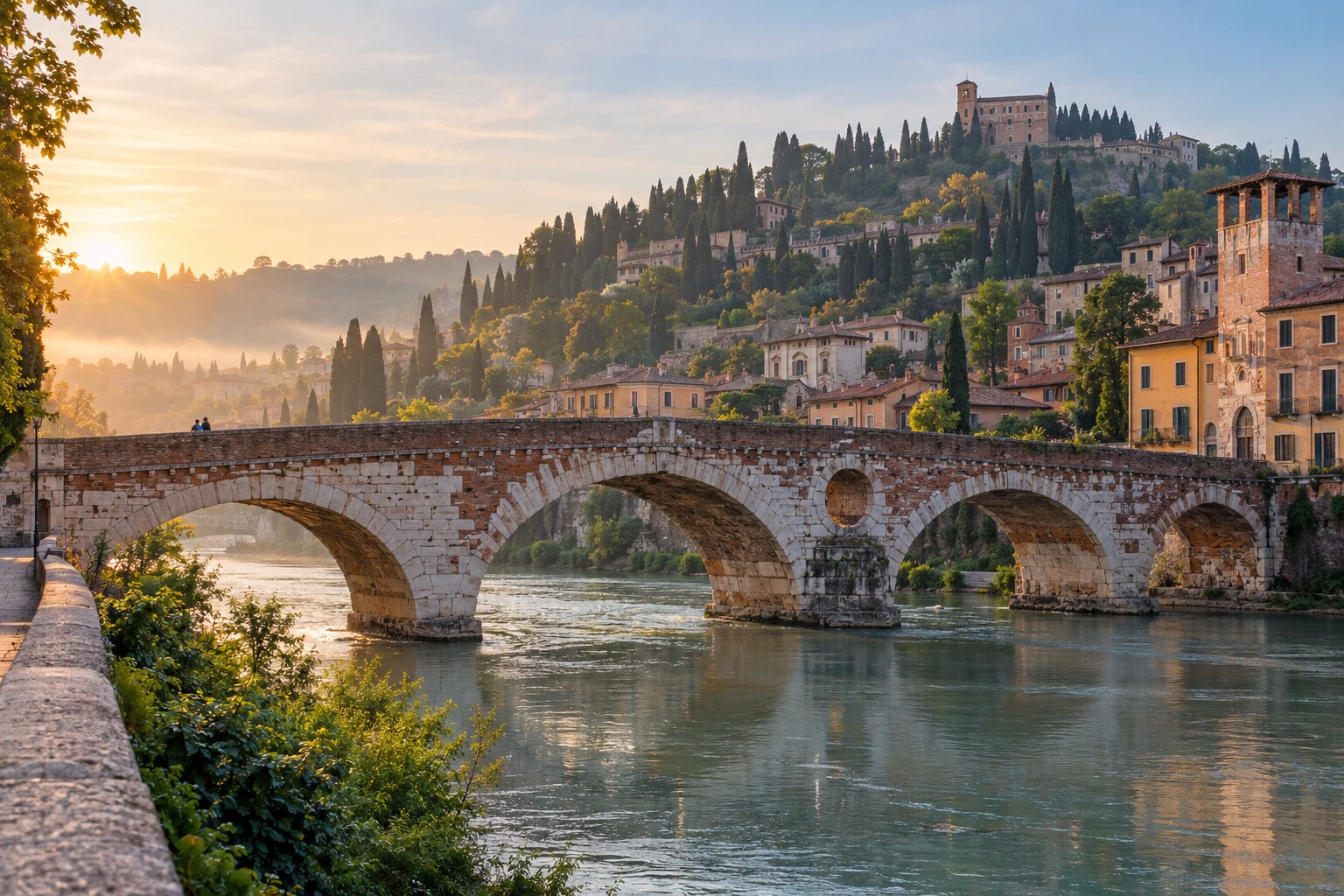
Verona is often explored between the Arena and Juliet’s courtyard, but the city becomes easier to understand from the Adige. This self-guided loop crosses ancient Ponte Pietra, climbs to Castel San Pietro and returns through Veronetta, combining Roman layers, river views and practical 2026 funicular information.
Why this route reveals a different Verona
Ponte Pietra is Verona’s oldest Roman monument and the historic crossing between the plain and San Pietro hill. The bridge seen today combines periods: two arches on the left preserve Roman limestone blocks, while brick and later reconstructed sections tell a longer story of floods, destruction and repair. It is reserved for pedestrians and bicycles.
Above it, San Pietro hill was occupied long before Roman Verona. The current hilltop building is a nineteenth-century Austrian barracks known as Castel San Pietro. Its interior is not open to visitors, but the terrace offers one of the clearest views of the river’s curve, roofs and bell towers.
A self-guided Adige and hill walk
1. Start from the cathedral quarter
Approach the river through Piazza Duomo and the quiet lanes near the bishop’s palace. Reaching the embankment gradually makes the geography visible: the old centre on one bank, Veronetta and the hills on the other.
2. Cross Ponte Pietra slowly
Pause without blocking the walkway. Notice the pale stone and red brick, the surviving tower and the current moving through the arches. Official tourism information gives the bridge a length of 92.8 metres and confirms full accessibility, although surrounding cobbled streets may be uneven.
3. Choose stairs or funicular
After crossing, climb the San Pietro steps for changing views, or take the accessible funicular from Via Fontanelle Santo Stefano. As of 17 October 2026, official information lists daily summer service from 10:00 to 21:00 through 25 October, then winter service from 10:00 to 17:00 from 26 October to March. The ticket office closes 15 minutes before the lift. Always recheck on the day of travel.
4. Castel San Pietro terrace
Enjoy the panorama from the public terrace, but do not plan an interior castle visit: the official listing states that Castel San Pietro cannot be visited inside. Morning gives softer light; sunset is beautiful but busier.
5. Descend through Veronetta
Return on foot beside the Roman Theatre or continue through Veronetta toward Piazza Isolo and Ponte Nuovo. This creates a loop instead of retracing every step and introduces quieter streets beyond the best-known centre.
Practical planning
- Allow 90 minutes for the basic loop, or two to three hours with church or museum stops.
- Wear shoes with grip for steps and cobbles.
- The funicular and Ponte Pietra are accessible, but the stair route and some lanes are not step-free.
- During heavy rain or high river conditions, follow local signs and keep away from closed lower embankments.
Use the Verona city page to compare an autonomous audio guide, available free walking tours and compatible bookable experiences. Add context with our Verona travel guide, or explore free tour options in Italy.
Frequently asked questions
Can you enter Castel San Pietro?
No. The official tourism page states that the building is not open inside; visitors go for the public viewpoint.
How long is the funicular ride?
Official information says it reaches the terrace in a little over one minute. Queues can add time.
Is Ponte Pietra wheelchair accessible?
The bridge itself is listed as fully accessible. Approach streets and hill paths vary, so the funicular is the practical route to the viewpoint.
What is the best time to walk?
Early morning is quieter. Late afternoon offers warmer views, but check the funicular’s seasonal closing time before relying on it for descent.