
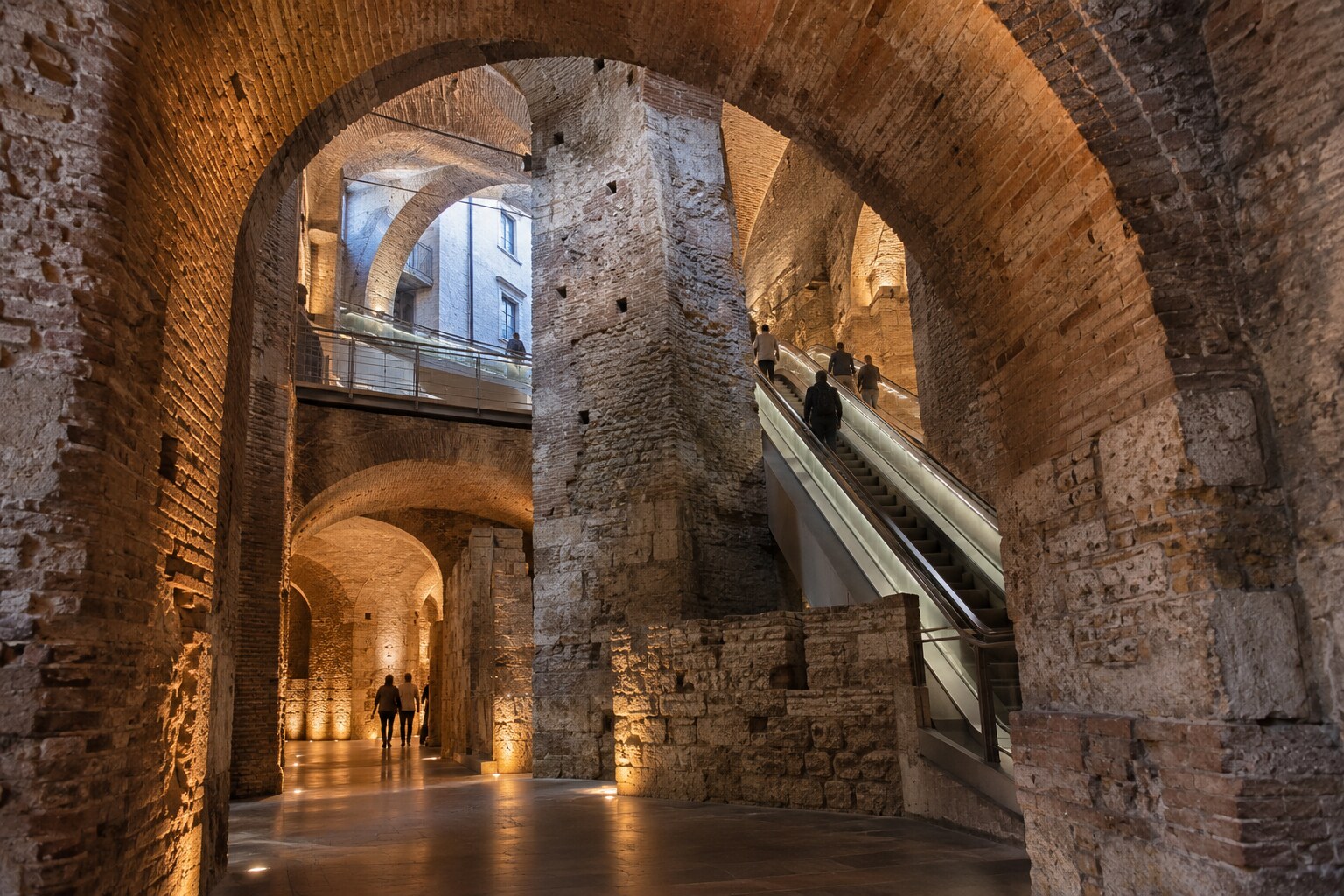
Perugia does not reveal itself all at once. The historic centre sits high above the surrounding valleys, but one of the most memorable ways to enter it is from below: through escalators that pass inside Rocca Paolina, a sixteenth-century papal fortress built over a medieval neighbourhood. The result feels like a buried city used as everyday public transport.
Why Perugia has an underground city
After the Salt War of 1540, Pope Paul III imposed a fortress on Perugia. Houses and streets associated with the Baglioni quarter were incorporated into the new structure. The fortress was partly demolished during nineteenth-century uprisings, yet its underground passages survived. In 1983, a public escalator system reopened the interior as a route between Piazza Partigiani and Piazza Italia. Today commuters and visitors travel through layers of Etruscan, medieval, Renaissance and modern Perugia.
Self-guided route from below to the historic centre
1. Start at Piazza Partigiani
Begin near the bus terminal and follow signs for the escalators. Starting low makes the city’s steep geography easy to understand. Save the Perugia city page before entering, because mobile reception may vary under the thick vaults.
2. Ride into Rocca Paolina
The first escalators turn a practical transfer into an architectural sequence. Look beyond the moving steps: walls, arches and fragments of former buildings show that this is not a purpose-built metro station. Umbria’s official tourism portal describes the complex as a “buried city” and notes that the underground route follows the operating hours of the escalator connection. Check current local notices before relying on a late return.
3. Walk the medieval passages
Step off where permitted and explore the public corridors without blocking commuters. The surfaces shift between brick vaults, rough stone and modern steel. Some rooms host temporary exhibitions and events, so the atmosphere can change from one visit to another. Keep voices low and remember that this remains a working pedestrian link.
4. Find Porta Marzia
Near the fortress, Porta Marzia preserves an ancient Etruscan gateway incorporated as a blind arch in the later masonry. It is one of the clearest signs that Perugia’s underground story began long before the papal fortress. Study the sculpted figures and the way the older gate is framed by the sixteenth-century construction.
5. Emerge at Piazza Italia
The exit opens onto nineteenth-century Perugia and the Carducci Gardens. Pause for the view towards the Umbrian hills, then continue along Corso Vannucci. The sudden transition from shadow to an elegant, lively street is part of the route’s appeal.
6. Finish in Piazza IV Novembre
Follow Corso Vannucci to Piazza IV Novembre, where Fontana Maggiore, Palazzo dei Priori and the Cathedral frame the civic heart. Under the cathedral there is another archaeological route, Perugia Sotterranea, but it is a separate attraction with its own access conditions. Do not confuse it with the freely accessible public passage through Rocca Paolina.
Practical planning
- Time: allow 45–75 minutes from Piazza Partigiani to Piazza IV Novembre, longer during exhibitions.
- Cost: the public Rocca Paolina passage and escalator route are normally free; museums or special spaces may charge separately.
- Accessibility: escalators reduce the climb, but maintenance or temporary closures can affect the route. Check local notices and identify lifts or alternatives if step-free access is essential.
- Best moment: morning for quieter passages, or late afternoon for the view after emerging at Piazza Italia.
- Photography: use available light, avoid tripods in circulation areas and never obstruct commuters.
Three ways to continue with Best Free Tour
Explore independently with the self-guided audio-tour matcher. Compare guided options through the free walking tour directory. For museums, tastings and day trips, browse bookable experiences. If local flavours interest you, continue with our Perugia food guide.
Frequently asked questions
Is Rocca Paolina really underground?
Much of the surviving structure forms a covered network beneath the modern city, incorporating streets and building fragments from the earlier neighbourhood.
Do I need a ticket?
The public passage used by the escalator connection is generally free. Exhibitions, museums and separate archaeological routes can have their own tickets.
Is this the same as Perugia Sotterranea?
No. Rocca Paolina is the fortress passage connecting the lower city with Piazza Italia; Perugia Sotterranea is a distinct archaeological visit beneath the Cathedral area.
Can I use the route with luggage?
The escalators are useful for the climb, but stairs, maintenance and busy periods can complicate large luggage. Check access conditions and keep passageways clear.
Official sources
Umbria Tourism: Rocca Paolina · Umbria Tourism: Perugia · Umbria Tourism: Porta Marzia