
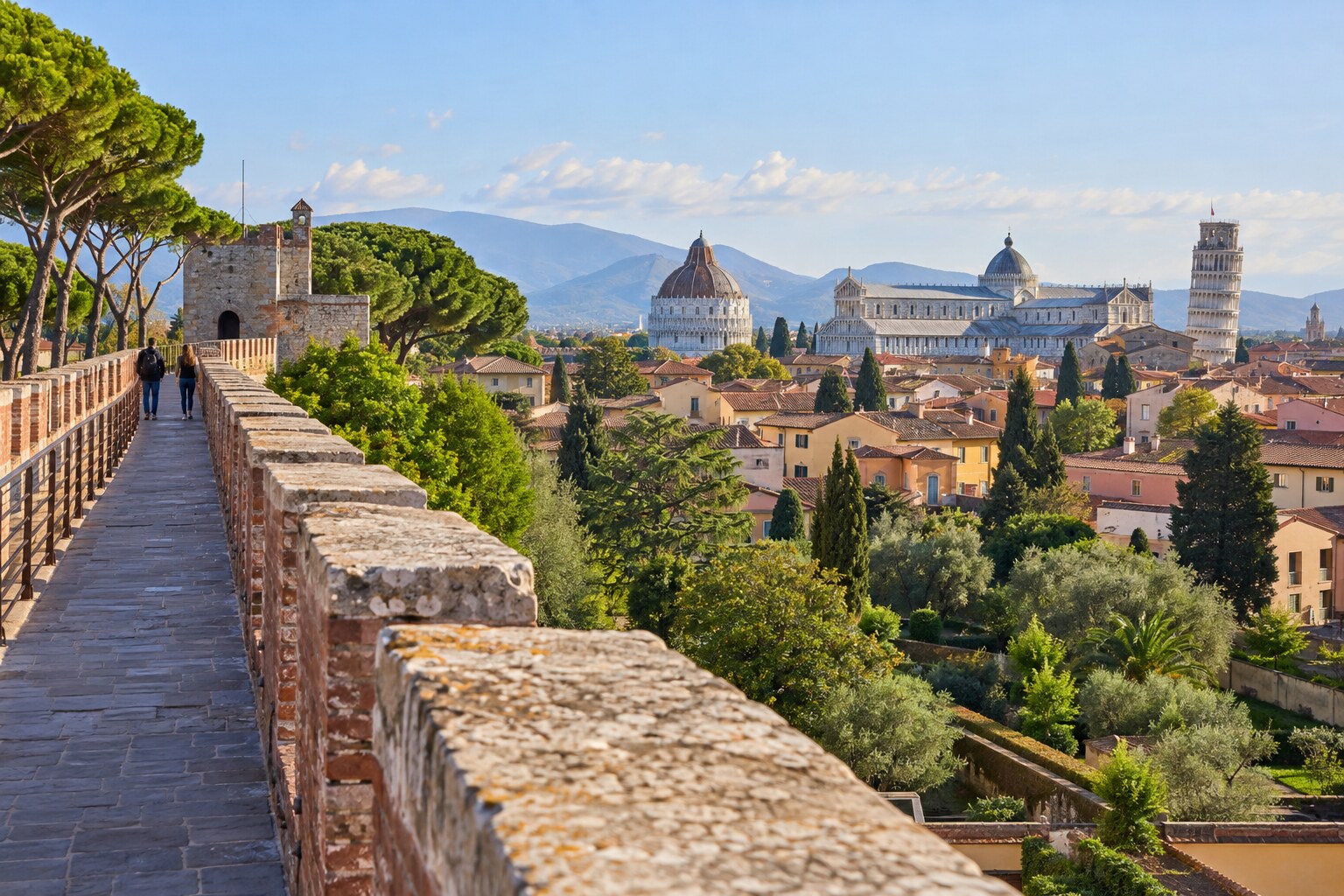
The Leaning Tower is Pisa’s unmistakable symbol, but the best way to understand the city’s shape may be to look at it from the medieval walls. The restored elevated walkway rises about 11 metres above streets and gardens, linking views of Piazza del Duomo with quieter university neighbourhoods. It turns a famous landmark into the start of a broader urban story.
Why the walls change the way you see Pisa
Construction began in 1154 north of the Arno and continued in stages for roughly a century and a half. From the walkway, defensive architecture becomes a balcony over churches, botanical gardens, rooftops and hidden green spaces. UNESCO describes Piazza del Duomo as a monumental ensemble of cathedral, baptistery, campanile and cemetery; the walls show how that celebrated square fits into the living city around it.
A practical self-guided route
1. Begin at Torre Santa Maria
Start beside Piazza del Duomo if you want the strongest first view. Before climbing, open the Pisa city page and save your next stops. The tower access leads directly onto the raised path, where the cathedral complex appears from an angle unavailable at ground level.
2. Leave the postcard behind
Walk away from the square and let the Leaning Tower recede. The parapet creates long sightlines towards terracotta roofs and the Monte Pisano landscape. This is the point of the route: not another close-up tower photo, but a reading of streets, gardens and neighbourhoods.
3. Pause near Bastione del Parlascio
The bastion is one of the useful access and exit points and sits near the Baths of Nero. Look at the change from medieval curtain wall to later fortified structures. If you need step-free access, the official walls website lists Parlascio among the accessible entrances, but always verify current operations before travelling.
4. Continue towards Porta Pacis and Piazza delle Gondole
The route crosses the northern city beside university buildings and less-visited streets. Porta Pacis and Piazza delle Gondole provide further access points, making it possible to adapt the walk instead of completing every section. Some stretches may close for events or maintenance, so check the official day notice.
5. Return through the historic centre
After descending, continue on foot through the university quarter, Borgo Stretto or the Lungarni. For a wider plan, use our Pisa travel guide. Combining the wall with street level prevents the experience from becoming only a viewpoint.
Opening hours, tickets and accessibility
The official 2026 visitor information gives seasonal hours: generally 10:00–17:00 from November to February, later closing in spring and summer, and 10:00–18:00 in October. Last admission is normally 30 minutes before closing. Hours can change for weather, maintenance and events, so confirm on the official website on the day of your visit.
- Duration: allow 60–90 minutes for a meaningful section; the complete route can take longer.
- Height: the walkway is about 11 metres above the city.
- Access: official entrances include Torre Santa Maria, Bastione del Parlascio, Porta Pacis, Piazza delle Gondole and Torre di Legno.
- Accessibility: several entrances are listed for visitors with disabilities, but not every connection is identical.
- Conditions: the route is exposed to sun, wind and rain; bring water and avoid the hottest hours.
Continue exploring with Best Free Tour
For independent narration, start with the self-guided audio-tour matcher. Compare guided options in the free walking tour directory, then browse bookable experiences for monuments, museums and Tuscan day trips.
Frequently asked questions
Can I see the Leaning Tower from the walls?
Yes. The stretch near Torre Santa Maria offers a distinctive elevated view of Piazza del Duomo and its monuments.
Do I need to walk the whole route?
No. Multiple access points allow shorter sections, subject to the openings operating that day.
Is the walkway free?
The elevated route is ticketed. Prices and reductions should be checked on the official website before visiting.
Is it suitable for children?
Families can enjoy it, but adults should supervise children closely and follow all staff instructions along the elevated path.
Official sources
Pisa’s Walls official site · Official visit information · Pisa municipal tourism portal · UNESCO: Piazza del Duomo