
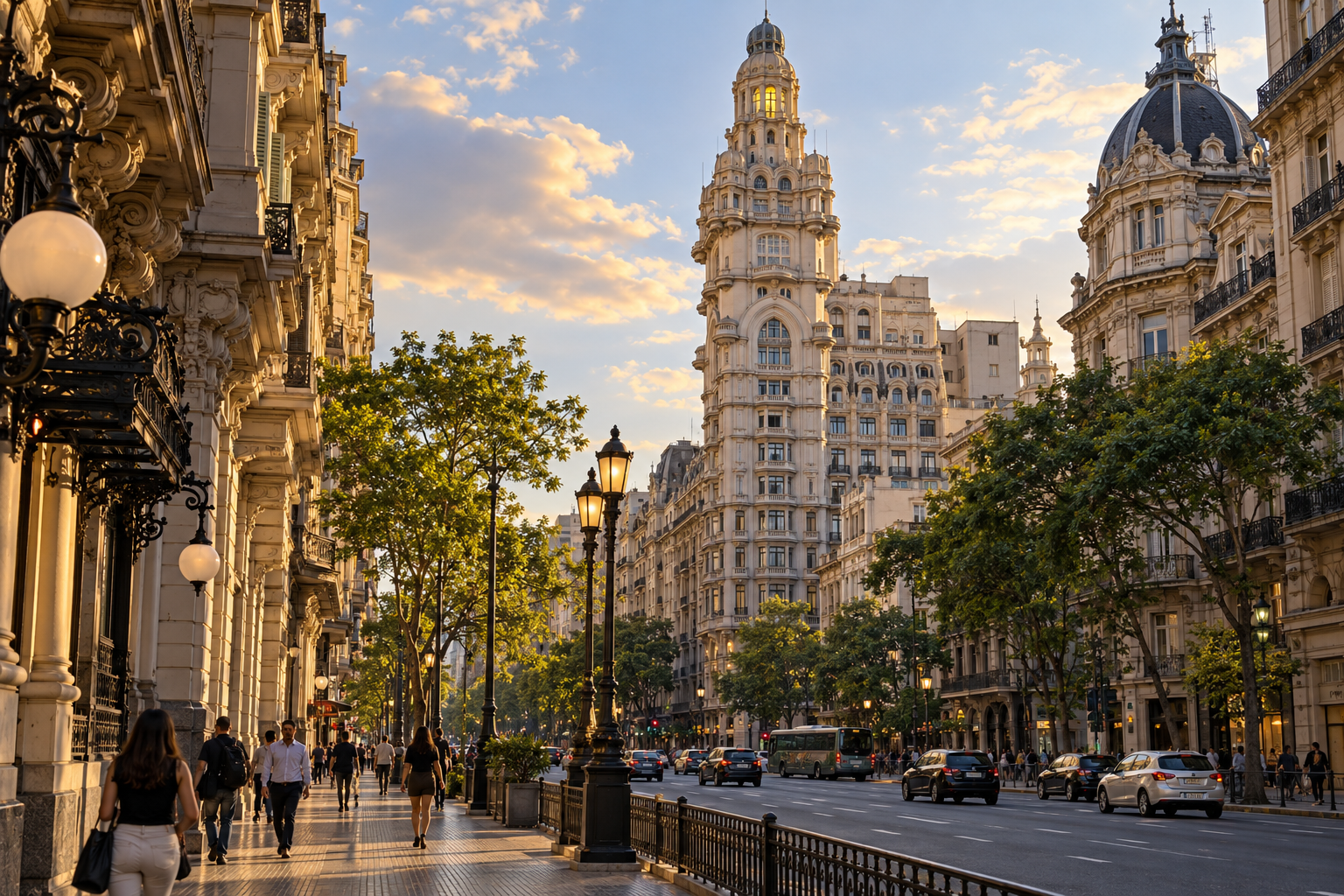
Avenida de Mayo is only about 1.35 kilometres long, yet it compresses several versions of Buenos Aires into one civic axis. Opened in 1894, it links the Casa Rosada and Plaza de Mayo with the National Congress. Its façades reveal French academicism, Spanish influence, Art Nouveau, eclectic domes and the early Latin American skyscraper.
Avenida de Mayo architecture walk: route and timing
Allow 2½ hours for the exterior route, or half a day if you book a Palacio Barolo tour and stop at a historic café. Walk east to west, from Plaza de Mayo toward Congress, so the Barolo and the green congressional dome build toward a strong finish. For colonial and San Telmo history, pair this route with our Buenos Aires historic walk.
1. Start at Plaza de Mayo and read the civic axis
Stand near the Cabildo and look west along Avenida de Mayo. The avenue was conceived as a symbol of modernity and as the city’s civic spine. Before entering it, compare the colonial scale of the Cabildo with the monumental government and bank buildings around the square. This contrast explains why opening the avenue required reshaping part of the older fabric.
2. La Prensa and Pasaje Roverano
At Avenida de Mayo 575, the former La Prensa newspaper building uses a Parisian composition crowned by a figure of Pallas Athena. Across the avenue, Pasaje Roverano offers a more intimate layer: a 1918 passage linking Avenida de Mayo with Hipólito Yrigoyen. Look for its preserved shopfront rhythm and the unusual relationship between street passage and subway access.
3. Historic cafés and Palacio Vera
London City is associated with writer Julio Cortázar, while Café Tortoni, founded in 1858, remains one of the avenue’s best-known interiors. A coffee stop is optional, but the façades and entrances already show how cafés worked as extensions of public life. Nearby, Palacio Vera houses the El Túnel bookshop and adds an elegant Art Nouveau note.
4. Cross 9 de Julio and slow down at the domes
The scale changes at Avenida 9 de Julio. Continue west past theatres and historic bars, looking upward rather than trying to photograph everything from the curb. Traffic is fast and sightlines are wide; use marked crossings and observe domes from the pavement. The avenue’s architecture rewards comparison: balconies, stucco, ironwork and corner towers repeat, but never identically.
5. Palacio Barolo: Buenos Aires through Dante
Mario Palanti designed Palacio Barolo for entrepreneur Luigi Barolo, and the building opened in 1923. Its programme refers to Dante’s Divine Comedy: the composition evokes Hell, Purgatory and Paradise, while the tower rises to about 100 metres and ends in a powerful lighthouse. It pioneered reinforced-concrete high-rise construction in the city and was once the tallest building in South America.
The building still contains offices, so the most complete access is through a paid guided visit booked in advance. Schedules change; check the official Palacio Barolo visit page before planning around the lighthouse or rooftop. Even without a ticket, the entrance hall and exterior proportions make it the route’s essential stop.
6. La Inmobiliaria and the National Congress
One block farther, La Inmobiliaria announces itself with twin reddish domes and an eclectic mix of Art Nouveau and neoclassical forms. Continue to Plaza del Congreso, where the avenue meets the National Congress and the restored Confitería del Molino. Step back into the square to understand the full civic composition rather than treating the dome as an isolated monument.
How to look at the avenue
- Walk in daylight, when façades and rooflines are easier to read.
- Use marked crossings and never step into traffic for a symmetrical photo.
- Carry binoculars or use a modest phone zoom for sculptures and domes.
- Book Palacio Barolo only through its current official channels.
- Choose one café interior; queues can consume the time needed for architecture.
Build the walk around your interests
Architecture lovers can focus on La Prensa, Palacio Vera, Barolo and La Inmobiliaria. Literary travellers may add Cortázar’s London City and a bookshop stop. First-time visitors can extend east into Plaza de Mayo or west toward Congreso. Compare a local free walking tour, use the Best Free Tour route matcher for self-guided planning, or browse compatible Buenos Aires experiences.
FAQ
Is the Avenida de Mayo walk free?
The street route is free. Palacio Barolo tours, food, performances and some interiors cost extra.
How long is the walk?
The avenue itself is about 1.35 kilometres. Allow 2½ hours for observation and photos, longer with interiors.
Can I enter Palacio Barolo without a tour?
It is an active office building. Visitor access beyond public areas is best arranged through an official guided tour.
What is the best time?
Morning offers softer light on façades; late afternoon can illuminate domes beautifully. Avoid rush-hour crossings if possible.
Information checked on 29 October 2026 against official Buenos Aires City tourism and heritage sources. Opening hours and tour access can change.