
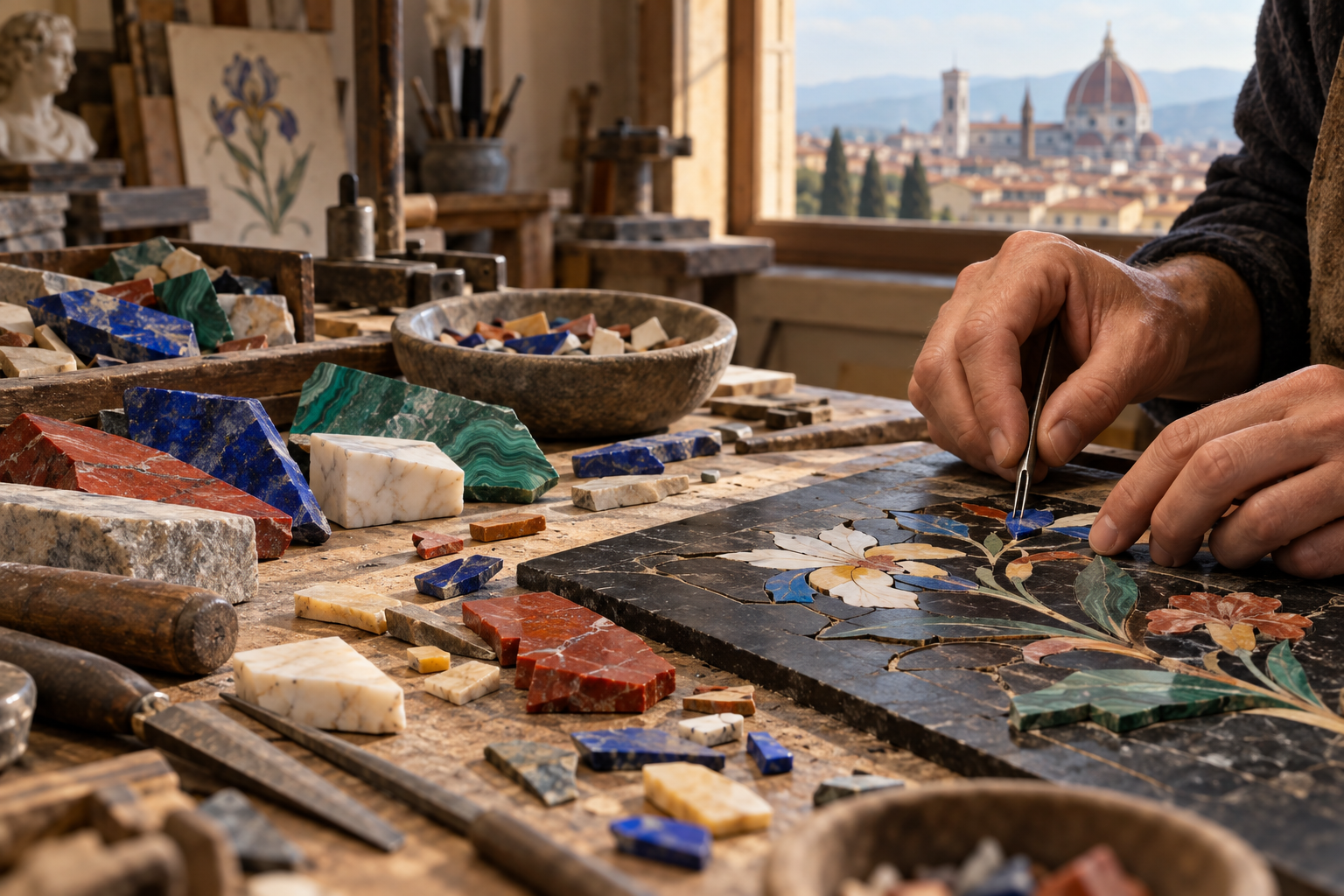
Florence is famous for painting and sculpture, but one of its most distinctive arts is made from stone. This Florence pietre dure walk connects the museum that explains the technique, the Medici court that financed it and the artisan tradition that still treats coloured minerals like a painter’s palette.
What is Florentine commesso?
Commesso fiorentino is not a mosaic made from small regular tiles. Artisans select thin pieces of marble and semi-precious stone for their natural colour and veining, cut them precisely, and fit them together so closely that the joins almost disappear. Flowers, birds, landscapes and architectural designs emerge without paint.
The grand-ducal workshop was formally founded in 1588 by Ferdinando I de’ Medici. Its legacy survives in the Museo dell’Opificio delle Pietre Dure, in Medici interiors and in a small number of specialist workshops. For broader planning, see the Florence artisan walk, compare guided options in the free walking tour hub, build an independent itinerary with the AI Tour Matcher, and browse compatible Florence experiences.
Self-guided pietre dure route
1. Begin at the Opificio museum
Start at the Museo dell’Opificio delle Pietre Dure, Via degli Alfani 78. The collection follows three centuries of court production and includes completed panels, cabinets, workbenches, tools and stone samples. It is the best place to understand how a rough fragment becomes “painting in stone”.
Official information checked on 1 November 2026 lists regular opening Monday–Saturday, 8:15–14:00, with the ticket office closing at 13:30. The museum is closed Sundays, public holidays and 24 June. The standard full ticket is listed at €6 and the museum states that it is accessible to visitors with reduced mobility. Always recheck before travelling.
2. Notice the special autumn openings
For autumn 2026, the museum has announced selected Thursday openings from 14:00 to 18:00 through 19 November, with guided visits included in the normal ticket while places last. Concerts are also scheduled on certain dates. Treat this as a temporary programme and consult the official calendar for the exact day.
3. Walk to San Lorenzo and the Medici Chapels
Continue toward Piazza San Lorenzo. The Chapel of the Princes was conceived as a dynastic memorial and became the great engine for Medici hardstone decoration. Even if you do not enter, the exterior context explains why a permanent court workshop was needed. If you plan an indoor visit, verify the Medici Chapels’ current timetable and ticket rules separately.
4. Cross the historic centre with a material eye
Walk via the Duomo toward Piazza della Signoria. Instead of collecting only famous façades, look at shop windows, church floors and palace details for the difference between marble, scagliola, true mosaic and commesso. Similar-looking surfaces can use very different techniques; the museum’s tool display makes these distinctions easier to recognise.
5. Continue to the Oltrarno workshops
Cross the river and enter the Oltrarno, where Florence’s craft identity remains visible. Specialist pietre dure studios are few and may work by appointment. A shopfront is not an invitation to enter a working area: ask before photographing, do not touch loose stone and avoid interrupting precision work. If a demonstration is offered, clarify the price and duration in advance.
6. Finish near Palazzo Pitti
End around Piazza Pitti, where workshops and showrooms connect the courtly tradition with contemporary commissions. Palazzo Pitti also preserves furnishings with hardstone inlay, although room openings and display rotations change. Decide whether to add a museum visit or keep the walk focused on public streets and artisan windows.
How to recognise good work
- Natural colour: the image comes from the stone itself, not surface paint.
- Veining: artisans use veins to suggest feathers, leaves, clouds or water.
- Joints: well-cut pieces meet with extremely narrow seams.
- Depth: polished surfaces can appear pictorial while remaining entirely mineral.
- Time: complex work is slow; very cheap souvenirs are unlikely to be traditional commesso.
Responsible craft tourism
Living craft is not a performance staged on demand. Support it by asking informed questions, respecting workshop rules and distinguishing handmade Florentine work from mass-produced objects. If you buy, request clear information about materials, technique, authorship and aftercare rather than bargaining over hours of skilled labour.
FAQ
Is the Opificio museum the same as the restoration laboratories?
No. The museum has a public collection; restoration laboratories have separate access and specialised visits that may require advance arrangements.
How long should I allow?
Allow about one hour for the museum and 90 minutes for the walk to the Oltrarno. Add more time for the Medici Chapels or Palazzo Pitti.
Is the route suitable on a rainy day?
Yes. The museum provides a strong indoor anchor, though the walk still includes outdoor sections and potentially slippery stone streets.
Can I visit an artisan workshop without booking?
Some showrooms welcome walk-ins, while working studios may require an appointment. Check the business’s own information and never enter private production space uninvited.
Florence through colour, stone and patience
This route reveals a Renaissance city beyond canvas and bronze. At the Opificio, Medici ambition becomes a technical process; in the Oltrarno, that process remains a demanding contemporary craft. Look closely and Florence’s stones begin to behave like paint.