
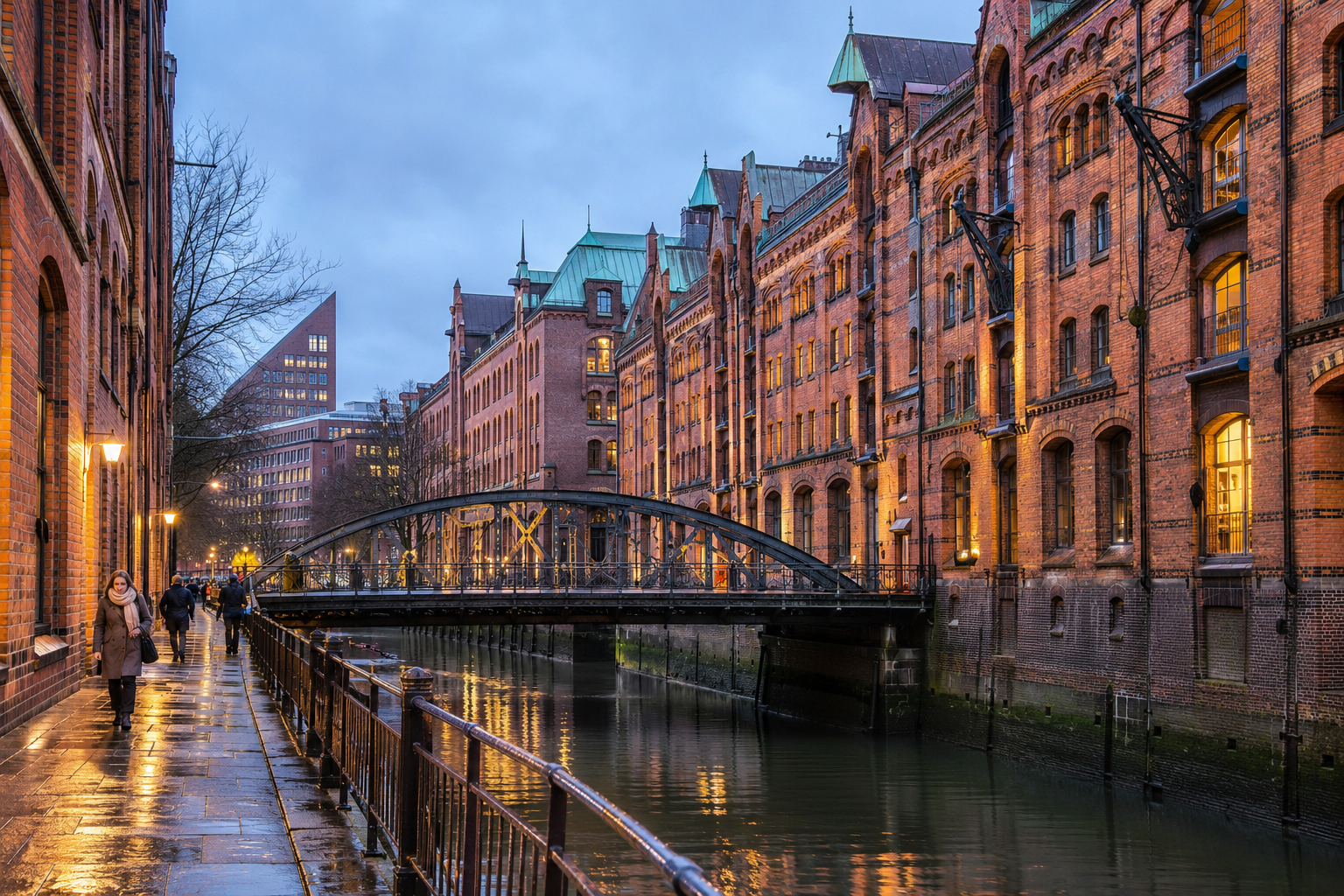
Hamburg’s UNESCO World Heritage Site is not one monument but a conversation between two working districts. The Kontorhausviertel shows how modern brick offices served a booming port economy; across the Zollkanal, Speicherstadt turns warehouses, bridges and canals into an extraordinary urban landscape.
This self-guided architecture walk starts at Meßberg U-Bahn station and ends at the World Heritage Info Point in the Kesselhaus. Allow about two hours for the 2.5 km route, or stay until blue hour when the warehouse façades and canal reflections become especially atmospheric.
Why this part of Hamburg is UNESCO-listed
UNESCO inscribed Speicherstadt and the Kontorhaus District with Chilehaus in 2015. Speicherstadt developed on narrow Elbe islands between 1885 and 1927 and became one of the world’s largest coherent historic warehouse ensembles. The neighbouring office district, built mainly from the 1920s onward, represented a new model for port-related businesses. Together they explain how global trade reshaped Hamburg.
Hamburg UNESCO architecture route
1. Meßberg and Chilehaus
Begin at Meßberg and walk to the Chilehaus. Fritz Höger’s brick landmark is famous for its sharp eastern corner, best understood by moving around it rather than taking one photograph. Notice how millions of dark clinker bricks create changing patterns, shadows and curves despite the building’s massive scale.
Continue into the inner courtyards and nearby Burchardplatz. These remain working offices, so keep entrances clear and avoid treating lobbies as public attractions.
2. Sprinkenhof and Kontorhausviertel
Next, circle Sprinkenhof, one of the district’s largest office complexes. Its patterned brick surfaces, sculptural details and courtyards reveal the ambition of early twentieth-century commercial architecture. Look toward Messberghof and Mohlenhof to compare different interpretations of the same functional brief: large, efficient office buildings for companies tied to the port.
3. Cross the Zollkanal into Speicherstadt
Walk toward Bei St. Annen and cross into Speicherstadt. The atmosphere changes immediately. Red-brick warehouses rise from canals, iron bridges compress the views, and loading doors and hoists recall the movement of coffee, cocoa, spices, tobacco and carpets. Stay on pavements and marked crossings; narrow bridges carry bicycles and service traffic.
4. Wasserschloss and warehouse canals
Follow the canal toward the classic view of Wasserschloss. The small building looks castle-like among the warehouses, especially at dusk. Continue along Holländischer Brook and Kehrwieder, changing sides when safe to see how the same blocks present road façades on one side and loading fronts on the water.
Speicherstadt is tidal. Water levels and reflections can change greatly, which is part of the district’s maritime character.
5. Finish at Kesselhaus World Heritage Info Point
End at the Kesselhaus, Am Sandtorkai 30. The city’s official World Heritage Info Point explains the history and significance of the two districts and offers practical material. The published schedule is Tuesday to Saturday 10:00–19:00 and Sunday 10:00–18:00, with Monday closed; check again before visiting because holiday hours may differ.
How to plan the walk
- Distance: about 2.5 km.
- Time: 1.5–2 hours without museum visits.
- Best light: morning for Chilehaus details; blue hour for Speicherstadt reflections.
- Weather: exposed bridges can be windy and wet; wear non-slip shoes.
- Accessibility: most of the route is level, but cobbles and bridge gradients occur.
For a broader city overview, read our Hamburg in one day guide. You can also compare free walking tours, use the AI Tour Matcher for an independent audio-style itinerary, or browse compatible Hamburg experiences.
FAQ
Is the UNESCO route free?
Yes. The streets, bridges and courtyards described here are public. Museums and guided interiors may charge admission.
Can I enter the Chilehaus?
It is primarily an office building. Publicly accessible passages and courtyards can be observed respectfully, but businesses and private areas should not be disturbed.
When is Speicherstadt illuminated?
The district is especially attractive after dusk, but lighting and sunset times vary by season. Avoid relying on a fixed hour.
Is the walk suitable with children?
Yes, with close supervision near canals, traffic and bridge edges. The route is short and can be combined with family attractions nearby.
Official sources
Information was checked on 2 November 2026 against the UNESCO World Heritage Centre, Hamburg.com, the city’s official World Heritage page and the Hamburg Travel route.