
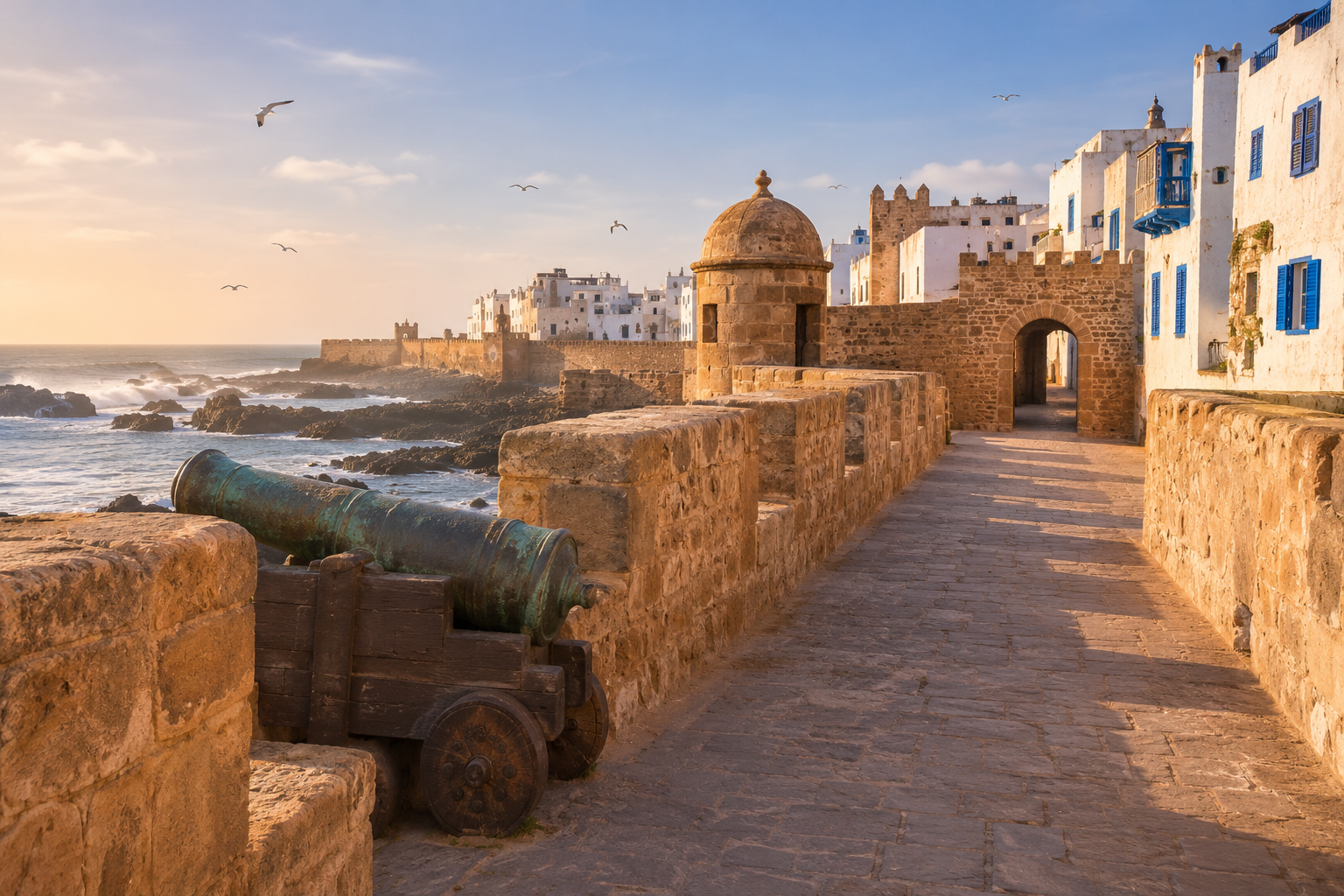
Essaouira is best understood on foot. Its compact UNESCO-listed medina brings together an active fishing port, Atlantic fortifications, ordered commercial streets and a long multicultural history. This self-guided route is designed for roughly three hours at an unhurried pace, with extra time for the Skala, workshops and Bayt Al Dakira.
Why this Essaouira walk is different
Unlike many older North African medinas, Essaouira was largely planned in the eighteenth century as a fortified royal port. UNESCO describes it as a meeting point between European military design and Arabo-Muslim architecture, as well as a trading link between Morocco, sub-Saharan Africa and Europe. The result is a medina that feels atmospheric but surprisingly legible.
If you are planning a wider Moroccan trip, pair this route with our Marrakech medina walk. For guided options, browse free walking tours, use the tour matcher for self-guided and audio-ready ideas, or share a genuine local discovery through Best Free Tour Experiences.
Route at a glance
- Distance: about 3 km, depending on detours
- Time: 2.5–3.5 hours
- Start: fishing port and Bab el-Marsa
- Finish: Bayt Al Dakira in the Mellah
- Best timing: morning for port activity; late afternoon for softer rampart light
Step-by-step Essaouira medina route
1. Begin at the fishing port and Sqala du Port
Start outside the medina where blue wooden boats, nets and the working quay set the city’s maritime context. Walk toward Bab el-Marsa, the monumental marine gate, then look across the defensive platform of Sqala du Port. This is a workplace as much as a landmark: keep clear of moving carts, ask before photographing fishermen and avoid blocking sales.
The Moroccan Ministry of Culture’s ticket portal lists visitor hours and admission categories for the Sqala du Port, but these can change. Check the official ticket page on the day rather than relying on an old screenshot or blog.
2. Cross Place Moulay Hassan into the planned medina
Pass through the gate toward Place Moulay Hassan, then continue along the commercial spine. Notice how the straighter streets and regular blocks differ from the maze-like plan associated with many medinas. Pause for thuya-wood workshops, textiles and small galleries, but treat the lanes as living neighbourhoods rather than an open-air set.
3. Follow the Atlantic wall to Skala de la Kasbah
Turn west for the sea-facing ramparts. Bronze cannons, stone parapets and ocean views make this the route’s most dramatic section. The official Moroccan tourism office highlights the two defensive citadels—the port Sqala and Kasbah Sqala—as central to Essaouira’s character. Wind can be strong even on warm days, so secure hats and keep phones away from the edge.
4. Walk north through the Mellah
Continue toward the former Jewish quarter. Look for traces of merchant houses and synagogues without entering residential doorways. The medina’s history is not a decorative footnote: UNESCO specifically notes the coexistence of Amazigh, Arab, African, European, Muslim, Christian and Jewish communities in the city’s development.
5. End at Bayt Al Dakira
Finish at Bayt Al Dakira, the House of Memory, inside the restored Simon Attia synagogue. Its collections document Jewish Moroccan life and Muslim-Jewish coexistence in Essaouira. The museum’s official page currently states free entry and notes that opening hours may vary with the cultural programme, so confirm locally before setting out.
Practical and respectful walking tips
- Wear shoes with grip: polished stone and damp port surfaces can be slippery.
- Carry a light layer for Atlantic wind, even when inland Morocco is hot.
- Ask before photographing people, workshops or religious interiors.
- Buy directly from craftspeople when possible and avoid bargaining aggressively over small sums.
- Check access conditions at monuments on the same day; restoration and events can alter routes.
Frequently asked questions
Is the Essaouira medina easy to navigate?
Yes. Its eighteenth-century planned layout is more regular than many historic medinas, though an offline map is still useful in the Mellah and souk lanes.
Do I need a guide?
No for basic navigation. A licensed local guide adds depth on trade, architecture and Jewish Moroccan history, while this route works well as a self-guided introduction.
Is the walk accessible?
The main commercial axes are relatively flat, but cobbles, kerbs, crowds and steps at fortifications create barriers. Confirm current access directly with each museum or monument.
What should I verify before visiting?
Check the official Ministry of Culture page for Sqala du Port access and the museum’s official listing for Bayt Al Dakira. Weather and high winds can also affect comfort on the ramparts.
Sources checked 3 November 2026: UNESCO World Heritage Centre, Moroccan National Tourist Office, Essaouira Provincial Tourism Council, and Bayt Al Dakira official museum listing.