
Welcome to the Neptune Fountain Bologna Guide, your clear and friendly look at one of Bologna’s most famous landmarks in Piazza del Nettuno. Whether you are exploring the city for the first time or simply love Renaissance art, this article explains who created it, why it was built, the artists involved, how the work unfolded, and the meaning of every important figure. Moreover, you will find practical tips that help you enjoy the fountain even more when you stand in front of it.
Why the Fountain Was Built
Shortly after the Council of Trent, Pope Pius IV wanted to show the generosity and good government of the Church in Bologna, which was then under papal rule. As a result, the papal vice-legate Pier Donato Cesi and Cardinal Carlo Borromeo commissioned the work in 1563. An entire block of buildings was demolished to open the new square next to Piazza Maggiore. Consequently, the fountain was originally called Aqua Pia in honor of the pope, and it served both as a beautiful public ornament and a clear political message: just as Neptune rules the seas, the pope rules the world.
Who Designed and Built It
The architectural design was entrusted to Tommaso Laureti, an architect from Palermo. Meanwhile, the bronze sculptures were created by the Flemish artist Giambologna (Jean de Boulogne), who was still building his reputation in Italy. Giambologna had earlier submitted a model for the Neptune Fountain in Florence but lost that commission; therefore, the Bologna project became one of his first major public works. Work began in 1563. The structure of the basin was largely finished by 1565, and the large bronze statue of Neptune was put in place around 1566. In addition, local founders such as Zanobio Portigiani helped cast the metal parts.
The Central Statue and Its Message
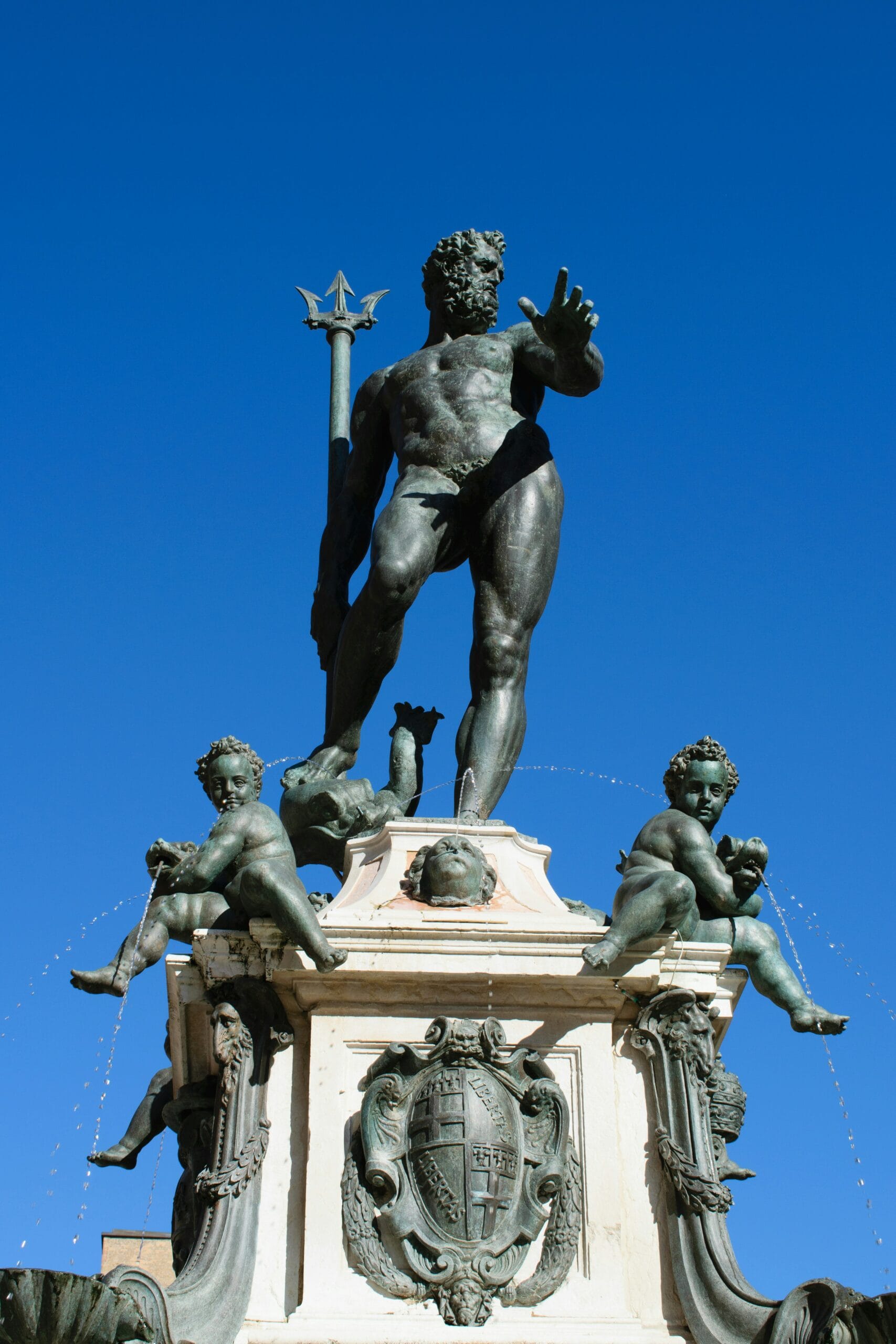
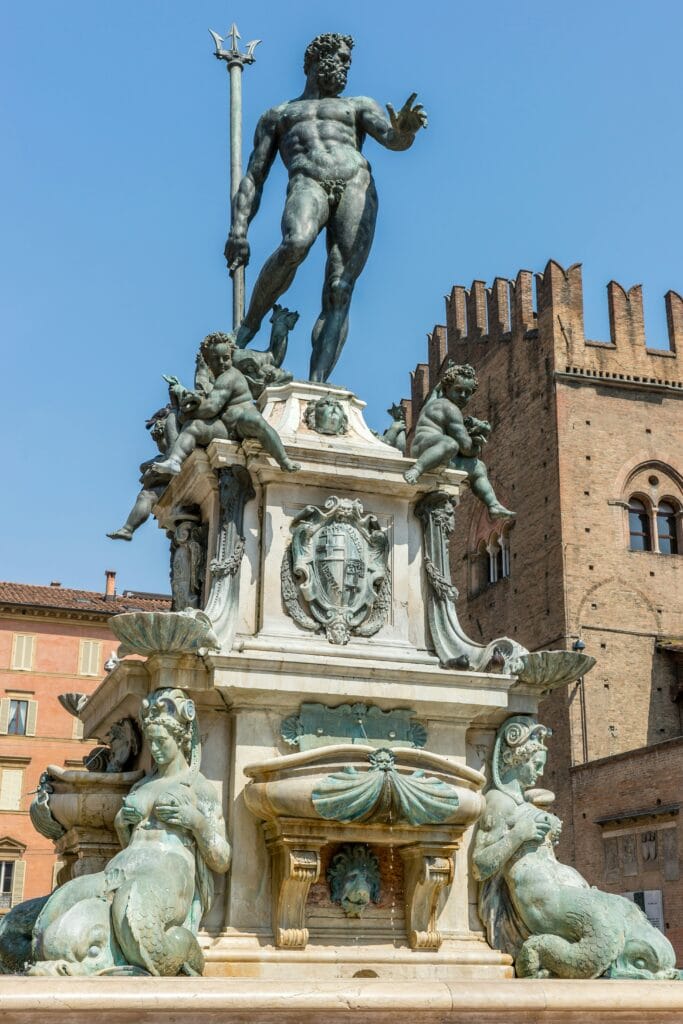
At the top stands the powerful bronze figure of Neptune, about 3.2 to 3.4 meters tall. Locals still call him “al Żigànt” (the Giant) in the Bolognese dialect. Giambologna shaped him in a dynamic Mannerist pose known as the figura serpentinata, with one arm stretched out as if he is calming the waves. This gesture is not only artistic; it is also political. It shows the pope bringing order and control, just as Neptune masters the waters. Furthermore, the statue rises above a base decorated with coats of arms and other symbols of papal authority, reinforcing the idea of Church power in the city. In this way, the Neptune Fountain Bologna Guide highlights how art and politics worked together in the Renaissance.
The Figures Around the Basin
The large basin rests on three steps and is covered with Verona marble. Around it you will find several bronze groups created by Giambologna. Four mermaids (or nereids) sit at the corners, and water originally flowed from their breasts. Four putti hold dolphins that represent the four known continents and their great rivers — the Ganges, the Nile, the Amazon, and the Danube. In addition, dolphins, coats of arms, and other decorative elements complete the scene. Together these figures celebrate water as a source of life and prosperity that the papal government provided for the people. Inscriptions on the four sides of the basin still remind visitors of the purpose: “Fori Ornamento” (ornament of the square), “Aere Publico” (built with public money), “Populi Commodo” (for the use of the people), and the date 1564.
Useful Links and Visiting Tips our Neptune Fountain Bologna Guide
If you want to learn more, the detailed page on Wikipedia gives solid historical background. The official city site offers clear explanations at Fontana del Nettuno – Storia. You can also read a modern overview on Italia.it and discover extra stories and curiosities on Taste Bologna.
Of course, the best way to experience the fountain is in person. When you visit Bologna, join a free walking tour that includes Piazza del Nettuno and Piazza Maggiore — you can find great options right here on www.bestfreetour.com. Standing beside the bronze giant, with the lively square around you, brings the whole history to life. Students even walk around the fountain twice before exams for good luck.
In the end, the Neptune Fountain Bologna Guide shows us more than a beautiful bronze statue. It is a celebration of papal power, public water, and Mannerist artistry that still defines the heart of Bologna. Next time you look up at Neptune with his arm outstretched, you will understand the political message, recognize the four continents at his feet, and appreciate the clever work of Laureti and Giambologna. That deeper knowledge turns a simple stop in the square into a richer and more memorable moment.