
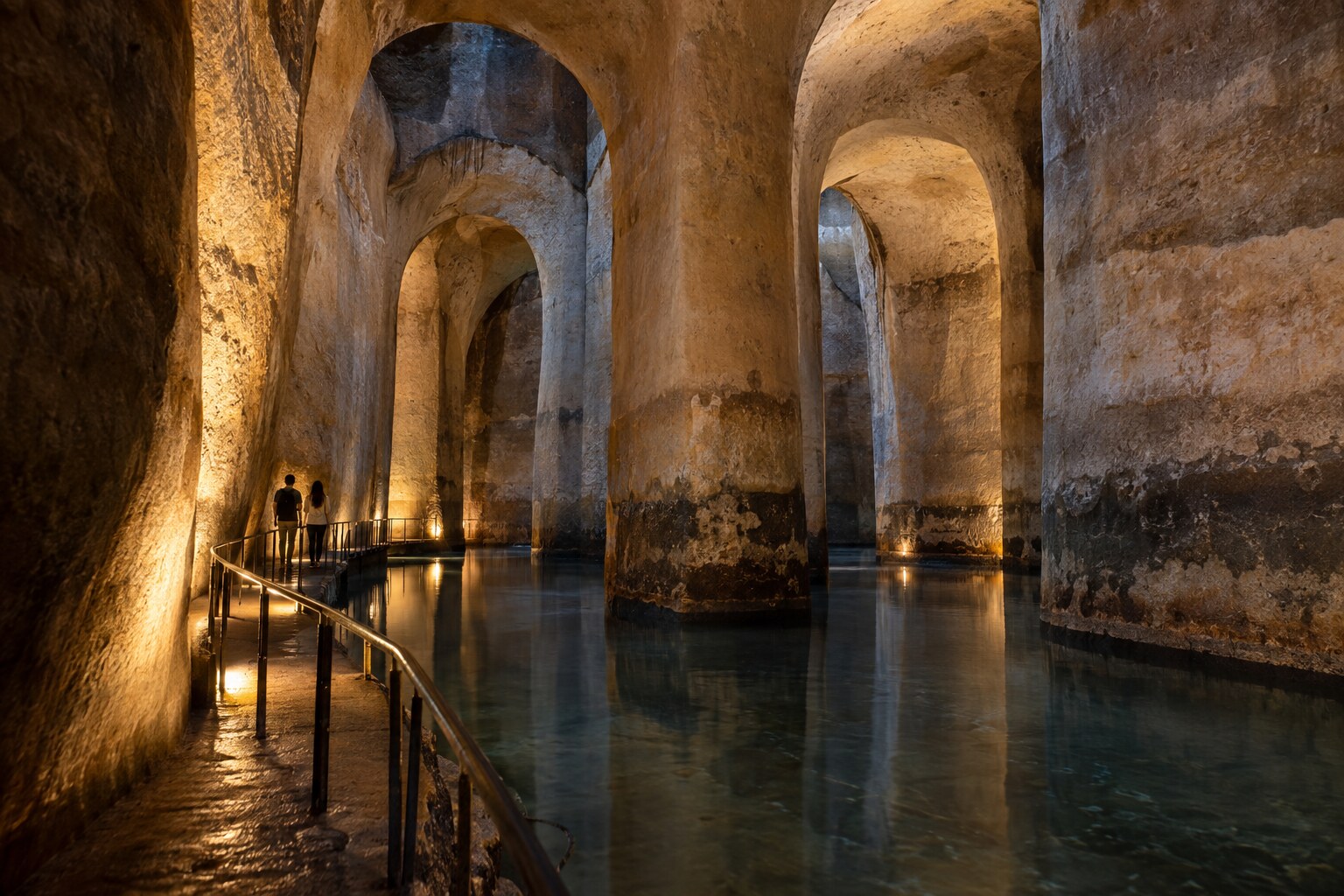
Matera is famous for homes carved into pale limestone, but its most ingenious architecture is often invisible. For centuries, families collected rainwater from roofs, lanes and courtyards, guiding it into rock-cut cisterns. Looking for this hidden network turns a visit to the Sassi into a lesson in how a city can adapt to a dry, steep landscape.
Why water explains Matera
UNESCO describes the Sassi and the Park of the Rupestrian Churches as an outstanding troglodyte settlement adapted to its terrain and ecosystem. More than a thousand dwellings, rock churches and shared spaces form a landscape shaped by long occupation and careful resource management. Water was not an accessory: it influenced roofs, channels, courtyards and the position of homes.
Instead of treating the Sassi as a backdrop, notice how one roof can become the street or terrace above another house. Sloping surfaces direct rainfall, while wells and cistern mouths reveal the underground half of the settlement.
A self-guided route through Matera’s water story
1. Piazza Vittorio Veneto and the Palombaro Lungo
Begin in Piazza Vittorio Veneto. Beneath the square lies the Palombaro Lungo, a monumental rock-cut reservoir. If you plan to enter, check the official same-day opening and ticket information: access can change. Even without entering, the square is the right place to understand the contrast between the modern city and the Sassi below.
2. Look over Sasso Barisano
Walk to the viewpoints above Sasso Barisano. From here, terraces and roofs read like a connected catchment rather than separate buildings. Continue slowly through the lanes and look for gutters, stone channels, wells and rounded cistern openings.
3. Cross the Civita ridge
Climb toward the Civita and cathedral area. The ridge separates the two principal Sassi and gives you a clear sense of how elevation controlled the movement of water. For a fuller route through Barisano, Civita and Caveoso, use our detailed Matera walking itinerary.
4. Descend into Sasso Caveoso
In Caveoso, cave rooms and rock-cut churches make the relationship between geology and daily life especially visible. Respect private dwellings and barriers; historic channels and wells are fragile infrastructure, not street furniture.
Practical advice
- Wear shoes with grip: polished stone, steps and cave interiors can be slippery.
- Carry water, especially in warm weather, but remember that many old cisterns are heritage features and not drinking sources.
- Allow two to three hours for an unhurried loop, longer if you enter museums or cisterns.
- For steep sections or limited mobility, choose the upper viewpoints and confirm accessibility directly with each attraction.
Use the Matera city page to compare an autonomous audio-guide experience with guided walks and compatible activities. If you prefer a local storyteller, browse our free walking tour options.
Frequently asked questions
Can you visit Matera’s cisterns?
Some can be visited, including major public sites, while others belong to homes, museums or accommodation. Check official opening information before going.
Is the route suitable for children?
Yes for families comfortable with many steps and uneven paving. Keep children close near drops, wells and wet surfaces.
Do I need a guide?
No, the route works independently. A guide or audio guide adds context because much of the water system is difficult to interpret at street level.
What is the best time to walk?
Early morning or late afternoon offers softer light and cooler temperatures. Avoid exposed, steep lanes during the hottest hours.