
Florence is usually read through domes, palaces and paintings, yet water offers a compact way to understand the city. This self-guided fountain walk links three very different works in roughly 1.5 kilometres: a bronze wild boar at the old market, a monumental Medici statement in Piazza della Signoria, and a theatrical mask set into an Oltrarno street corner. Allow 60–90 minutes, longer if you stop for photographs or a museum.
Florence fountain walk at a glance
- Start: Loggia del Mercato Nuovo, by the Porcellino.
- Finish: Fontana dello Sprone, at Borgo San Jacopo and Via dello Sprone.
- Distance: about 1.5 km, mostly level paving with some uneven stone.
- Best time: early morning for quieter squares and softer light.
- Cost: free; all three fountains are viewed outdoors.
The route follows the historic centre and crosses the Arno on Ponte Santa Trinita. The Municipality’s official tourism site also groups these landmarks in its fountain route.
The route, stop by stop
1. Porcellino: a wild boar with a polished snout
Begin beside the Loggia del Mercato Nuovo. Despite the affectionate nickname “Porcellino”, the bronze animal is a wild boar. Pietro Tacca created the fountain from an ancient marble model; the original bronze is conserved in the Stefano Bardini Museum, while the busy market displays a copy. Look closely at the base, where water, plants and small animals turn a familiar photo stop into a miniature natural world.
The ritual of touching the snout and dropping a coin is popular, but the better reason to pause is the fountain’s relationship with the market: water, trade and public space meet within a few metres. From here, walk along Via Calimala and Via Vacchereccia to Piazza della Signoria.
2. Neptune Fountain: water as Medici power
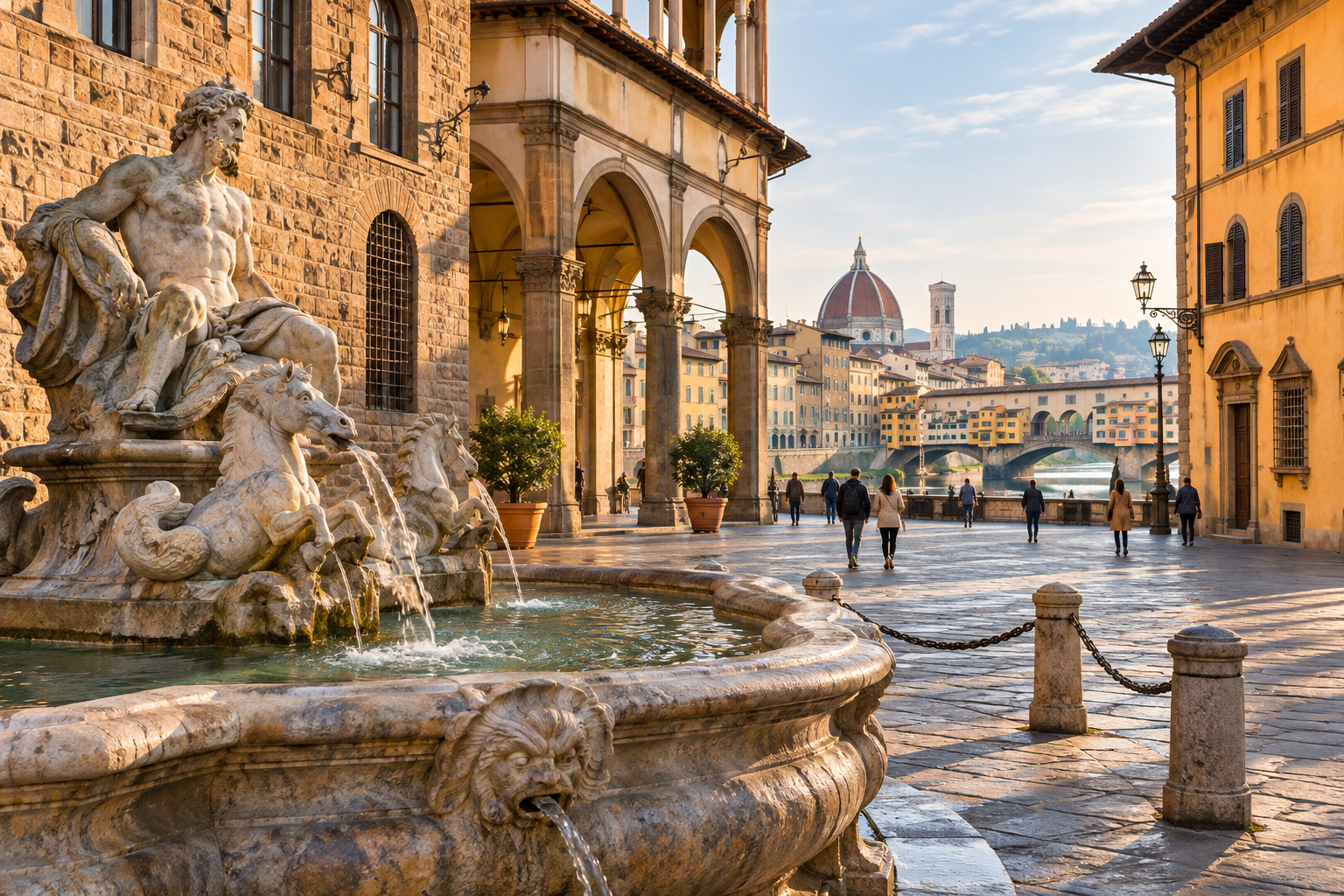
Bartolomeo Ammannati’s Fountain of Neptune was commissioned by Cosimo I de’ Medici during a major expansion of the city’s water system. The marble sea god, known locally as the Biancone, recalls Cosimo’s features and stands above an octagonal basin animated by horses, tritons, satyrs and sea figures. The civic setting matters: Palazzo Vecchio rises immediately behind it, so the fountain works as both sculpture and political theatre.
Walk around the basin rather than viewing it only from the front. Details change with the light, and the side views make the bronze figures easier to read. The Municipality’s official Neptune history explains how the work has marked Piazza della Signoria for almost five centuries.
3. A useful pause: the public drinking fountain
Before leaving the square, refill your bottle at the public water point by the wall of Palazzo Vecchio, behind the Neptune Fountain. The official Florence low-cost guide notes that the city’s fontanelli provide free still and sparkling water. This practical stop also clarifies an important difference: monumental fountains are artworks, while fontanelli are designed for drinking.
4. Cross the Arno on Ponte Santa Trinita
Continue to Via delle Terme, reach Piazza Santa Trinita and cross the bridge. Pause halfway for a broad view of Ponte Vecchio, but keep the pedestrian flow moving. On the south bank, turn left along Borgo San Jacopo and then into Via dello Sprone.
5. Fontana dello Sprone: a corner transformed
The route ends where two streets meet at an acute angle. Bernardo Buontalenti’s fountain turns that awkward geometry into a stage: a grotesque marble mask spills water into a curving basin, making the building corner feel fluid and theatrical. It is smaller than Neptune but rewards slow looking. Step back toward Via dello Sprone to see how the sculpture, masonry and street line were designed together.
How to make the walk work
- Wear shoes with grip: historic paving can be slippery after rain.
- Do not drink from ornamental basins; use marked public fontanelli.
- Keep valuables secure around the market and crowded squares.
- Check temporary works or barriers on the official municipal pages before setting out.
- Combine the route with the nearby Oltrarno artisan walk or the Pietre Dure walk for a longer cultural day.
Continue exploring Florence
Prefer a guide who can connect the sculptures with Medici politics and city life? Browse free walking tours. For an independent route or audio-led option, use the AI Tour Matcher; for bookable activities, see current experiences.
FAQ
Is the Florence fountains walk free?
Yes. The three main fountains are in public outdoor spaces, and the drinking-water stop is free.
How long does the route take?
The walk itself takes about 25 minutes without stops. Allow 60–90 minutes to observe the sculptures, take photographs and refill water.
Can I drink from the historic fountains?
No. Drink only from clearly marked public fontanelli, not from the ornamental basins.
Is the route suitable at night?
The central streets are active after dark, but details are easier to appreciate in daylight. Early morning is the calmest option.