
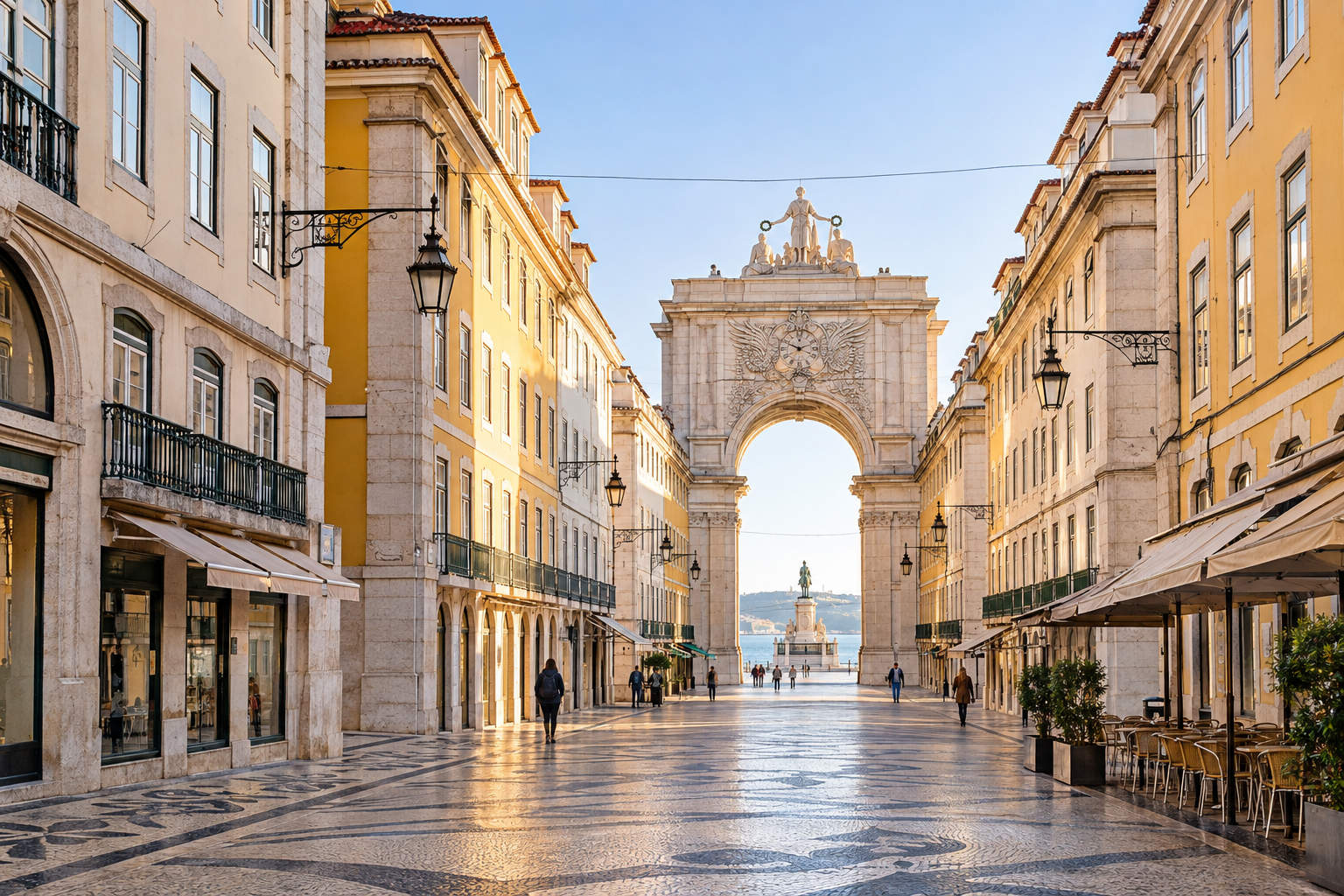
Lisbon’s centre is not simply old: much of it is the result of a radical rebuilding project after the earthquake of 1 November 1755, followed by fires and a tsunami. This self-guided route moves from a surviving ruin on the hill to the rational streets of Baixa and the open riverfront. In about 1.8 kilometres, it shows how disaster, engineering and Enlightenment-era planning reshaped the Portuguese capital.
Lisbon earthquake walk at a glance
- Start: Carmo Convent and Largo do Carmo.
- Finish: Praça do Comércio and Cais das Colunas.
- Distance: about 1.8 km, mostly downhill.
- Time: 75–100 minutes without museum visits.
- Cost: the outdoor route is free; museums and viewpoints charge separately.
The route is best in daylight, when façades and street lines are easiest to read. The official Lisbon City Council records the 1755 event as an estimated magnitude 8.7 earthquake that caused extensive destruction, especially downtown; estimates are historical reconstructions rather than modern instrument readings. Read the city’s current earthquake data and figures before the walk.
The route, stop by stop
1. Carmo Convent: the roof that never returned
Begin at Largo do Carmo. The roofless nave of the Carmo Convent is one of central Lisbon’s clearest physical reminders of 1755. Rather than reconstructing the church completely, later generations preserved the open Gothic arches. From the square, look through the surviving stone ribs and compare their irregular, medieval rhythm with the ordered streets you will soon enter below.
The archaeological museum inside adds context, but the exterior already makes the key point: the earthquake did not erase every trace of pre-1755 Lisbon. Some fragments survived, others were adapted, and much of the lower city was reimagined.
2. Rossio: from medieval crossroads to rebuilt square
Descend via Calçada do Carmo toward Rossio. The square remained a major civic meeting place, but the buildings around it reflect later reconstruction and nineteenth-century change. Stand near the centre and notice the way streets now leave the square in straight, legible lines. That clarity prepares you for the Pombaline grid.
3. Rua Augusta and the Pombaline plan
Continue south through Rua Augusta. After 1755, the rebuilding of Baixa replaced a dense medieval street pattern with an orthogonal plan of regular blocks. The official Visit Lisboa city-centre guide describes Baixa Pombalina as a grand and modern undertaking for its time.
Do not focus only on shopfronts. Look upward at repeated window bays, controlled cornice heights and long parallel streets. Many buildings used the “gaiola pombalina”, a timber framework inside masonry walls designed to improve structural behaviour. It is usually hidden, so the street itself—regular, modular and connected—is the visible lesson.
4. Arco da Rua Augusta: a monument to rebirth
At the south end of Rua Augusta, the monumental arch frames the river. Visit Lisboa explains that the Arco da Rua Augusta symbolises the rebirth of Lisbon after the earthquake, fire and tsunami. Walk beneath it before turning back to study how its sculptural programme celebrates the city and the figures associated with national history.
The viewpoint at the top is optional. From above, the straight Pombaline streets and their relationship with the Tagus become especially clear, but check the official page for current access and tickets.
5. Praça do Comércio: from royal palace to public stage
Step into Praça do Comércio, traditionally called Terreiro do Paço. The royal palace once stood here before the earthquake. The rebuilt square opened the city toward the river with a broad, ordered ensemble; the equestrian statue of King José I occupies its centre. The official Praça do Comércio page explains this earlier palace identity.
Finish at Cais das Colunas, facing the Tagus. The water is essential to the story: after the shaking and fires, the tsunami intensified the destruction along the riverfront. Today the open view provides a calm place to consider how Lisbon’s relationship with the river is both beautiful and vulnerable.
Optional museums and deeper context
- Lisboa Story Centre: beside Praça do Comércio, with multimedia interpretation of the city’s history.
- Museu de Lisboa – Pimenta Palace: its collection includes a large model of Lisbon before 1755 and reconstruction drawings; see the museum’s official collection page.
- Quake – Lisbon Earthquake Centre: an immersive attraction in Belém; consult Visit Lisboa for current details.
Practical and respectful walking tips
- Wear shoes with grip: calçada paving can be slippery when wet.
- Keep to pedestrian areas and cross tram tracks carefully.
- Treat the event as human history, not disaster spectacle.
- For current earthquake-preparedness advice, use Lisbon City Council’s official guidance rather than travel blogs.
- Continue with the Lisbon hidden-gems guide or browse the broader Portugal city collection.
Continue exploring Lisbon
For local storytelling and orientation, compare available free walking tours. If you prefer an independent or audio-led route, use the AI Tour Matcher. For bookable museums, food tours and river activities, check current experiences.
FAQ
Is the Lisbon earthquake walk free?
Yes. The street route is free. Carmo’s museum, the Rua Augusta viewpoint and other attractions may require tickets.
How long does the walk take?
Allow 75–100 minutes for the outdoor route, or half a day if you add museums and the arch viewpoint.
Is the route accessible?
Most of Baixa is relatively level, but the start at Carmo involves a descent and uneven paving. The Santa Justa area can provide alternatives, but current lift access should be checked.
Why is Baixa called Pombaline?
The name refers to the reconstruction associated with the Marquis of Pombal after 1755, characterised by a regular plan, standardised façades and new construction methods.