
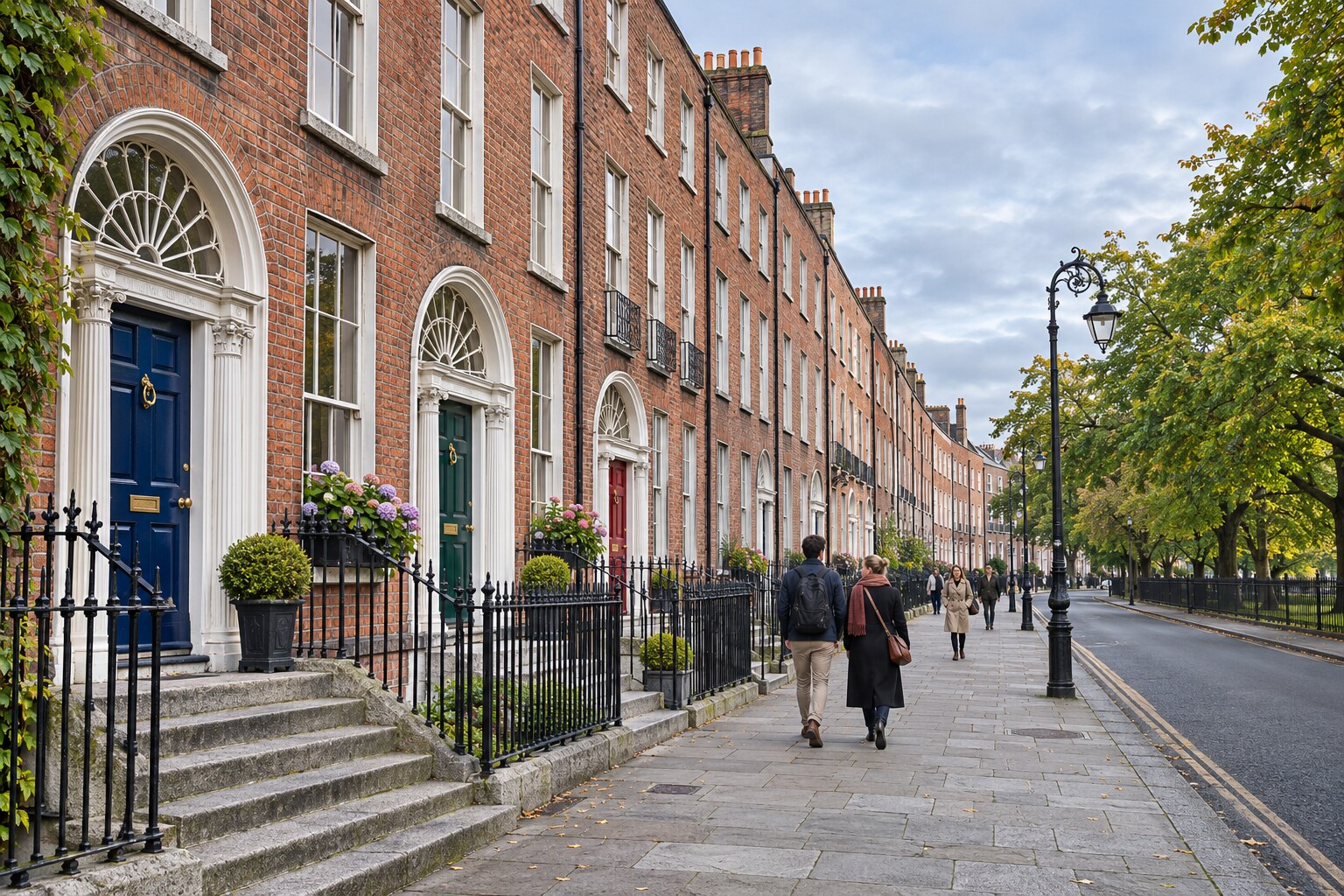
Dublin’s Georgian quarter rewards slow looking. Behind the famous coloured doors lies a carefully composed streetscape of red brick, granite steps, fanlights and sash windows. This self-guided Georgian Dublin walk links Merrion Square with Fitzwilliam Square through public streets, making it an easy architecture-focused route close to the city centre.
Allow 60–90 minutes for roughly 2 km, longer if you enter Merrion Square Park or stop for museums and cafés. The walk is free, while indoor attractions have their own opening times and admission rules.
Why walk Dublin’s Georgian quarter?
Eighteenth-century Dublin expanded around formal squares and terraces. The apparently uniform façades are full of small variations: brick tones, door surrounds, ironwork and the fanlights that brighten entrance halls. Visit Dublin’s Georgian architecture guide explains how these houses and civic buildings shaped the city’s identity.
Start your wider planning on the Ireland city page. You can also compare a hosted introduction in the free walking tour hub or create a flexible independent plan with the AI Tour Matcher and self-guided audio options.
Georgian Dublin walking route
1. Merrion Square Park and Oscar Wilde
Begin inside or beside Merrion Square Park. Houses were developed around the square from 1762, and the park remains one of Dublin’s clearest examples of Georgian urban design. Look for the Oscar Wilde memorial opposite the writer’s childhood home, then walk the perimeter to appreciate the terraces as complete compositions rather than isolated doors. Check the Dublin City Council park page for current access information.
2. Leinster House and the cultural edge
On the west side, pause outside Leinster House, the seat of Ireland’s parliament. The nearby National Gallery and Natural History Museum show how the square combines domestic terraces, government and culture. Security arrangements can change, so remain on public pavements and follow signs.
3. Merrion Row and Upper Merrion Street
Continue toward Merrion Row and Upper Merrion Street. Compare fanlights: semicircular or elliptical glazing above the door brings daylight into a deep hallway. Notice how upper windows become smaller, reinforcing the façade’s proportions. Photograph respectfully; these are working offices, institutions and homes.
4. Upper Mount Street
Turn onto Upper Mount Street for one of the route’s strongest long perspectives. Rather than hunting only for the brightest door, read each terrace as a rhythm of brick bays, chimneys, railings and granite steps. The changing details reveal that separate builders worked within shared rules.
5. Fitzwilliam Square
Finish at Fitzwilliam Square, the smallest of Dublin’s great Georgian squares. Its central garden is private, but the surrounding public pavements provide clear views of the façades and mature greenery. Circle only where crossings and footpaths are safe, then continue to Baggot Street for refreshments.
How to read a Georgian doorway
- Fanlight: decorative glazing above the door, designed to illuminate the hall.
- Doorcase: columns, pilasters or carved surrounds that frame the entrance.
- Railings and steps: the transition from public pavement to the raised main floor.
- Sash windows: vertically sliding windows, usually decreasing in size toward the top.
Practical tips
- Walk in daylight for the best view of brickwork and fanlights.
- Use pedestrian crossings: traffic around the squares can be busy.
- Merrion Square Park paths are mostly level, but granite steps and uneven pavements appear along the route.
- Do not enter private gardens, steps or hallways for photographs.
- Rain is common; a compact umbrella and shoes with grip are useful.
Extend your Dublin day
After the walk, pair architecture with local flavours using the Classic Dublin Food Guide. For bookable museums, river trips and compatible activities, browse Dublin experiences.
FAQ
Is the Georgian Dublin walk free?
Yes. The route follows public streets and Merrion Square Park. Museums, guided visits and special exhibitions may charge separately.
How long does the route take?
Plan 60–90 minutes for the walk itself, or half a day with museum and café stops.
Can visitors enter Fitzwilliam Square garden?
The central garden is private. Enjoy the architecture from public pavements and respect gates and residents.
Is this route suitable in the rain?
Yes, but pavements and granite steps can become slippery. Shorten the route via Merrion Row if conditions worsen.