
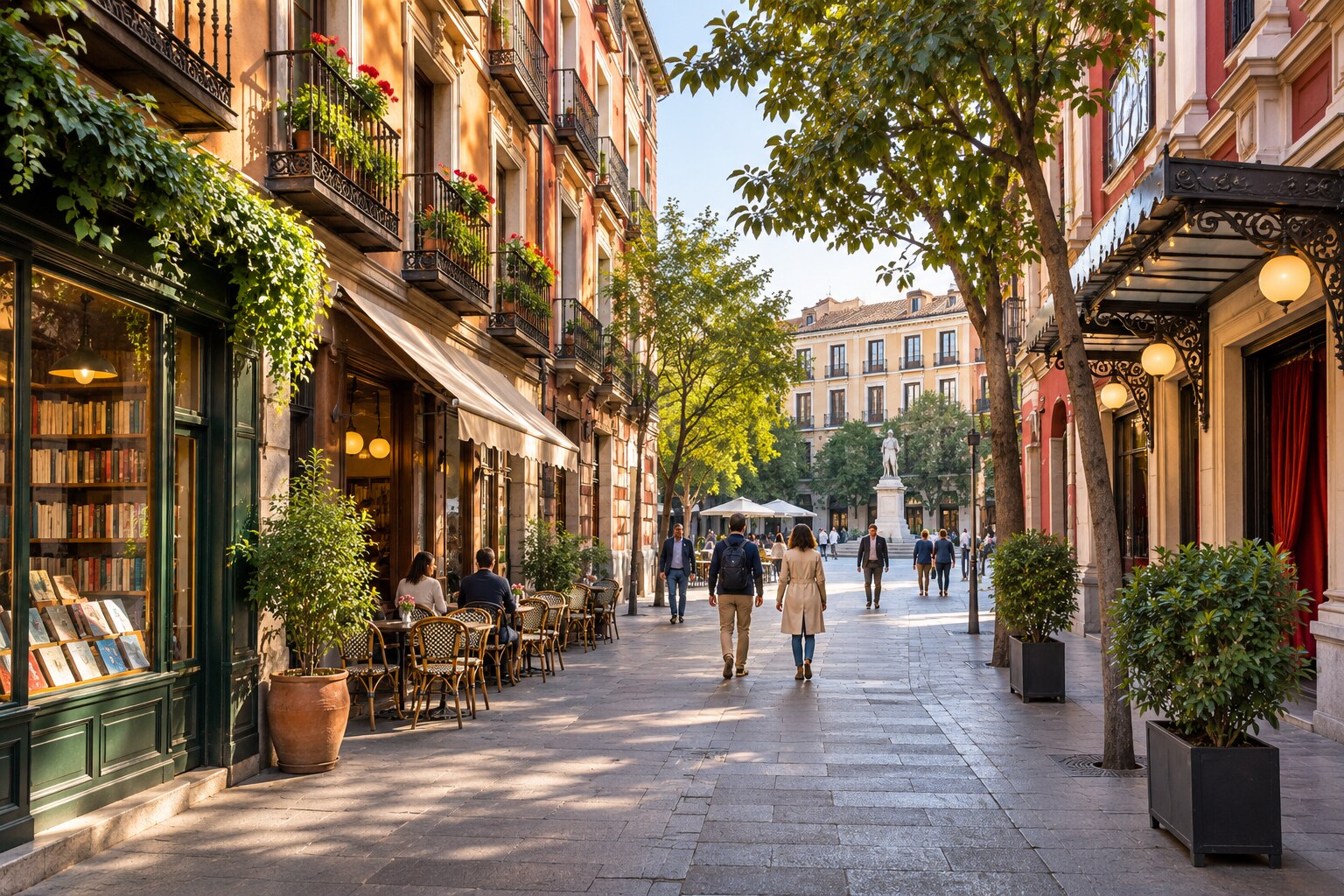
Madrid’s Barrio de las Letras is a compact district where literature is embedded in the street plan. Cervantes, Lope de Vega, Quevedo and other writers of Spain’s Golden Age lived or worked here, while old playhouses evolved into modern theatres. This self-guided Madrid Literary Quarter walk links the neighbourhood’s most meaningful public landmarks without turning the route into a checklist of plaques.
Allow 75–100 minutes for roughly 1.8 km. The streets are lively at lunch, in the evening and on weekends, so an early start gives you more space to notice façades, paving and small squares.
Why is it called the Literary Quarter?
The area between Plaza de Santa Ana and Paseo del Prado became closely associated with writers and theatres during Madrid’s seventeenth-century Golden Age. The official Madrid tourism guide to Barrio de las Letras traces the district’s connections with Cervantes, Lope de Vega, Quevedo, Tirso de Molina and Góngora.
For wider planning, compare a hosted introduction in our Madrid free walking tour guide, browse the free tour hub, or build a flexible independent route with the AI Tour Matcher and self-guided audio options.
Self-guided Barrio de las Letras route
1. Plaza de Santa Ana and Teatro Español
Begin in Plaza de Santa Ana, the social heart of the quarter. The statues of Calderón de la Barca and Federico García Lorca connect different periods of Spanish theatre. On the eastern side, Teatro Español descends from the Corral del Príncipe, one of the neighbourhood’s historic open-air playhouses. Read the square as a living stage: residents, theatre audiences and café terraces continually change its atmosphere.
2. Calle Huertas and words underfoot
Walk down Calle de las Huertas. Quotations from Spanish-language writers are set into the paving, turning the street into a fragmented anthology. Look down without blocking the pedestrian flow, then look up at balconies and old commercial fronts. The experience works even if you do not recognise every quotation: the point is that literature occupies ordinary public space.
3. Casa Museo Lope de Vega
Turn toward Calle Cervantes and the Casa Museo Lope de Vega, where the playwright lived for his final twenty-five years. The restored rooms and garden evoke domestic life in the Golden Age, but admission follows the museum’s current guided-visit and reservation rules. Check the official Lope de Vega House Museum page rather than assuming walk-in access. The exterior remains an essential stop even without a booking.
4. Convent of the Barefoot Trinitarians
Continue to Calle Lope de Vega and the Convento de las Trinitarias Descalzas. A commemorative plaque recalls that Miguel de Cervantes is buried within the convent. Keep the visit quiet and exterior-focused: this is a religious community, not simply a literary attraction.
5. Callejón del Gato and the distorted city
Loop back toward Calle de Álvarez Gato, popularly called Callejón del Gato. Its concave and convex mirrors are associated with the distorted vision of Madrid in Valle-Inclán’s Luces de Bohemia. The stop broadens the walk beyond the Golden Age and shows how later writers continued to reinterpret the same streets.
How to read the neighbourhood
- Street names: many preserve the memory of writers, theatres and older trades.
- Paving: literary quotations make the ground part of the narrative.
- Theatres: today’s venues continue a tradition of performance in the district.
- Private and sacred spaces: plaques often mark places that cannot be entered freely.
Practical tips
- Walk in the morning for quieter streets, or before an evening performance for more atmosphere.
- Use pedestrian crossings around Atocha and Carrera de San Jerónimo.
- Book the Lope de Vega House Museum in advance if an interior visit matters to you.
- Wear shoes with grip: polished paving can be slippery after rain.
- Keep voices low near the convent and never obstruct doorways for photographs.
Extend your Madrid day
Continue to Paseo del Prado or use our Perfect Madrid Day Guide to connect the route with other districts. For museums, performances and compatible activities, browse Madrid experiences.
FAQ
Is the Literary Quarter walk free?
Yes. The route follows public streets and squares. Museums and theatre performances have separate access conditions.
How long does the route take?
Plan 75–100 minutes, or half a day with the house museum, a performance or food stops.
Do I need Spanish to enjoy the walk?
No. Knowing Spanish adds meaning to the pavement quotations, but the urban history, theatres and façades are rewarding in any language.
Is the route step-free?
Most streets are paved and relatively level, but kerbs, busy crossings and uneven surfaces occur. Check individual museum accessibility before visiting.