
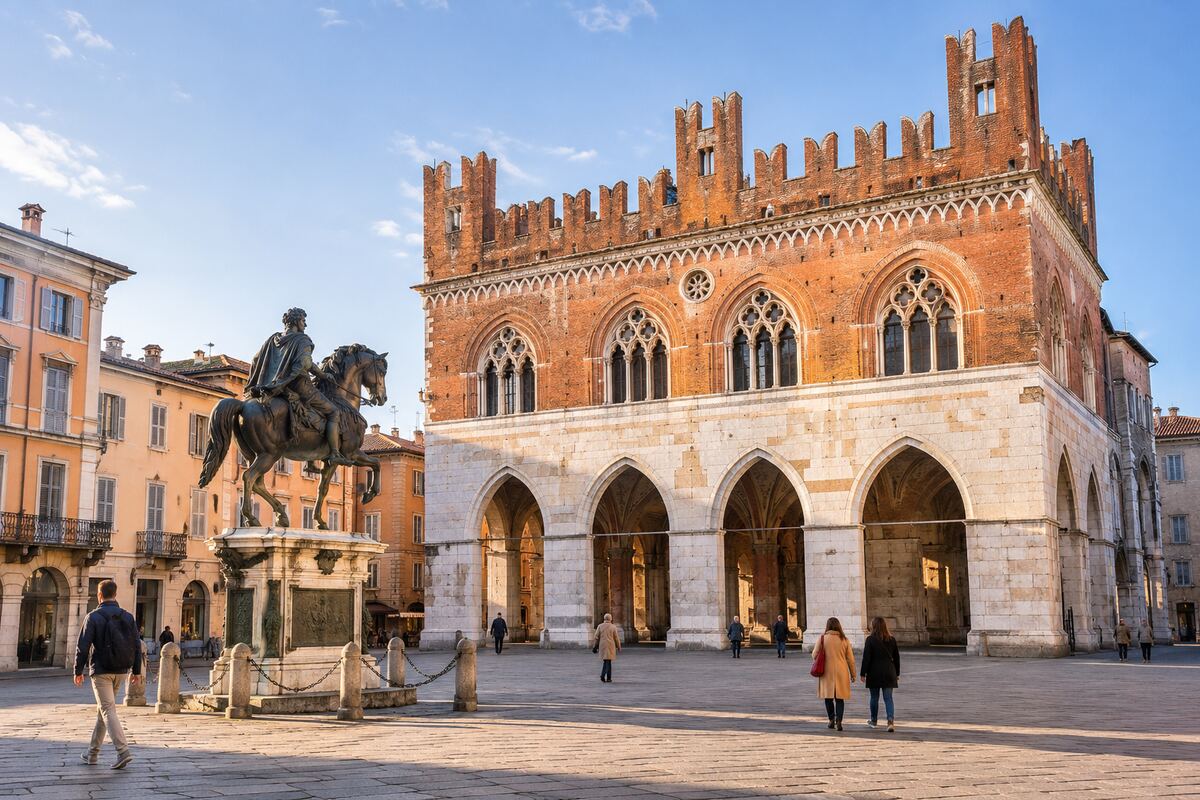
Piacenza rewards travellers who look beyond a single monument. Within a compact historic centre, Romanesque sculpture, medieval civic architecture, nineteenth-century Italian painting and the ambitions of the Farnese dynasty sit only a few streets apart. This self-guided art walk links the Cathedral, Piazza Cavalli, the Ricci Oddi Gallery and Palazzo Farnese in a route of about 2.5 kilometres.
Allow two hours for the outdoor walk, or four to five hours if you enter both main museums. Start with the Piacenza city page, then check museum and church hours on the day: exhibitions, services and events can change access.
Piacenza art walk at a glance
- Start: Piazza Duomo
- Finish: Palazzo Farnese, Piazza Cittadella
- Distance: about 2.5 km
- Walking time: 35–45 minutes without stops
- Recommended visit time: 4–5 hours with two museums
- Best for: medieval architecture, Italian painting and urban history
Step-by-step route
1. Cathedral: stone carving and the Guercino dome
Begin at the Cathedral of Santa Maria Assunta and Santa Giustina, built from 1122 to 1233. Its sandstone and pink Verona marble façade introduces the city’s Romanesque language. Look closely at the portal reliefs and, inside, the medieval guild plaques that record how local trades helped finance construction. The dome fresco cycle was begun by Morazzone and completed by Guercino in 1626–1627.
Entry to the cathedral is normally free. Respect services and use the ramped entrance through the Bishop’s Palace courtyard if stairs are difficult.
2. Piazza Cavalli and Palazzo Gotico
Walk north to Piazza Cavalli. The two equestrian monuments by Francesco Mochi stage Farnese authority in bronze, while Palazzo Gotico expresses an older civic power. Begun in 1281 for Alberto Scoto, the palace contrasts a white-and-pink marble loggia with an upper level of warm brick, pointed windows and battlements.
The great hall has been regularly visitable since June 2026, but it also hosts events. Ask the tourist office before building your day around interior access.
3. Ricci Oddi: modern Italian art and Klimt
Continue to Via San Siro for the Galleria d’Arte Moderna Ricci Oddi. Collector Giuseppe Ricci Oddi created the gallery as a public home for Italian figurative art from the late nineteenth and early twentieth centuries. Its collection includes works by Medardo Rosso, Previati, De Nittis, Boldini, Boccioni, Pellizza da Volpedo, Casorati and Carrà.
Gustav Klimt’s Portrait of a Lady returned to the gallery on 4 April 2026 after an exhibition in Seoul. The museum also introduced a 38-stop audio guide in 2026, useful for building a visit at your own pace. Confirm the work’s presence and current hours before travelling, because loans and installations can change.
4. Sant’Antonino and the Via Francigena
Walk to the Romanesque Basilica of Sant’Antonino. Its unusual octagonal tower and the so-called Porta del Paradiso connect art, pilgrimage and civic identity. The basilica was an important stop on the Via Francigena, reminding visitors that Piacenza developed as a crossroads rather than an isolated court city.
5. Palazzo Farnese and the civic collections
Finish at Palazzo Farnese, begun in 1558 and later developed under architect Vignola. The unfinished palace is itself a lesson in dynastic ambition. Its Civic Museums contain archaeological, medieval, arms, carriage, Risorgimento and picture-gallery sections.
Two objects deserve special attention: the Etruscan Liver of Piacenza, a rare bronze model connected with divination, and Botticelli’s round painting of the Madonna adoring the Child with the young Saint John. Do not rush every department; choose two or three sections and leave time to understand the building.
How to plan museum time
If you have half a day, enter Ricci Oddi and select one section at Palazzo Farnese. With a full day, add the Cathedral museum or a longer Palazzo Farnese visit. Monday closures are common, while special events can alter Palazzo Gotico access. Always verify official pages shortly before arrival.
Guided, audio and compatible options
Compare local walks through the Best Free Tour city finder. For a self-guided or audio-ready plan, use the AI Tour Matcher. You can also browse free tours in Italy and compatible experiences before fixing museum times.
Practical tips
- Wear comfortable shoes; the centre is compact but museum floors add distance.
- Photographing artworks may be restricted; follow each room’s signs.
- Keep voices low and shoulders covered in active churches.
- Book timed or special-access visits directly with the venue.
- Leave space for Piazza Cavalli near sunset, when brick and marble read especially well.
Frequently asked questions
Can I do the Piacenza art walk for free?
The streets, squares and cathedral can largely be enjoyed without charge, but Ricci Oddi and Palazzo Farnese require tickets. Check current concessions and free-entry initiatives.
Is Klimt’s Portrait of a Lady currently in Piacenza?
The gallery announced its return on 4 April 2026 after the Seoul exhibition. Verify the official news page before your visit in case of a new loan.
Which museum should I choose with limited time?
Choose Ricci Oddi for nineteenth- and twentieth-century painting. Choose Palazzo Farnese for a broader journey through archaeology, dynastic history and civic collections.
Is the route accessible?
The street section is mostly manageable, and the cathedral provides an alternative ramped entrance. Accessibility varies by museum section, so contact each venue for lifts, entrances and temporary restrictions.