
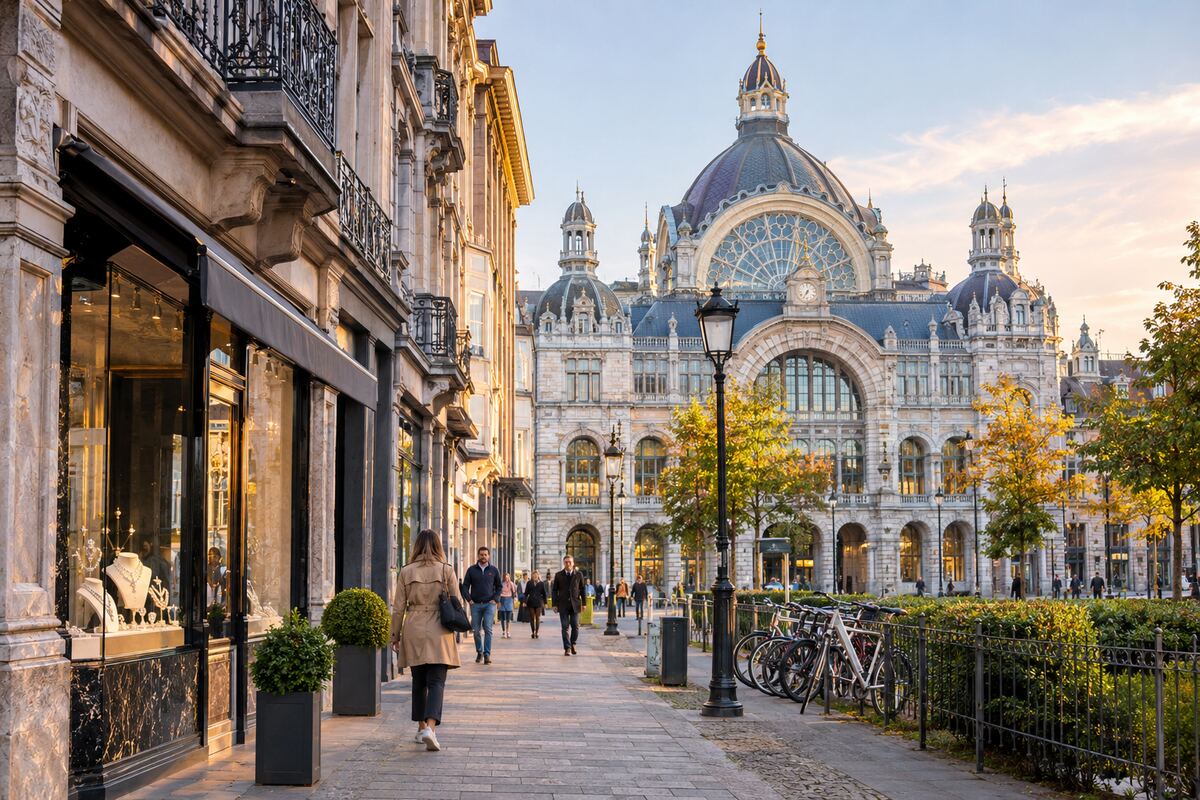
Antwerp makes a memorable entrance. Step off the train beneath the vast iron-and-glass roof of Antwerpen-Centraal and you are already inside one of the city’s great landmarks. From here, a compact first-day walk leads through the Diamond District, along the Meir, into the medieval lanes around the cathedral and finally to the Scheldt. This route is designed for travellers who want orientation, history and atmosphere without rushing between attractions.
Antwerp first-day walk at a glance
- Distance: about 4 km one way, depending on detours.
- Walking time: around 60 minutes; allow half a day with stops.
- Start: Antwerpen-Centraal.
- Finish: Het Steen and the Scheldt quays.
- Best for: first-time visitors, architecture fans and independent walkers.
Before setting out, open the Antwerp city page for current tour ideas and practical options.
1. Begin inside Antwerpen-Centraal
Do not hurry out of the station. Look up at the dome, the stone entrance hall and the soaring platform canopy. The building opened in 1905, while later works transformed a terminal station into a through station with tracks on several levels. The city’s official visitor site explains why locals call it the “railway cathedral”. Walk through the main hall, then step outside onto Koningin Astridplein for the full façade.
A useful arrival ritual
Take five minutes to identify the station entrances and tram stops before continuing. This makes the return journey easier and lets you appreciate the transition from monumental architecture to the busy streets of the station district.
2. Read the Diamond District without treating it as a showroom
Just west and south-west of the station lies Antwerp’s Diamond Square Mile. The district is still a working commercial area, so the interest is in its specialist windows, guarded exchanges and concentration of crafts and trade rather than in flashy architecture. Antwerp’s diamond story spans more than five centuries, linking merchants, cutters, designers and jewellers.
Stay on public streets, avoid photographing security points, and only enter shops if you genuinely want information or a purchase. For a deeper introduction, consider DIVA in the historic centre or the city’s official diamond walk.
3. Follow De Keyserlei and the Meir
De Keyserlei draws you west toward the Meir, Antwerp’s principal pedestrian shopping street. The route is direct, but keep looking above the shopfronts: elaborate façades and former town palaces reveal the city’s prosperity. The restored Stadsfeestzaal offers a grand interior break, while side streets provide calmer alternatives when the Meir is crowded.
Choose discovery over speed
This stretch is ideal for a guided introduction. Browse the available free walking tours, or use the AI Tour Matcher to compare a historical route with more specialised themes.
4. Enter the historic centre slowly
Continue via Groenplaats to the Cathedral of Our Lady and Grote Markt. The cathedral tower, guild-house façades and Brabo Fountain form Antwerp’s classic ensemble, but the best detail often hides between them. Walk around Handschoenmarkt, then look for the discreet entrance to Vlaeykensgang at Oude Koornmarkt 16.
This narrow passage dates from 1591. Once associated with modest dwellings and local cobblers, it survived twentieth-century demolition plans and is now a quiet pocket of courtyards, galleries and restaurants. Visit respectfully: it is small, partly residential in feel and quickly loses its charm when groups block the passage.
5. Add the Plantin-Moretus printing story
From Vlaeykensgang, Vrijdagmarkt is a short walk away. Here the Museum Plantin-Moretus occupies the historic home and workshop of a printing dynasty. It is the only museum inscribed on the UNESCO World Heritage List as a complete site of this kind, with early printing presses, archives, art and a courtyard that make book history tangible.
If you enter, check opening hours and tickets on the museum’s official website. If time is limited, the square and exterior still create a meaningful link between Antwerp’s commercial Golden Age and its culture of ideas.
6. Finish at Het Steen and the Scheldt
Walk north-west to Suikerrui and Het Steen, the riverside fortress that now houses a visitor experience. The Scheldt explains Antwerp’s scale and outlook: trade connected the city to the world, while the broad water still provides breathing space after the dense centre. Continue along the quays for open views, or time the finish for late-afternoon light.
Extend the walk independently
For more context at your own pace, choose a self-guided audio tour. You can also compare bookable Antwerp experiences, including museum and themed options, without changing the core walking route.
Practical tips for this Antwerp walk
- Wear shoes with reliable grip; cobbles and wet paving can be slippery.
- Start early on weekends if you want a quieter Vlaeykensgang and Grote Markt.
- Check official sites for museum hours, temporary works and access conditions.
- Keep the route flexible: Antwerp rewards short detours into side streets.
- Use trams for the return if your energy is better spent along the river.
Frequently asked questions
Can I do this Antwerp route in two hours?
Yes, if you mainly walk and pause briefly. Allow three to five hours for the station interior, lanes, a museum and a relaxed meal.
Is the walk suitable in rain?
Mostly yes. The station, Stadsfeestzaal and museums provide indoor breaks, but cobbles require care. A compact umbrella is useful.
Do I need a ticket for the main sights?
The streets, squares, Vlaeykensgang and quays are free. Museums and some interiors may require paid admission or timed booking.
Where is the best final viewpoint?
The Scheldt quays around Het Steen give an immediate river view. For a wider skyline, extend the trip through the pedestrian tunnel to Linkeroever.
Editorial research checked against official Antwerp visitor information for Antwerpen-Centraal, the Diamond District, Vlaeykensgang and Museum Plantin-Moretus on 15 November 2026. Always confirm live opening information before visiting.