
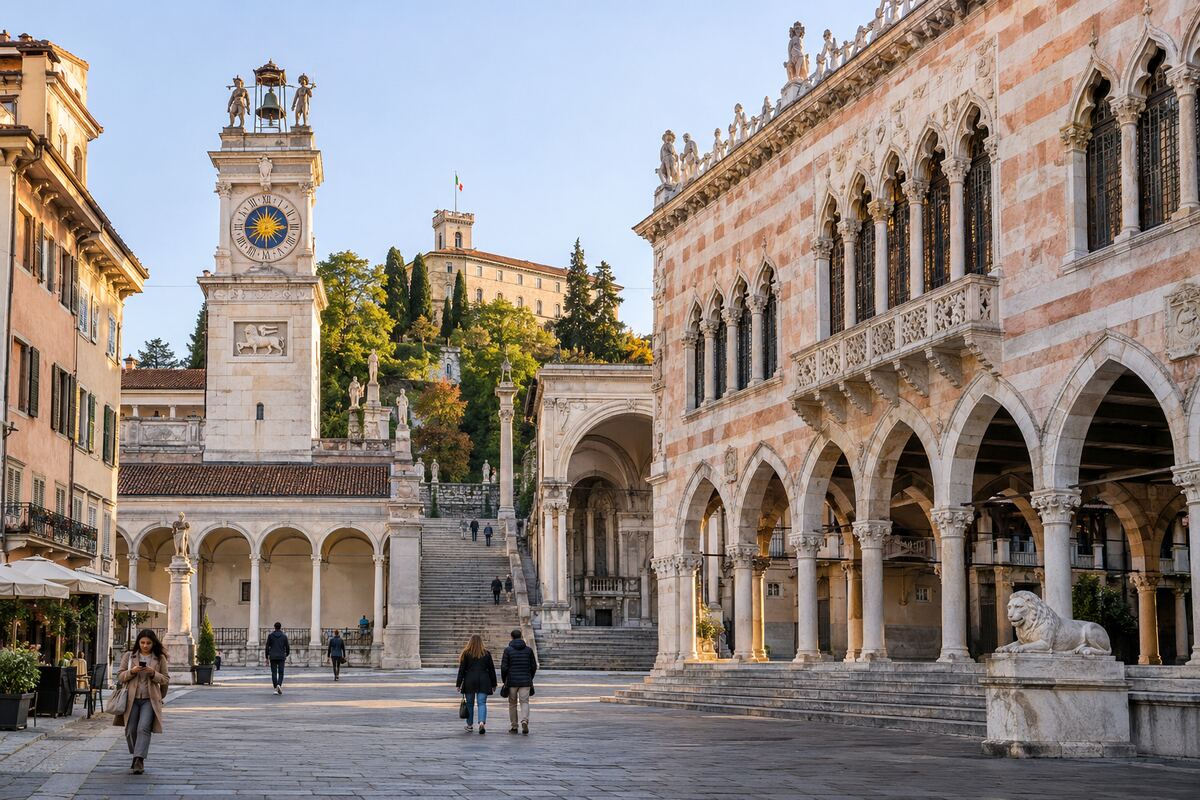
Udine is not Venice, yet the centuries of Venetian government are written clearly across its most beautiful square. Winged lions, arcades, a clock tower and pale stone lead the eye from Piazza Libertà toward the Castle hill. This compact walk links that civic stage with the city’s Friulian identity and the luminous frescoes of Giambattista Tiepolo. It is a practical first route for travellers who want architecture, art and local atmosphere without a long transfer.
Udine Venetian walk at a glance
- Distance: about 3 km, with short optional detours.
- Walking time: 45–60 minutes; allow half a day with museums.
- Start: Piazza Primo Maggio.
- Finish: Piazza Matteotti or the historic centre’s canals.
- Best for: first-time visitors, art lovers and independent walkers.
Check the Udine city page before setting out for current tour ideas and practical options.
1. Begin in Piazza Primo Maggio
Piazza Primo Maggio provides breathing space before the dense historic centre. From here the Castle hill is easy to recognise and the route begins gently. The official regional tourism site describes Udine as both refined and convivial: bookshops, osterias, art and everyday life sit close together. Walk toward the centre via the streets that frame the hill rather than rushing directly to the main monuments.
Notice the shape of the city
The hill is the visual anchor of Udine. Tradition links it to Attila, though the legend matters more as a local story than as archaeology. Keep the summit in sight: the route will spiral upward after Piazza Libertà.
2. Read Piazza Libertà as a Venetian stage
Piazza Libertà is the clearest expression of Udine’s Venetian face. The Loggia del Lionello, begun in the fifteenth century, uses alternating pale and pink stone, pointed arches and an open ground floor. Across the square, the Loggia di San Giovanni and Torre dell’Orologio create a theatrical counterpoint. The lion of Saint Mark and other civic symbols reveal how public architecture communicated authority.
Do not treat the square as a single photo stop. Walk around its edges, compare the arcades and look back from the steps toward Via Mercatovecchio. Morning light usually makes the stone easier to read; late afternoon gives the square a warmer, busier character.
Choose a guide for the details
Small sculptures and inscriptions are easy to miss. Browse the available free walking tours, or use the AI Tour Matcher to compare a general introduction with an art-focused route.
3. Climb through Arco Bollani to the Castle
Pass under Arco Bollani and follow the covered ascent beside the Loggia del Lippomano. The climb is short but stepped. At the top, Udine Castle occupies the site once used by the Patriarchs of Aquileia and later by Venetian lieutenants. Today it houses several civic collections, including archaeology, the Risorgimento, photography and ancient art.
Even without entering, the terrace gives useful orientation across the rooftops and toward the surrounding Friulian landscape. Travellers with reduced mobility can use the lift accessed from Vicolo Sottomonte; official museum information should be checked for current access and opening arrangements.
4. Descend toward the Duomo and the Oratorio della Purità
Return to the lower city and walk toward Udine Cathedral. Its history is layered, while the interior introduces another side of the city’s eighteenth-century art. Nearby, the Oratorio della Purità contains work connected with Giambattista Tiepolo and his son Giandomenico. Check access before visiting, because religious services and special closures can change availability.
Why Tiepolo matters here
Tiepolo’s Udine years helped establish the illusionistic space, bright colour and theatrical storytelling that later made him famous across Europe. Seeing his work close to the streets and patrons that shaped it gives more context than viewing a single canvas in isolation.
5. Enter the Patriarchal Palace and Tiepolo Galleries
The Museo Diocesano e Gallerie del Tiepolo occupies the Patriarchal Palace in Piazza Patriarcato. Official tourism information notes that the complex became the residence of the Patriarchs of Aquileia in the late sixteenth century and now preserves around seven hundred works. The highlights include Tiepolo’s frescoes on the Staircase of Honour, in the guest gallery and in the Red Room.
The Fall of the Rebel Angels, biblical narratives and the Judgement of Solomon show how painted architecture seems to open ceilings and walls. Allow enough time to look upward slowly. Confirm current hours and tickets on the museum’s official website rather than relying on an old timetable.
6. Finish with canals, Piazza Matteotti and an osteria
After the museum, follow a section of the old canals toward the medieval streets and Piazza Matteotti. The square works as Udine’s open-air sitting room, with the church of San Giacomo, cafés and local movement. This final stretch balances monumental art with daily life.
If you want more context without fixing a start time, choose a self-guided audio tour. You can also compare bookable Udine experiences, including cultural and food-focused options.
Practical tips
- Wear shoes with grip: the castle ascent includes steps and stone paving.
- Start early if you want quieter views in Piazza Libertà.
- Check official museum websites for hours, tickets and temporary closures.
- Use the Vicolo Sottomonte lift if stairs are unsuitable.
- Leave room for an unplanned stop in an osteria; this is part of Udine’s rhythm.
Frequently asked questions
Can I complete the route in two hours?
Yes if you mainly walk and make short stops. Allow three to five hours to enter the Castle Museums and Tiepolo Galleries.
Is Udine Castle difficult to reach?
The traditional ascent is short but stepped. A lift from Vicolo Sottomonte provides an alternative; check current access information.
Do I need museum tickets?
Piazza Libertà, the streets and castle terrace are free. Museum interiors require tickets or specific opening conditions.
When is the best time to walk?
Morning offers softer light and fewer people. Late afternoon is livelier and flows naturally into the local aperitivo tradition.
Editorial research checked on 16 November 2026 against official Friuli Venezia Giulia tourism and Comune di Udine information for Piazza Libertà, the Castle Museums and the Tiepolo Galleries. Confirm live opening details before visiting.