
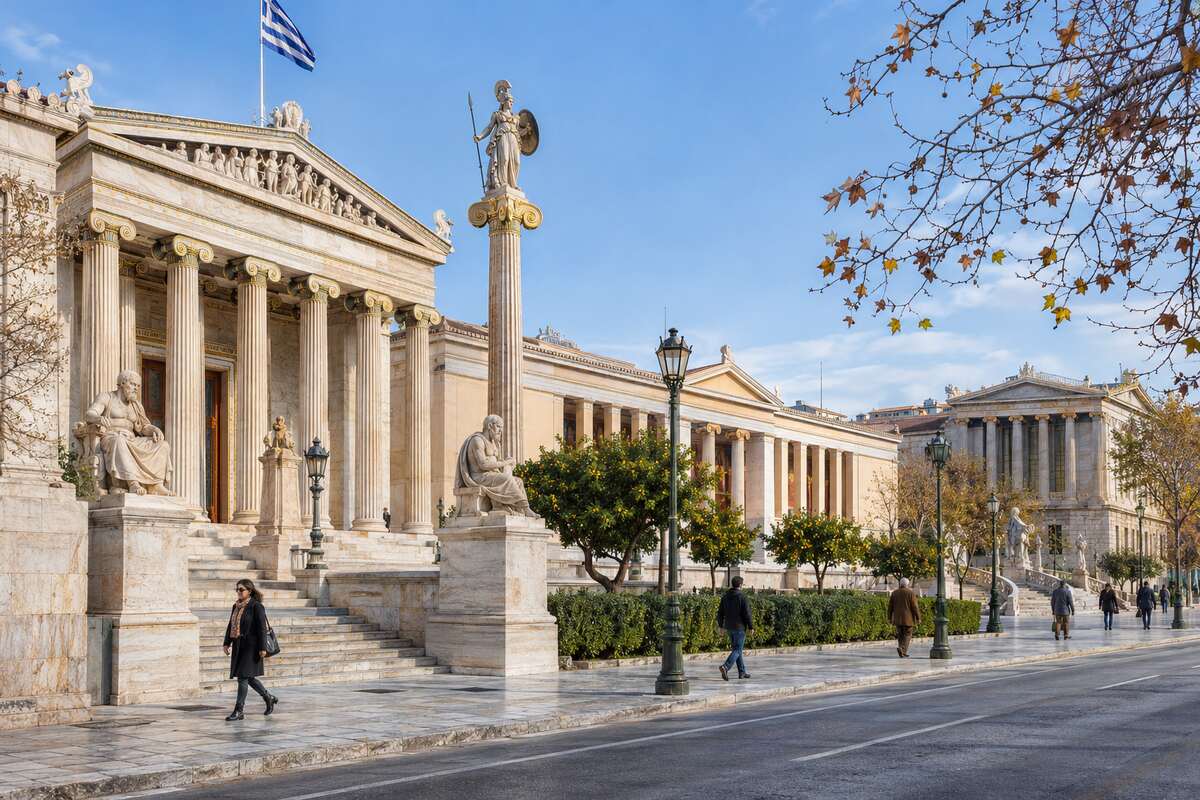
Most first-time visitors come to Athens for the Acropolis, yet the centre also tells the story of a young capital inventing a modern identity after Greek independence. This compact Athens neoclassical walk follows that transformation from Syntagma Square to the celebrated Academy–University–Library ensemble on Panepistimiou Street.
The route is roughly 2 km and takes about 60–90 minutes without museum visits. It works well before a free walking tour, or as a calm, self-guided introduction supported by Best Free Tour’s independent audio guides. Check individual venues before entering: several landmarks are primarily working institutions and exterior viewing is the most reliable option.
Why walk through modern Athens?
When Athens became the capital in 1834, planners and architects used neoclassicism to connect the new state with the ancient city. Columns, pediments and mythological sculpture were not merely decorative: they expressed education, civic authority and national ambition. The Official Athens Guide identifies the Academy, University and former National Library as the city’s “Neoclassical Trilogy”.
Athens neoclassical walking route
1. Syntagma Square and the Parliament façade
Begin at Syntagma metro station. Face the Hellenic Parliament and the Tomb of the Unknown Soldier, where the evzones stand guard. The hourly guard change is visible throughout the day; the fuller ceremonial change is normally held on Sunday at 11:00, but local restrictions or official events may alter access. Keep the square behind you and walk down Stadiou Street.
2. Old Parliament and Kolokotronis Square
At the Old Parliament, pause by the equestrian statue of Theodoros Kolokotronis. Greece’s official tourism portal proposes this stretch as part of an urban sculpture walk. Notice how the building’s measured symmetry differs from the monumental scale of the present Parliament.
3. Athens City Museum: the first royal residence
Continue to Paparrigopoulou Street. The Athens City Museum occupies two early houses; its official history explains that the 1834 residence at number 7 served as the palace of King Otto and Queen Amalia from 1836 to 1843. If you have time, the collection adds useful context about the city’s nineteenth-century transformation. Consult the museum’s official website for current opening hours and tickets.
4. Klafthmonos Square and Korai pedestrian street
Cross toward Klafthmonos Square, then use Korai Street to reach Panepistimiou. This short connector reveals the everyday city between the grand monuments: cafés, offices and university life. At Panepistimiou, turn left for the architectural climax.
5. Academy of Athens
The Academy is the most theatrical of the three buildings. The Academy’s official history credits Danish architect Theophil Hansen with the 1859 design, inspired by fifth-century BCE Athenian architecture. Athena and Apollo rise on tall columns, while Plato and Socrates sit below. The building is generally a working institution rather than a conventional attraction, so admire the sculptures from the forecourt unless an official visit has been arranged.
6. University of Athens
Next door, Christian Hansen’s University building was constructed between 1839 and 1864. Its H-shaped plan and painted portico combine ceremonial grandeur with a surprisingly human scale. The Official Athens Guide notes that it was the first university of the newly independent Greek state and the first in Southeast Europe.
7. The former National Library
Finish at the Vallianeion building, completed in 1902. Its double staircase and Doric façade form a memorable final view. The national collection moved to the Stavros Niarchos Foundation Cultural Centre in 2018, so do not confuse this landmark with the library’s main modern home. The old building’s function and public access can change; verify before planning an interior visit.
Practical planning
- Start: Syntagma metro station. Finish: Panepistimio metro station.
- Distance: about 2 km on mostly level pavements, with regular crossings.
- Best light: morning for the Academy façade; late afternoon for a warmer city atmosphere.
- Accessibility: the route is largely step-free, but pavement width and temporary works vary. The Official Athens Guide publishes an accessible version of the modern Athens itinerary.
- Transport: Syntagma and Panepistimio are on Metro Line 2; confirm live service information with OASA.
Make the walk part of a wider Athens day
Use the Greece destination page to continue planning, compare free tours in Athens and other cities, and browse compatible experiences. A good pairing is the National Garden and Panathenaic Stadium after lunch, or an Acropolis-area walk later in the day.
Frequently asked questions
Is the Athens Neoclassical Trilogy free to visit?
Viewing the façades and sculptures from the street is free. Interior access varies because the buildings remain institutional spaces; check official websites rather than assuming daily admission.
How long does the route take?
Allow 60–90 minutes for the walk and exterior stops. Add at least an hour if you visit the Athens City Museum.
Can I do the walk with children?
Yes. The distance is short, but Panepistimiou and Stadiou are busy avenues. Use marked crossings and keep younger children close.
What is the best starting point?
Syntagma is the clearest start because it connects the political centre with the nineteenth-century cultural axis and has excellent metro access.
Is this route suitable in summer?
Yes, but begin early, carry water and use shaded pauses. The route is urban and much of Panepistimiou is exposed to direct sun.