
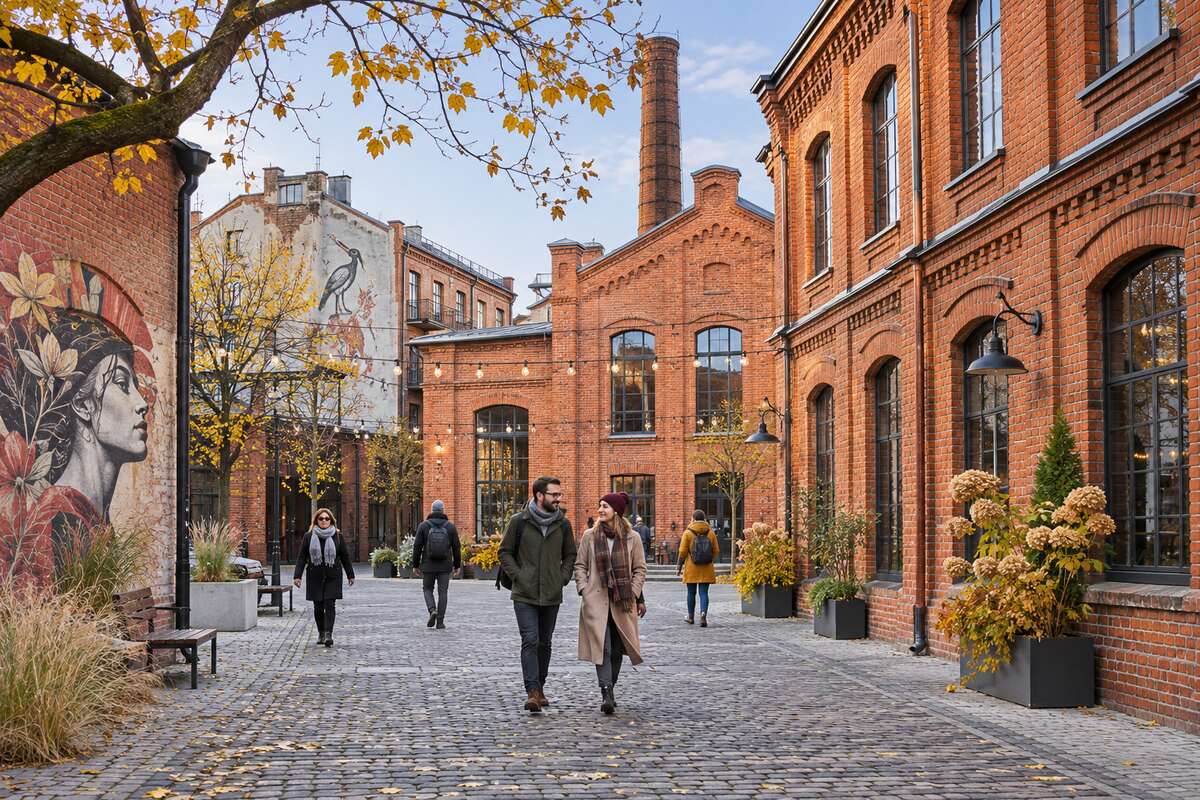
Warsaw’s right bank feels different from the rebuilt centre across the Vistula. In Praga, nineteenth-century tenements and former factories sit beside cafés, studios and murals. This self-guided walk follows a compact line from Dworzec Wileński to Ząbkowska Street and the red-brick Koneser complex.
Why walk through Praga?
Praga is a counterpoint to the Old Town. More of its street pattern and pre-war fabric survived, so the interest lies in the conversation between lived-in courtyards, revived industry and daily neighbourhood life. For wider planning, open our Poland page and the Warsaw three-day guide.
Route at a glance
- Start: Metro Dworzec Wileński.
- Finish: Centrum Praskie Koneser.
- Distance: about 2.5 km without museum detours.
- Time: two to three hours.
- Cost: free outdoors; museums charge separately.
The route is mostly level, but old paving and cobbles can be uneven. Check museum hours before setting out.
From Dworzec Wileński into Old Praga
St Florian’s Cathedral
From Plac Wileński, look for the twin spires of the Cathedral of St Michael the Archangel and St Florian. Its brick silhouette is a useful landmark and introduces the material repeated along the route. Continue south towards Targowa.
Praga Museum and Różycki Market
The Praga branch of the Museum of Warsaw explains the district’s growth through trade, migration and industry. Even without entering, slow down around Targowa. The nearby Różycki Market area is part of Praga’s commercial memory and remains a living place, not a staged attraction.
Ząbkowska Street: façades and courtyards
How to read the street
Look above shop level for balconies, patched brickwork, gates and traces of old advertising. Some courtyards are residential, so enter only where access is clearly public and keep noise low.
Street art without a checklist
Murals change over time. Rather than chasing a fixed list, notice how contemporary art shares walls with older plaster and brick. The walk still works when one artwork disappears or a façade is restored.
Koneser and Warsaw’s industrial past
The red-brick complex
The former vodka factory opened in the late nineteenth century and now houses restaurants, cultural spaces, offices and the Polish Vodka Museum. Walk through the public courtyards before deciding whether to add a ticketed visit.
A practical final stop
Koneser has seating, food options and a Warsaw Tourist Information point. Official tourism information describes step-free approaches from Ząbkowska and Nieporęcka, although cobbles elsewhere may still be awkward.
Planning your self-guided walk
Weekday mornings are calmer for architecture; late afternoon brings more neighbourhood life. In winter, start early because daylight is short. Use the official Go2Warsaw North Praga walk for current visitor details. You can also browse our self-guided audio tours, compare free walking tours, or find compatible local experiences.
Frequently asked questions
Is Praga safe to visit on foot?
The main daytime route around Targowa, Ząbkowska and Koneser is well travelled. Use normal city precautions and avoid poorly lit shortcuts late at night.
Can I walk it without entering museums?
Yes. It works as a free outdoor architecture and neighbourhood walk; both museums are optional paid additions.
Which metro stop is best?
Dworzec Wileński on line M2 is the most convenient start. Koneser is also a short walk from the station.
Is it wheelchair or pushchair friendly?
Distances are short and mostly level, but historic cobbles, kerbs and uneven paving can cause difficulty. Check each museum’s latest access details.