
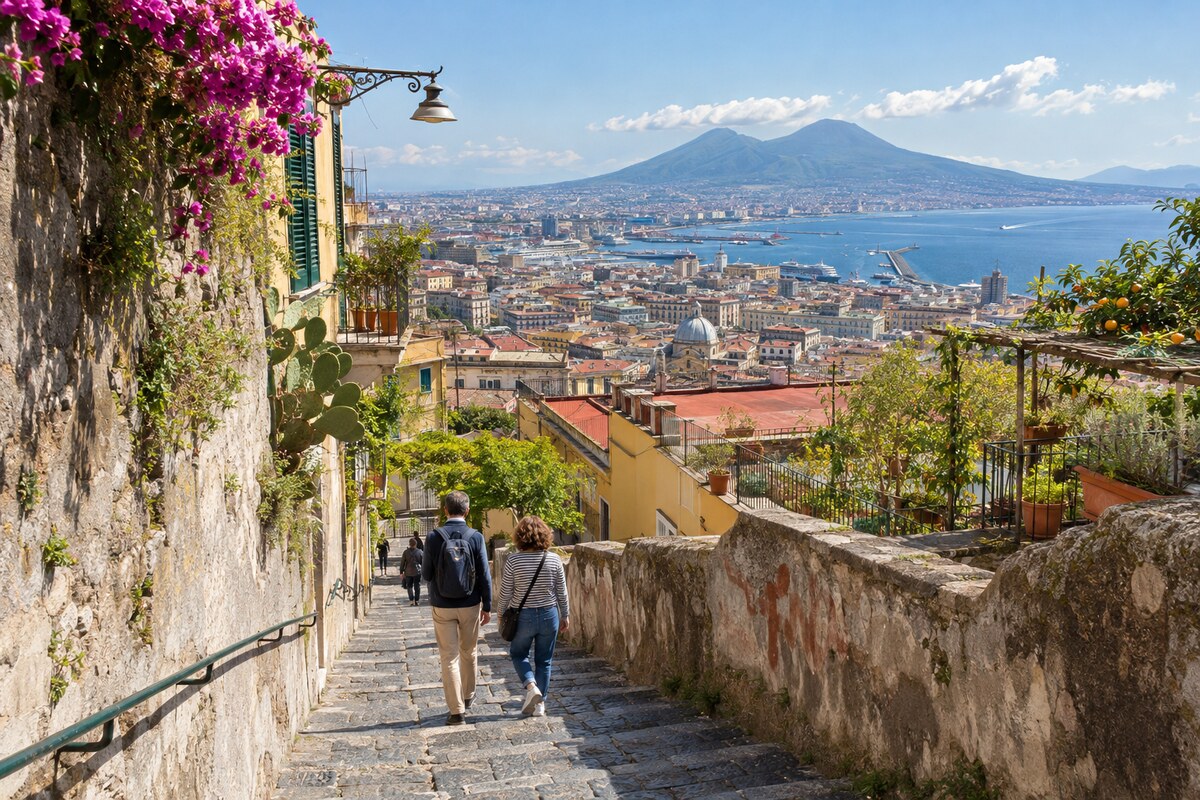
Naples is a vertical city. Hills, funiculars and stone stairways connect neighbourhoods that look close on a map but sit at very different heights. The Pedamentina di San Martino is one of the clearest ways to experience this geography: 414 historic steps descend from Largo San Martino towards Corso Vittorio Emanuele, with changing views over rooftops, the bay and Vesuvius.
This self-guided route deliberately goes downhill. You reach Vomero by funicular or metro, enjoy the panorama beside Castel Sant’Elmo and the Certosa di San Martino, then descend through the Pedamentina and continue towards Montesanto, Pignasecca and Via Toledo. Allow two to three hours without museum visits.
Why the Pedamentina is worth walking
The stairway is more than a shortcut. The City of Naples describes it as a historic and urban landmark approximately 640 metres long, paved in lava stone and edged by tuff walls, gardens and cultivated terraces. Its 414 steps connect San Martino with Corso Vittorio Emanuele and reveal how the hillside shaped everyday movement.
Visit Campania includes the descent in its official Toledo–Vomero itinerary. The route is free, but it is not step-free and can be tiring in the opposite direction.
Pedamentina route, step by step
1. Reach Vomero without spending your energy
Take the Central Funicular towards Piazza Fuga or Metro Line 1 to Vanvitelli, then walk through Vomero to Largo San Martino. Check the live ANM service page before leaving because maintenance and direct services can affect intermediate stops.
2. Pause at Largo San Martino
The terrace outside the Certosa and Castel Sant’Elmo is the best place to understand the route before starting. The historic centre spreads below, while the bay and Vesuvius form the horizon. If you plan to enter either museum, check the official opening information separately and add several hours.
3. Descend the 414 steps
From Largo San Martino, follow the Pedamentina signs downhill. The stone surface, bends and walls create a sequence of framed views rather than one continuous panorama. Walk slowly after rain: worn lava stone can be slippery, and residents use these stairs as a real neighbourhood connection.
4. Cross Corso Vittorio Emanuele
The Pedamentina reaches the long hillside avenue. From here, continue towards the monumental Montesanto stairways. Keep navigation open at junctions, as the network of ramps, lanes and staircases is less obvious than a single straight street.
5. Finish in Pignasecca or Via Toledo
End near Montesanto and the Pignasecca market for a lively neighbourhood atmosphere, or continue to Via Toledo for Metro Line 1 and the historic centre. This makes the walk easy to combine with lunch, a guided tour or an afternoon museum.
Practical advice and accessibility
- Direction: downhill is easier for most visitors; people with knee problems may prefer another route.
- Footwear: choose shoes with grip, especially after rain.
- Luggage: avoid wheeled suitcases, pushchairs and bulky bags.
- Timing: walk in daylight and avoid rushing at busy intersections.
- Respect: keep noise down, do not block doorways and remember that this is a residential passage.
The Pedamentina is not wheelchair accessible and is unsuitable for most mobility aids. Families with young children should use close supervision; a carrier is more practical than a stroller.
What to see before and after the stairs
At the top, the Certosa di San Martino and Castel Sant’Elmo explain the city from above. At the bottom, Montesanto and Pignasecca bring you back into dense street life. The official Visit Campania itinerary links these layers in one day, but a shorter version works well if your priority is the stairway itself.
Plan the rest of your Naples visit
Start with the Naples city page, then compare our Naples walking-tour guide. You can also unlock self-guided audio tours, find compatible free walking tours and add local experiences.
Visiting this place, or curious to discover more? Unlock your personal audio guide, then build the day around the best free tour and experiences for you.
Frequently asked questions
How many steps does the Pedamentina have?
The official municipal description counts 414 steps between Largo San Martino and Corso Vittorio Emanuele.
Is the Pedamentina free?
Yes. It is a public pedestrian connection. Museums at the top have separate tickets and opening times.
How long does the descent take?
The stairs alone can take about 20 to 30 minutes, but allow two to three hours for viewpoints, transport access and the continuation to Montesanto or Toledo.
Is it safe after dark?
Daylight is the better choice for first-time visitors because the surface is uneven and navigation becomes less clear. Check local conditions and do not walk while distracted by your phone.