
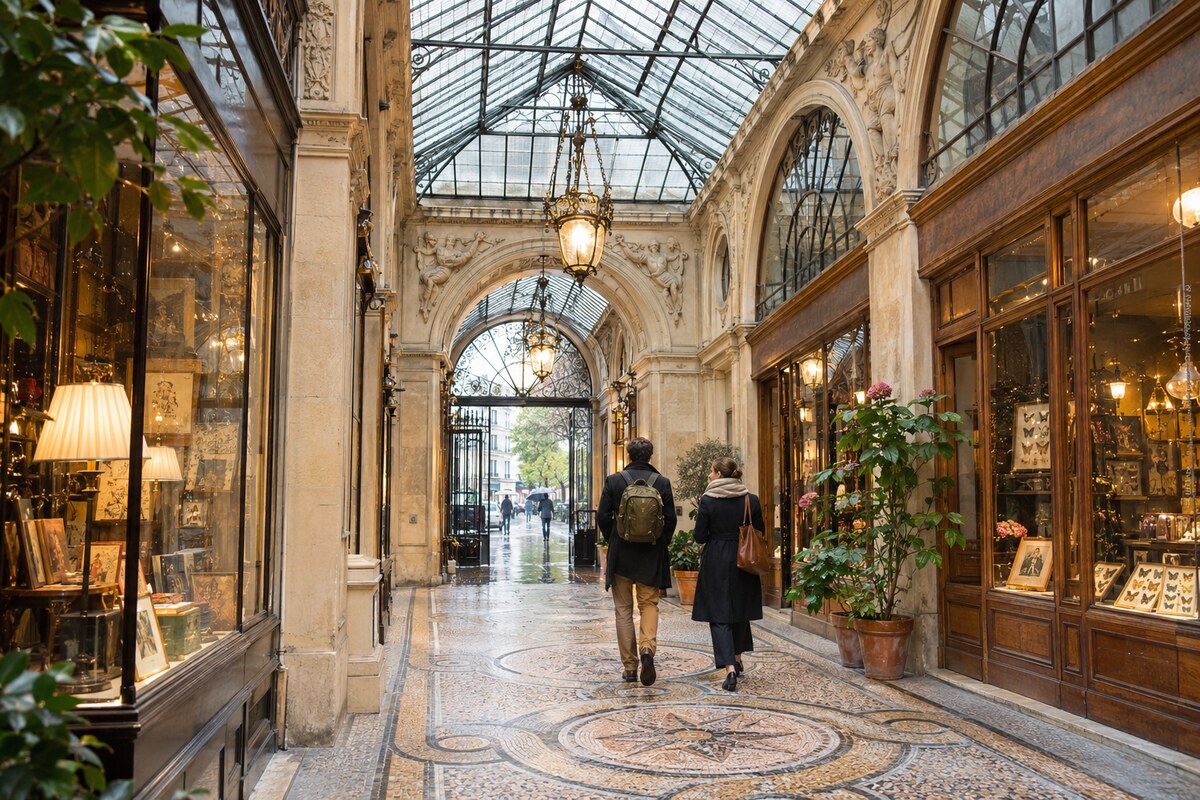
Paris rewards walkers even when the weather turns. This self-guided route links the elegant arcades around Palais-Royal with Galerie Vivienne, Passage des Panoramas, Passage Jouffroy and Passage Verdeau. Most of the experience unfolds beneath glass roofs, so it is a practical rainy-day walk as well as a compact introduction to nineteenth-century Paris.
Why Paris has covered passages
Covered passages appeared before the great department stores and Haussmann’s boulevards. They offered dry, illuminated shortcuts lined with shops, cafés, printers and curiosities. The City of Paris explains that the capital once had as many as 150 passages and galleries; around thirty survive today.
This route is about 2 to 2.5 kilometres. Allow 90 minutes for an unhurried walk, or two hours if you browse, stop for coffee or photograph architectural details. Access to the passages themselves is generally free, but individual doors and businesses follow their own schedules. Check current information on the day of your visit.
Paris covered passages route
1. Start at Palais-Royal
Begin near Palais Royal–Musée du Louvre station, served by Métro lines 1 and 7 according to RATP. Cross the Palais-Royal gardens and arcades slowly. Their sheltered colonnades set the scene for the commercial promenades that follow, while the courtyard gives you a useful open-air pause if the rain eases.
2. Galerie Vivienne: mosaics and measured elegance
Walk north towards rue des Petits-Champs and enter Galerie Vivienne. Inaugurated in 1826, it combines arches, pilasters, a glass roof and a richly patterned mosaic floor by Giandomenico Facchina. Look down as often as you look up: the floor’s symbols, the curved glass and the rhythm of the shopfronts are the real attraction.
Keep voices low and leave doorways clear. This is not a museum corridor but a working passage with residents, shops and cafés.
3. Passage des Panoramas: the oldest survivor
Continue towards the former Bourse district. Passage des Panoramas dates from 1799 and is widely described as the oldest surviving covered passage in Paris. The official Paris tourism office notes its 133-metre route, historic shopfronts and long association with collectors, printers and food businesses. Its branching galleries are part of the charm, but they can make the route feel less linear. Aim for the boulevard Montmartre exit.
Pause for the old Stern printing premises and period decorative details. Avoid turning the walk into a shopping checklist: the passage is most rewarding when you notice how architecture, commerce and movement share the same narrow space.
4. Passage Jouffroy: iron, glass and popular culture
Cross boulevard Montmartre carefully and enter Passage Jouffroy. Opened in 1847, it was the first Paris passage built entirely in iron and glass. Its stepped floor follows the terrain, while bookshops, specialist stores and the entrance to Musée Grévin give it a livelier character than Galerie Vivienne.
The glass canopy provides shelter, not climate control. On cold or wet days, stone and tile can feel slippery near entrances, so wear shoes with grip and do not rush.
5. Finish in Passage Verdeau
Continue across rue de la Grange-Batelière into Passage Verdeau. The atmosphere becomes quieter, with antique dealers, old books and photography-related shops. Exit towards rue du Faubourg Montmartre. From here, Grands Boulevards and Le Peletier stations are nearby, or you can continue on foot towards the Opéra district.
How to plan the walk well
Best time and weather
Late morning on a weekday is usually calmer than the lunch period or Saturday afternoon. The passages are useful in rain, but short outdoor sections remain between them, and boulevard crossings are exposed. Bring a compact umbrella rather than relying on the roofs for the entire route.
Accessibility and step-free alternatives
The route is mostly level, but it is not uniformly step-free. Passage Jouffroy follows a change in level, some thresholds are narrow, and older entrances may be awkward for wheelchairs or larger pushchairs. Conditions can change with works or private access. If step-free access is essential, check each passage individually and consider visiting Galerie Vivienne and Passage des Panoramas as separate out-and-back stops.
Responsible visiting
Photograph discreetly, never block a shop entrance and ask before taking close pictures of staff or interiors. Buy only when something genuinely interests you; browsing is welcome, but these arcades depend on real businesses rather than staged tourism.
Make it part of a Paris day
Before or after the walk, explore our Paris hidden gems guide and our Paris museums and attractions overview. To build a self-guided audio itinerary around your interests, start from the Best Free Tour audio matcher. You can also compare a free walking tour or browse compatible local experiences.
Frequently asked questions
Are the Paris covered passages free?
Yes, walking through the public passages on this route is generally free. Museums, cafés and purchases inside them are separate.
Can I do this route when it rains?
Yes. Most stops are covered, but the links between passages include outdoor pavements and road crossings. Carry a small umbrella and take care on wet floors.
How long does the route take?
Allow about 90 minutes for the walk itself and up to two hours with browsing or a café stop.
Do all passages keep the same hours?
No. Opening and closing times vary, and individual businesses keep separate hours. Check official information on the day rather than relying on old listings.
Would you like to hear more as you walk?
If you will visit these passages—or want to discover their stories in greater depth—unlock your personal Paris audio guide. Then pair it with a free walking tour and the experiences that fit your day.