
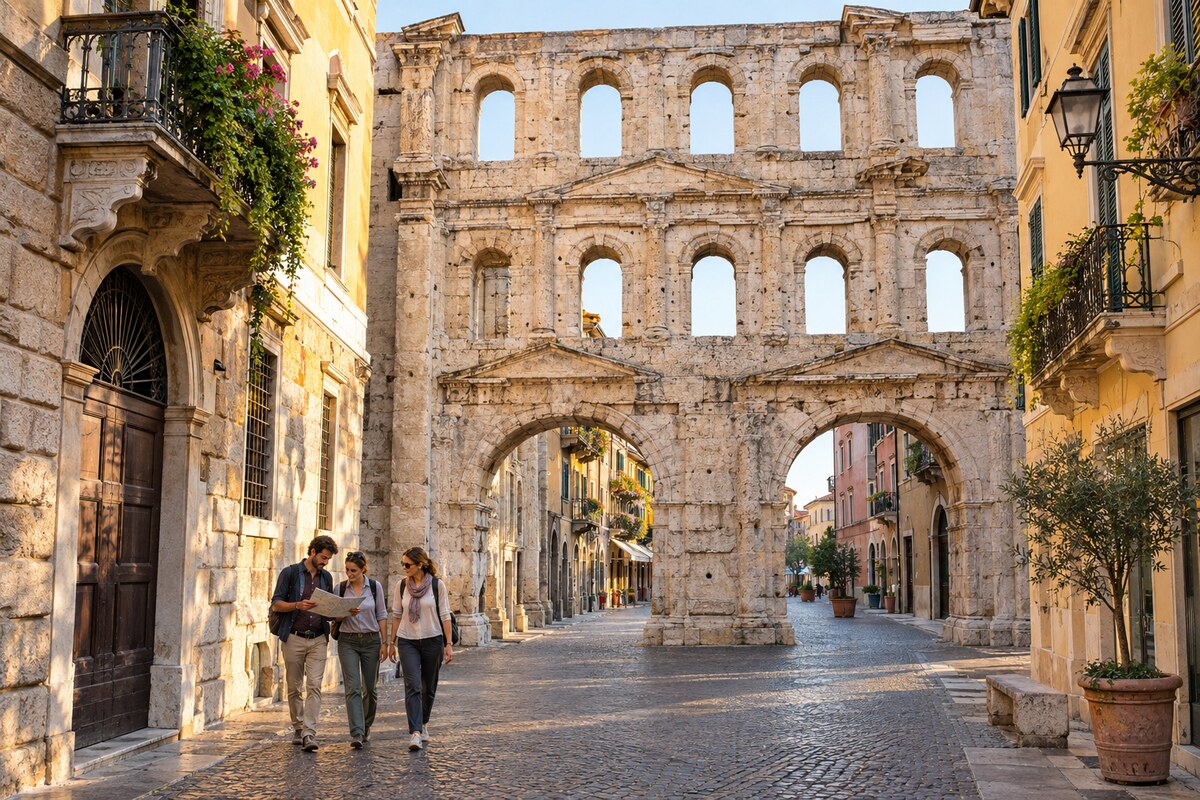
Verona’s Roman past is not confined to the Arena. Its street grid still follows the ancient city, monumental gates frame everyday shopping streets, and archaeological remains appear beside cafés and medieval palaces. This practical walk links the most important traces in about 3.5 kilometres. Allow around four hours if you enter the Arena and the Roman Theatre; the outdoor route alone can be completed in roughly two hours.
Why Roman Verona deserves a dedicated walk
Verona became a Roman municipium in the 1st century BCE and developed at a strategic crossing of the Adige. UNESCO describes its historic centre as one of northern Italy’s richest collections of Roman remains, incorporated into a city that evolved continuously for two millennia. The official Roman Verona itinerary rates the route easy and estimates 3.5 kilometres and about four hours.
The value of this walk is continuity. You are not moving between isolated ruins: the Roman cardo and decumanus still shape the centre, while later buildings reuse and reinterpret the ancient city.
Route at a glance
- Distance: approximately 3.5 km, excluding detours inside museums.
- Walking time: about 2 hours outdoors; 4 hours with visits.
- Difficulty: easy and mostly flat, with steps inside some monuments.
- Best starting point: Arco dei Gavi beside Castelvecchio.
- Finish: the Arena in Piazza Bra.
A step-by-step Roman Verona route
1. Arco dei Gavi: begin with a reconstructed landmark
Start beside Castelvecchio at the Arco dei Gavi, commissioned by the local Gavia family in the 1st century. The arch was dismantled during the Napoleonic period and rebuilt near its original area in the 1930s. Look at the paving beneath it: wheel ruts help make the ancient road tangible before you enter the historic centre.
2. Porta Borsari: the ceremonial entrance
Walk east along Corso Cavour to Porta Borsari. This elegant white-stone façade belonged to the main gate on the Via Postumia and dates to the 1st century CE. Only the external façade survives, but its two arches and tiers of windows still announce a monumental arrival. Stand back in the small square to read the structure before passing through.
3. Follow the decumanus to Piazza delle Erbe
Corso Porta Borsari continues the line of the Roman decumanus maximus. Piazza delle Erbe occupies the area of the forum, once the civic and commercial heart of the Roman city. The square now looks medieval and Venetian, yet its position explains why so many streets converge here. Nearby archaeological areas have limited or scheduled access, so check the municipal museum information before relying on an indoor stop.
4. Cross Ponte Pietra to the Roman Theatre
Continue towards the river and cross Ponte Pietra. The bridge has been rebuilt several times, most recently after wartime destruction, using recovered original material wherever possible. Across the Adige, the Roman Theatre climbs the hillside beneath the Archaeological Museum. The museum adds context through sculpture, inscriptions and finds from Roman Verona; allow at least an hour if you enter.
5. Return to Porta Leoni
Cross back into the centre and follow the ancient street grid to Porta Leoni. Part of the gate is embedded in a later building, while remains of its foundations and inner courtyard are visible below street level. It is less imposing than Porta Borsari but more revealing: the exposed layers show how the Roman city sits directly under the modern one.
6. End at the Arena
Finish in Piazza Bra at the Arena, built around the middle of the 1st century CE outside the Roman walls. Its elliptical design once accommodated about 30,000 spectators. Today it remains an active performance venue, so visits can be shortened or modified by opera and event installations. The official schedule currently lists Tuesday to Sunday opening, but always check the same day.
Practical planning
When to go
Begin early in the morning for quieter views at Porta Borsari and Piazza delle Erbe. The route is pleasant year-round, but summer heat and evening crowds around the Arena can slow the final section. Monday is a poor choice for museum interiors because several civic sites normally close.
Tickets and reservations
The streets, gates, bridge and exterior of the Arena are free to see. Entry to the Arena and the Roman Theatre–Archaeological Museum is ticketed. Combined municipal tickets and the Verona Card may be available, but inclusions can change; verify them on official channels rather than buying around an outdated plan.
Accessibility and families
The outdoor route is largely level and works well with children. Historic paving and crowded lanes require attention, while the theatre complex includes slopes and steps. Porta Leoni’s below-street remains can be viewed from the pavement, making it a useful short stop even for visitors who do not enter museums.
Responsible visiting
Do not climb on exposed masonry or place bags on ancient stone. Keep passages clear at the gates, which remain part of busy streets, and remember that Ponte Pietra is shared with residents and other visitors.
Continue exploring Verona
Start with the Verona city page, then compare this ancient-city route with our Adige and Castel San Pietro walk. For wider planning, use the Verona travel guide, browse free walking tours and explore compatible experiences. Independent audio-guide options, when available, are useful for controlling your pace between the Roman stops.
Frequently asked questions
Can I see Roman Verona without buying a ticket?
Yes. Arco dei Gavi, Porta Borsari, Piazza delle Erbe, Ponte Pietra and Porta Leoni can all be appreciated outdoors. Tickets are needed for the Arena interior and the Roman Theatre–Archaeological Museum.
How long does the route take?
Allow about two hours for the outdoor walk or roughly four hours with the two principal ticketed interiors.
Is the Arena always fully open?
No. Performances, rehearsals and installations can restrict access, especially from spring to autumn. Check the official Arena page on the day of your visit.
Where is the best place to start?
Arco dei Gavi is a logical start because it leads naturally along Corso Cavour to Porta Borsari and finishes at the Arena without backtracking.
Is this route suitable in the rain?
Yes, although the stone paving can become slippery. Porta Borsari, Porta Leoni and the Arena exterior remain easy to reach, while museum visits provide indoor breaks.
Walk through two thousand years of Verona. Use an independent audio guide at your own pace, then add a free walking tour or a compatible experience to complete the day.