
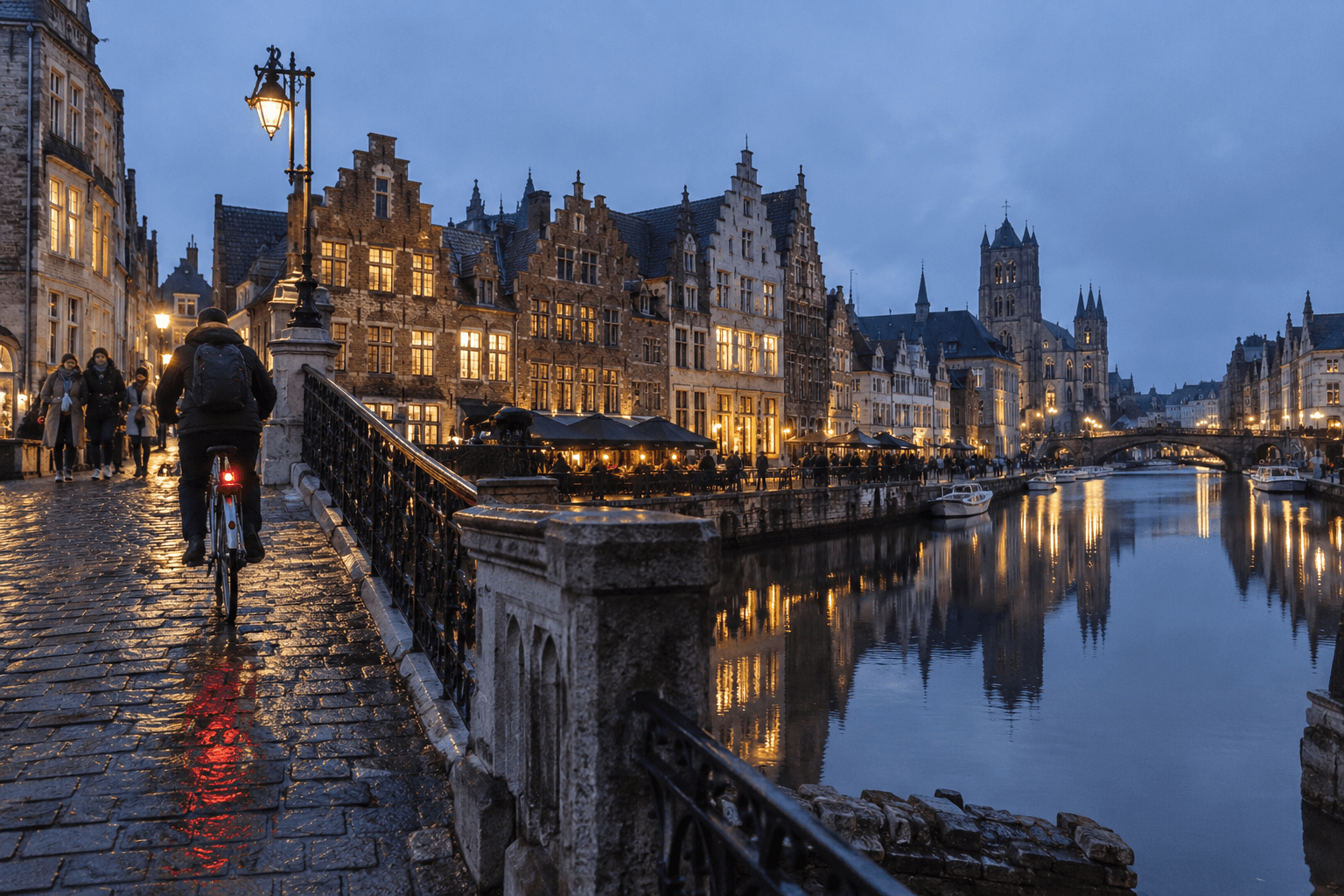
Ghent rewards travellers who refuse to hurry. Its medieval towers draw the eye first, but the city becomes memorable in the transitions: a quiet lane behind a guild house, a bicycle slipping past a canal, a piece of street art appearing between old brick walls. This route connects the monumental centre with the lived-in city.
A half-day walking route through Ghent
Allow three to four hours. Begin at Saint Michael’s Bridge, where the towers of Saint Nicholas’ Church, the Belfry and Saint Bavo’s Cathedral line up across the historic centre. Morning offers softer light and fewer people; late afternoon brings reflections and warm façades along the water.
1. Korenlei and Graslei
Descend to the Leie and walk between Korenlei and Graslei. The façades belonged to guilds and merchants, but the quays now work as Ghent’s shared living room. Pause without blocking the narrow paths, then cross one of the bridges to see the architecture from both banks.
2. Korenmarkt, Belfry and Saint Bavo’s Cathedral
Continue through Korenmarkt toward the Belfry. The compact group of civic and religious buildings tells the story of a city shaped by trade, textile wealth and urban independence. If you enter the cathedral or climb the Belfry, check current opening hours and ticket conditions before your visit.
3. Werregarenstraat and Vrijdagmarkt
For a deliberate contrast, detour to Werregarenstraat, the legal graffiti alley. Its appearance changes constantly, so treat it as a living space rather than a permanent gallery. From there, continue to Vrijdagmarkt, a broad square with a long commercial and political history.
4. Patershol
Finish in Patershol. Narrow streets and irregular plots reveal the older scale of Ghent, while small restaurants bring evening life to the district. Walk slowly and remember that people live behind the photogenic doors.
What to eat on the way
Try cuberdons if you enjoy a very sweet raspberry-flavoured candy, or look for Gentse neuzen, their local nickname. For something savoury, order waterzooi, a creamy stew traditionally made with chicken or fish. Ghent is also known for a strong vegetarian culture, making it easy to build a lighter lunch into the walk.
Practical planning
- Arrive by train: trams connect Gent-Sint-Pieters station with the centre.
- Respect cycle lanes: bicycles move quickly and often have priority.
- Check the low-emission zone: drivers should verify registration and access rules on the city’s official website.
- Consider CityCard Gent: compare the current inclusions with the museums and transport you genuinely plan to use.
Continue planning your Belgian trip
Browse the Belgium destination page, create a route around your starting point with the AI Tour Matcher, compare free walking tours, or explore traveller-led ideas on EXPERIENCE.
Frequently asked questions
Can Ghent’s centre be explored on foot?
Yes. The main historic sights are close together, although cobbles and bridges can slow the route.
Is Werregarenstraat suitable for children?
It is a public lane and generally easy to visit, but the artwork changes and may include mature themes.
How much time is enough for Ghent?
A half-day covers this route; a full day allows time for museums, a boat trip or a slower meal.
Is the route free?
The streets, quays and squares are free. Individual monuments and museums may charge admission.
Official sources
Planning details were checked with Visit Gent and the City of Ghent low-emission-zone guidance. Opening hours and access conditions can change, so verify them before departure.