
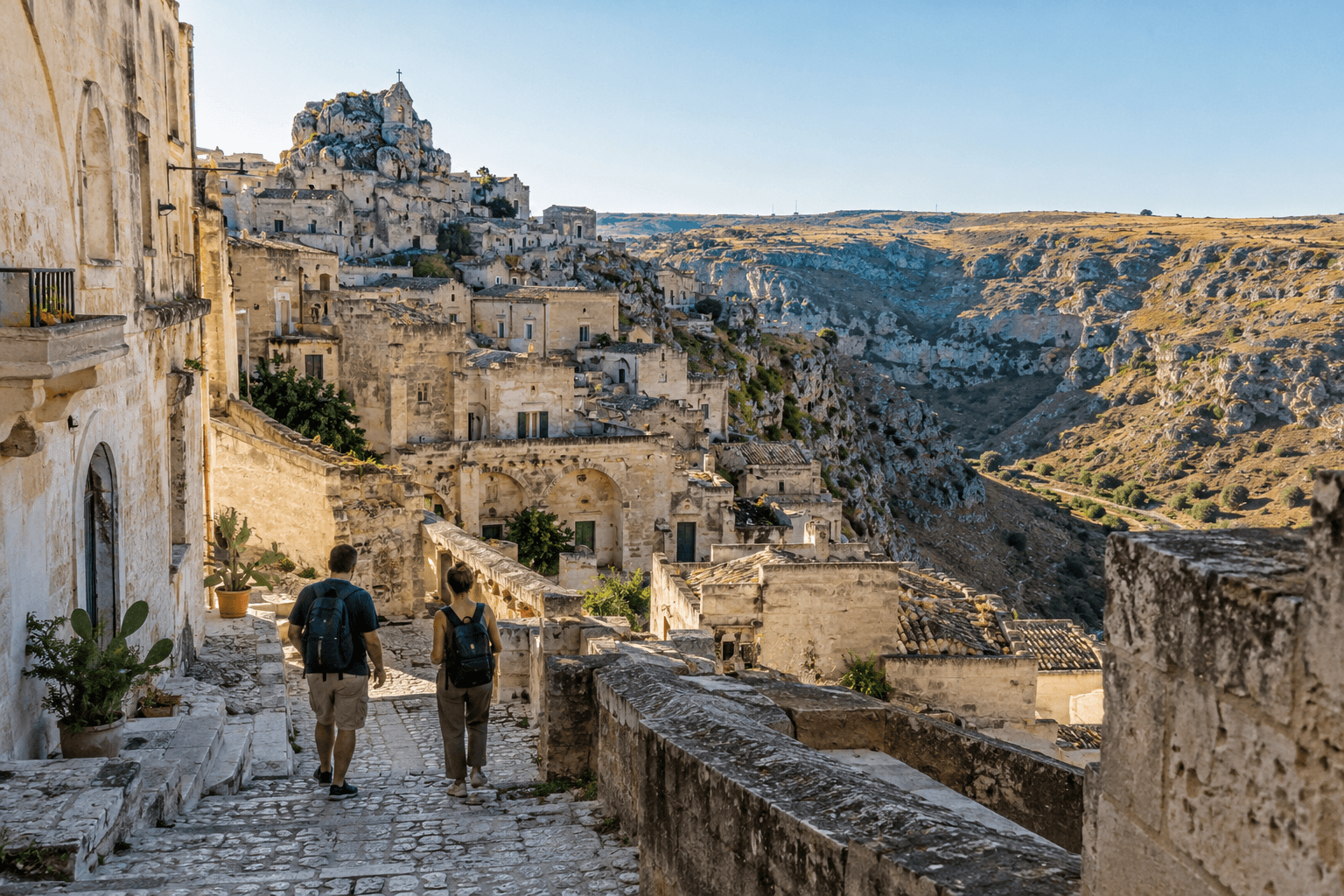
Matera does not reveal itself from one square. Its streets sit on roofs, stairways become viewpoints, and carved rooms continue behind façades that look ordinary from outside. The best first walk is therefore not a list of monuments but a descent and ascent through the three connected landscapes of Sasso Barisano, Civita and Sasso Caveoso.
Matera walking route: time, slopes and orientation
Allow four to six hours for a slow circuit of roughly five kilometres. The distance is modest, but stone steps, polished surfaces and repeated climbs make it more demanding than a flat city walk. Start in daylight, carry water and avoid scheduling every cave church or museum back-to-back.
Begin above Sasso Barisano
Start near the modern centre and approach Sasso Barisano from an upper viewpoint. Before descending, identify the ravine, the cathedral ridge and the mass of stone dwellings below. This overview explains why maps can be misleading: a street that appears close may sit several levels above or below you.
Descend instead of chasing shortcuts
Follow signed public lanes and let the neighbourhood unfold gradually. Barisano contains restored homes, workshops and hospitality spaces alongside traces of older water collection and cave living. Enter one carefully interpreted site rather than several repetitive displays; the aim is to understand how rooms, cisterns and shared spaces worked together.
Cross the Civita ridge
Climb towards Civita, the oldest elevated nucleus between the two Sassi. Around the cathedral, the city opens in both directions. Pause to look back at Barisano before turning towards Caveoso. The contrast is useful: one side feels denser and more built, while the other exposes caves and the edge of the ravine more clearly.
Explore Sasso Caveoso with restraint
Choose one rupestrian church
Caveoso is the right place to visit a rock church, but access, conservation rules and opening hours vary. Choose according to current official information and respect photography restrictions. These spaces are not generic caves: paintings, liturgical use and changes over centuries require more attention than a quick stop.
Walk towards the quieter edges
Continue through lanes where the inhabited city gradually meets bare rock. Do not enter closed cavities or cross barriers for a photograph. The fragile landscape and private homes deserve the same care as formal monuments. A viewpoint towards the Murgia plateau is enough to understand the relationship between settlement, ravine and countryside.
Where to pause for food
Matera’s cuisine suits a walking day: bread, focaccia, pulses, vegetables, cheeses and simple pasta dishes can form a satisfying lunch without slowing the route too much. Look for pane di Matera, crapiata when available, or a plate using local peperoni cruschi. Choose a shaded table away from the busiest viewpoint and check opening times, especially outside peak season.
Should you cross to the Murgia?
The opposite plateau offers exceptional views, but it is a separate outing rather than an improvised extension. Trails involve exposed terrain, uneven ground and heat. Use an official access point, check conditions and consider a guide or transport if you are not equipped for hiking. The city walk remains complete without crossing the ravine.
Create a tour around your pace
Use the AI Tour Matcher to adapt Matera to your starting point, interests and mobility. Compare free walking tours and autonomous audio guides, then add compatible food or cultural activities from Experiences.
Practical advice
- Wear shoes with grip; smooth limestone becomes slippery when wet.
- Carry water and sun protection, especially from late spring to early autumn.
- Ask before photographing residents or private interiors.
- Check tickets and opening times for rock churches on the day.
Frequently asked questions
Can I visit Matera’s Sassi in one day?
Yes. A focused route through Barisano, Civita and Caveoso works well, provided you allow time for climbs and pauses.
Is Matera suitable for limited mobility?
The historic terrain is challenging. Some viewpoints and attractions are accessible by road, but a tailored route and current accessibility information are essential.
Which Sasso should I visit first?
Barisano offers a gradual introduction from the modern centre; Caveoso gives a more exposed relationship with the ravine. The sequence in this guide connects both.
Where can I verify current information?
Consult the Basilicata tourism board, the Municipality of Matera and the UNESCO World Heritage listing. Information checked on 25 September 2026.