
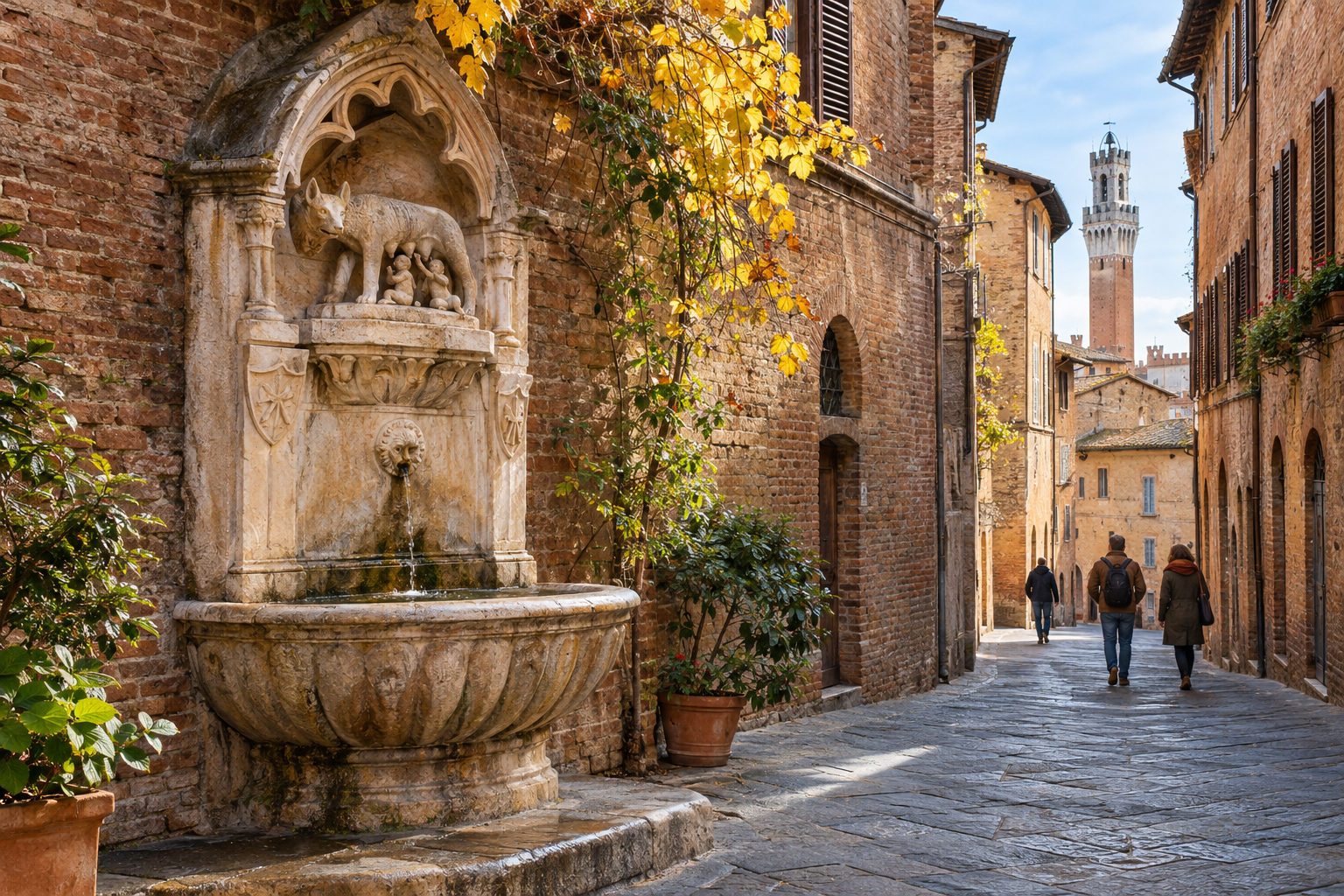
Siena is often introduced through Piazza del Campo and the Palio, but its deepest urban story is written in seventeen neighborhoods called Contrade. Each has an emblem, an oratory, social spaces, a museum and a small ceremonial fountain. This self-guided walk connects public monuments with quieter lanes while explaining how to explore a living community respectfully.
Allow about 2½ hours for the outdoor route, longer if a Contrada museum is open. Begin with the Siena city page, and use a phone-based route or your preferred self-guided audio app so you can pause without blocking narrow streets.
Why the Contrada fountains matter
Siena’s historic center is divided into seventeen Contrade whose boundaries were formalized in 1729. The small neighborhood fountains are more recent: the idea developed in the twentieth century, yet they have become central symbols of belonging. Water is used in a civic “baptism” that welcomes children into their Contrada. The official Visit Siena guide to the fontanine explains their role and identifies them as a network of seventeen fountains.
These are not decorative checkpoints or a scavenger hunt. They belong to communities that meet, celebrate and care for their streets throughout the year. Observe the sculpture and emblem, keep voices low near oratories and never enter a private courtyard simply because a door is open.
A practical walk from civic water to neighborhood identity
1. Fonte Gaia in Piazza del Campo
Start at Fonte Gaia, the monumental fountain on the upper side of the Campo. Its current marble reliefs are copies; the original sculptures by Jacopo della Quercia are preserved at Santa Maria della Scala. Access to the square and fountain is free and step-free, as confirmed by the Comune di Siena. Arrive early to read the basin and figures before the square fills.
2. Civetta and Leocorno: compact streets, distinct symbols
Walk through Via del Porrione and the San Martino district. Around Castellare degli Ugurgieri, the Civetta (Owl) fountain turns its emblem into a recognizable neighborhood marker. Continue toward the Leocorno (Unicorn) territory near Piazzetta Virgilio Grassi. The short distance makes the contrast clear: every fountain speaks a different visual language, while brick façades and sloping lanes keep the route unmistakably Sienese.
3. Torre and Valdimontone: look beyond the race
Descend toward Salicotto and the Torre (Tower), then continue toward the Valdimontone (Ram). Notice how plaques, colors and animal emblems define territory without conventional street barriers. Contrada museums protect banners, costumes, sacred furnishings and the painted drappelloni won at the Palio. The city’s official guide to Contrada headquarters and museums notes that each headquarters brings together museum, oratory and social club. Opening is often by appointment or on special dates, so check the individual Contrada before visiting.
4. Fontebranda and the Oca
Finish downhill at Fontebranda, one of Siena’s best-known medieval water structures, in the territory of the Oca (Goose) and close to the house of Saint Catherine. This final stop reveals the useful side of water: the large covered basins once supported daily life and crafts, unlike the symbolic twentieth-century fontanine. The climb back toward the center is steep, so take it slowly or use local transport from the lower city.
Make the walk work for you
- Best time: weekday mornings, when lanes are calmer and details are easier to see.
- Footwear: choose shoes with grip; stone paving becomes slippery after rain.
- Accessibility: Piazza del Campo is relatively straightforward, but Fontebranda involves steep gradients and uneven paving.
- Museum visits: never assume daily opening. Contact the Contrada or use the official listings first.
- Palio periods: community activities take priority. Follow barriers and local instructions.
On 14 November 2026, the “A Spasso per San Martino” initiative is scheduled to open seventeen historic sites in the San Martino district free of charge from 15:30 to 18:30, including several Contrada oratories and museums. Check the Fondazione Musei Senesi announcement before traveling in case details change.
Continue exploring Siena and Tuscany
For a broader first visit, pair this route with the Siena walking guide. You can also compare guided options through Best Free Tour and browse free tours in Italy. If you want a compatible day trip, the Monteriggioni itinerary extends the medieval theme without repeating Siena’s Contrada story.
FAQ
Can I visit all seventeen fountains in one day?
Yes, but a complete circuit is better treated as a half-day walk. This shorter route prioritizes variety and leaves time to understand each stop.
Are Contrada museums free?
Rules vary. Some open on special occasions, some request a donation and others require advance contact. Verify directly with the relevant Contrada.
Is this route suitable during the Palio?
It is physically possible, but access and local activity can change significantly. Respect closures and avoid treating preparations as a tourist performance.
Do I need a guide?
No. A self-guided visit works well outdoors, while a local guide adds valuable context about boundaries, symbols and etiquette.