
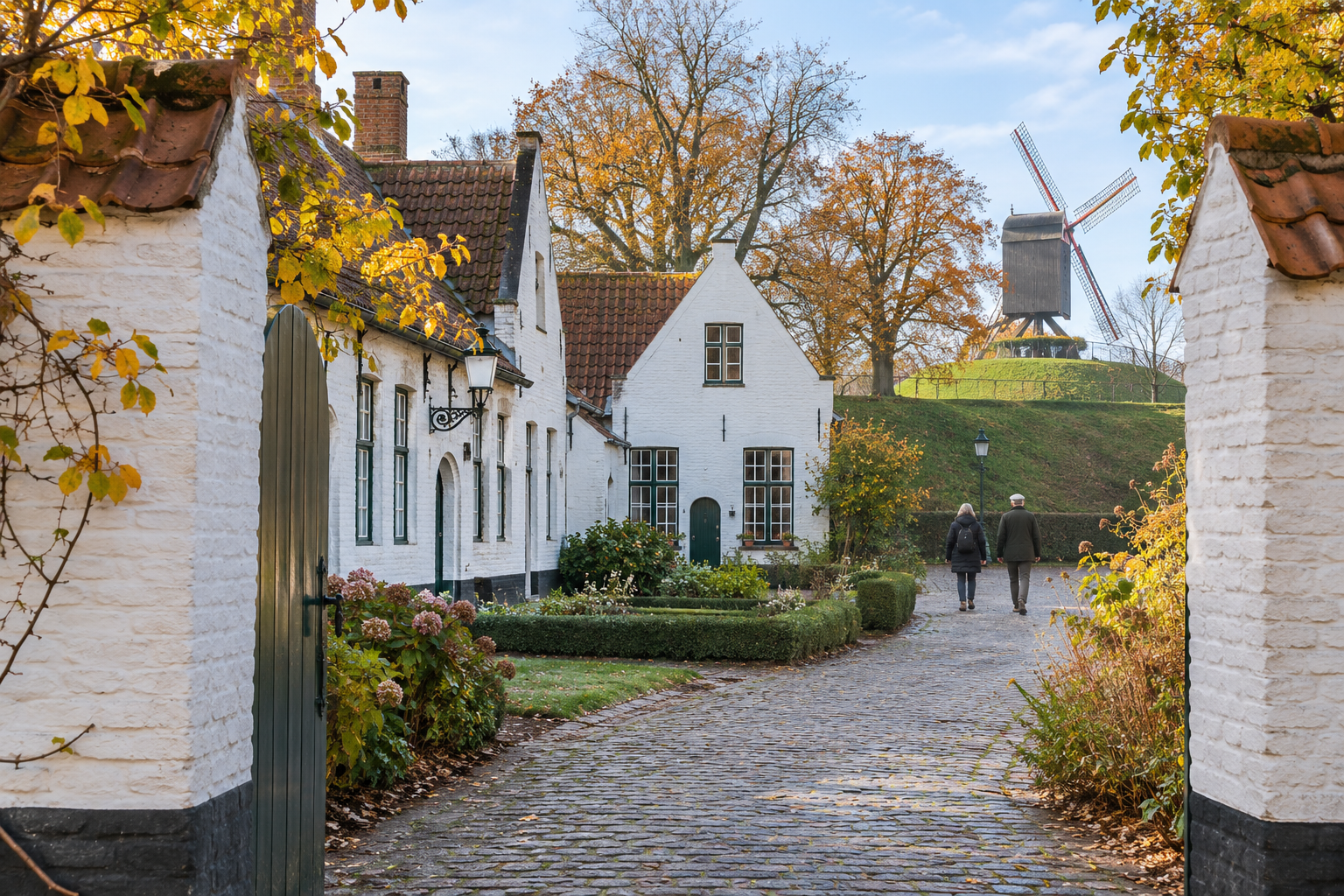
Bruges can feel busiest around Markt and the most photographed canals, yet a quieter city survives only a few streets away. This self-guided walk links the Beguinage, small charitable housing courtyards known as godshuizen, and the windmills on the eastern ramparts. Together they reveal women’s history, social care and working heritage rather than another checklist of postcard views.
Allow three hours for the complete 7-kilometre route, excluding the optional mill interior. Start with the Bruges city page, download your map or preferred self-guided audio tool in advance, and carry headphones so the silent sites remain silent.
Why this side of Bruges deserves time
More than forty historic almshouse complexes still exist in Bruges. From the fourteenth century onward, wealthy residents, guilds and religious foundations created small homes for older or vulnerable townspeople. Many remain occupied today and continue their social purpose. Whitewashed façades, modest chapels and shared gardens make them beautiful, but they are homes first. The official Visit Bruges guide to almshouses asks visitors to keep quiet and remain on designated paths.
A self-guided route from the Beguinage to Kruisvest
1. Begijnhof Ten Wijngaerde
Begin beside the Minnewater and cross into the Princely Beguinage, founded in 1245. Beguines were lay women who lived a religious but comparatively independent communal life. The white houses still surround a tranquil garden, now inhabited by single women and women with a religious vocation. Entry is free; the official Beguinage visitor page lists daily hours that can change and specifically asks for silence. At the time of checking, the site showed 07:30–18:30, but verify on the day.
Access across the main bridge includes a steep slope and uneven cobbles. Wheelchair users may find the alternative entrance near the lock keeper’s house at Minnewater more manageable, as described in the city’s accessibility guidance.
2. Katelijnestraat and the first almshouse courtyards
Walk north on Katelijnestraat, but look beyond shop windows. Het Rooms Convent at numbers 9–19 and Spanoghe at number 8 are among the courtyards recommended by Visit Bruges. If a gate is open and public access is indicated, enter quietly, stay on the path and leave residents’ doors and windows alone. If closed, admire the entrance from the street and continue.
3. Garenmarkt and Sint-Trudo
Continue toward Garenmarkt, where the Sint-Trudo almshouses form another calm pocket within the historic center. Look for the typical pattern: a dated or named entrance, a row of compact dwellings and a shared garden. The architecture expresses care in practical terms—small scale, proximity and common space—rather than monumental display.
4. De Vette Vispoort and the quieter northwest lanes
Cross the center without lingering in the busiest squares and head toward Moerstraat. The De Vette Vispoort almshouse shows how these communities are woven into ordinary streets. Nearby courtyards such as De Croeser on Raamstraat can be added if energy allows. This middle section is ideal for listening to a self-guided audio narration, because stops are short and the streets themselves provide context.
5. Sint-Anna and the eastern ramparts
Turn east through Sint-Anna, then reach Kruisvest. The green ramparts carry four wooden windmills: Bonne Chiere, De Nieuwe Papegaai, Sint-Janshuis and Koelewei. Only Sint-Janshuis is authentically Bruges and still operates; the other three were relocated to preserve the city’s mill landscape. Climb the grassy mound for views, but keep clear of moving sails and fenced working areas.
6. Sint-Janshuis Mill
The eighteenth-century Sint-Janshuis Mill can grind grain when wind and staffing allow. Its official Visit Bruges listing describes it as a working baker’s mill and currently lists adult admission at €5, with free entry for children under 13 and Musea Brugge Card holders. Opening varies by date and season, so check before setting out. The rampart walk itself remains worthwhile even when the interior is closed.
Practical tips for a respectful walk
- Best time: weekday mornings offer the calmest courtyards; the Beguinage gate closes at dusk.
- Distance: about 7 kilometres; allow three hours plus stops.
- Surfaces: expect cobbles, narrow pavements and grassy slopes. After rain, the mill mounds can be slippery.
- Etiquette: almshouses and the Beguinage are inhabited. Keep voices low, avoid photographing residents and never test private doors.
- Facilities: use public toilets and cafés in the central area before reaching the longer rampart section.
Extend the day without repeating the same story
For orientation and guided options, compare the Best Free Tour directory and the wider selection of free walking tours. The Belgium destination page helps plan another stop, while the Ghent quays and street-art walk offers a compatible day trip with a livelier urban theme.
FAQ
Are Bruges almshouses free to visit?
Outdoor courtyards that are explicitly open can generally be entered without a ticket. Access varies, and residents’ privacy always takes priority.
Can I enter every courtyard?
No. Some open regularly, others only occasionally, and some are private. Follow signs and never force a gate.
Is the route wheelchair accessible?
Parts are manageable with assistance, but cobbles, steep bridge approaches and grassy mill mounds create obstacles. Use the Beguinage’s alternative Minnewater entrance and adapt the rampart section.
Is the windmill always turning?
No. Operation depends on wind, maintenance and miller availability. Check the official listing for opening information.