
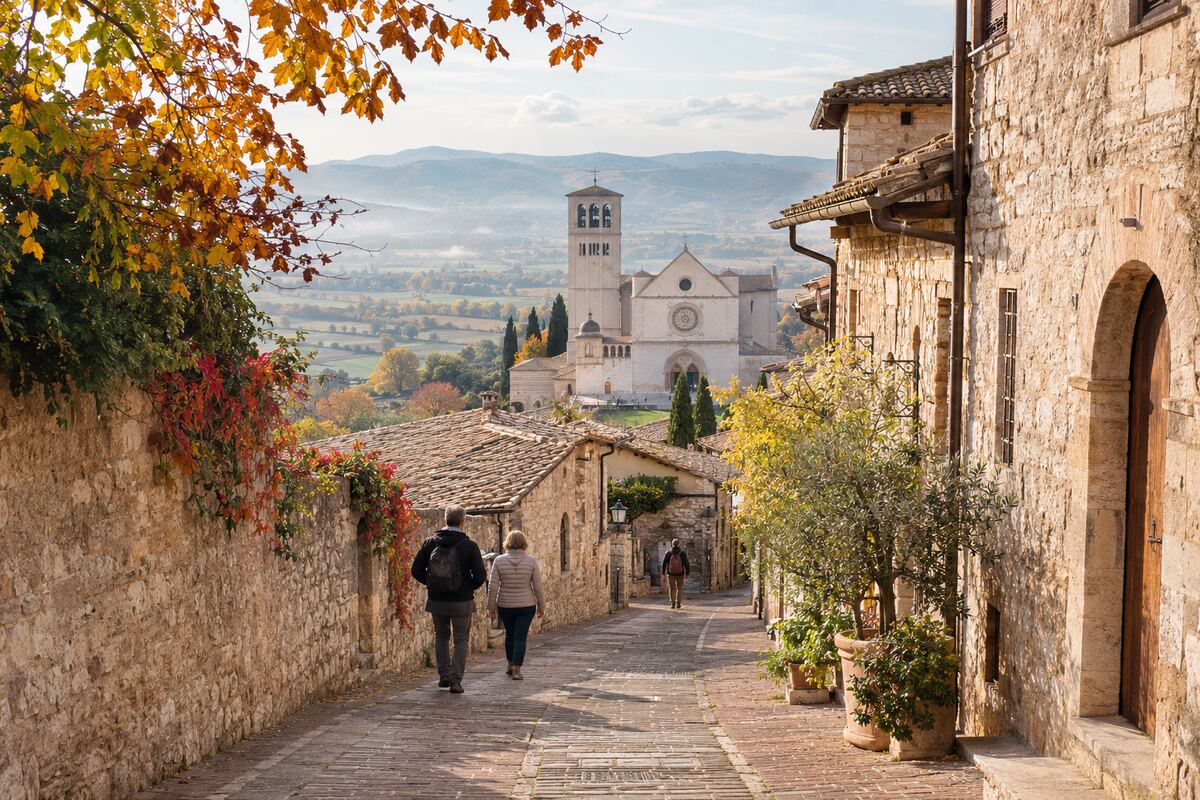
Assisi rewards slow walking, but its steep streets can make an improvised itinerary unnecessarily tiring. This route solves the problem by starting near Porta Nuova, at the upper eastern side of the historic centre, and mostly descending toward the Basilica of Saint Francis. It connects the city’s essential landmarks without turning the day into a race.
The walk is about 2.5 kilometres and takes roughly 45 minutes without visits. Allow three to four hours if you enter the churches, pause at viewpoints and explore the Roman Forum. Start with the Assisi city page, then save this route for offline use.
Why walk Assisi from east to west?
Assisi rises along the slope of Mount Subasio. Beginning at Porta Nuova places you close to the Basilica of Saint Clare and lets gravity help for much of the route. The paving remains uneven and several sections are still steep, so “downhill” does not mean step-free. Wear shoes with grip and avoid rushing on wet stone.
Drivers should remember that access to the historic centre is restricted. The official visitor information lists Porta Nuova parking as the nearest major parking area to the Basilica of Saint Clare. Travellers arriving by train can take a local bus from Santa Maria degli Angeli and begin near the upper town.
Assisi downhill route at a glance
- Start: Porta Nuova
- Finish: Basilica of Saint Francis
- Distance: about 2.5 km
- Walking time: about 45 minutes, excluding visits
- Best for: first-time visitors, independent travellers and audio-led walks
- Main challenge: sloping, sometimes polished stone paving
Step-by-step self-guided walk
1. Porta Nuova and the first Umbrian view
Begin at Porta Nuova, one of the gateways through Assisi’s historic walls. Before entering the centre, look back toward the Umbrian plain. This first panorama explains the city’s geography: the medieval streets cling to the hillside while the valley opens below. Keep the view in mind, because the route will gradually move west across the slope.
2. Basilica of Saint Clare
Walk a short distance to the Basilica of Saint Clare. Its pale-and-pink stone façade and massive external buttresses are easy to recognise. Entry is free, but this remains an active place of worship; check current hours and avoid sightseeing during services. The official Visit Assisi page notes that an audio guide in several languages is available through the tourist information office in Piazza del Comune.
The square in front of the basilica is also one of the route’s best open viewpoints. Pause here before continuing along Corso Mazzini.
3. San Rufino Cathedral
Make a short uphill detour to Piazza San Rufino. The cathedral stands over an area important in both Roman and Christian Assisi, and its Romanesque façade is one of the city’s finest pieces of carved stone. Look for the three rose windows and the animal figures around the portals. If you want to keep the route almost entirely downhill, this stop can be skipped and you can continue directly toward Piazza del Comune.
4. Piazza del Comune and the Temple of Minerva
Descend toward Piazza del Comune, the civic heart of Assisi. The ancient Temple of Minerva is the square’s most striking survival: its Roman columns were preserved while the interior later became the Church of Santa Maria sopra Minerva. Visit Assisi states that entry is free, although the interior is not fully accessible to visitors with limited mobility.
This is the best place for a practical break. The tourist information office is nearby, and the square connects Corso Mazzini with Via Portica, the street that descends toward Saint Francis.
5. Optional detour to the Sanctuary of the Spoliation
From the civic centre, take a brief detour to Santa Maria Maggiore, also known as the Sanctuary of the Spoliation. Tradition associates this place with Francis’s renunciation of material possessions before the bishop of Assisi. The detour adds slopes and steps, so travellers protecting their knees may prefer to continue directly down Via Portica.
6. Via Portica and Via San Francesco
Follow Via Portica downhill. Beneath the square lies the Roman Forum and Archaeological Collection, reached through a museum entrance near the beginning of the street. Continue into Via San Francesco, a long urban approach lined with stone façades, small courtyards and historic palaces. Walk close to the buildings when groups pass and leave doorways clear.
7. Basilica of Saint Francis
The route ends at the Basilica of Saint Francis, composed of upper and lower churches and the saint’s tomb. Individual entry is free; group rules and opening hours vary, so check the official basilica website on the day of your visit. Services take priority over tourism, photography rules must be respected and silence is part of the experience.
Accessibility is more complex than the broad squares suggest. The official “Assisi for everyone” guide describes ramps, lifts and alternative entrances, but also significant gradients and uneven stone. Travellers with limited mobility should consult that page before setting out rather than relying on the downhill direction alone.
How to turn this route into a fuller Assisi day
For a guided introduction, compare options through the Best Free Tour city finder. If you prefer to walk independently, use the AI Tour Matcher for self-guided and audio-ready ideas. You can also browse free tours in Italy and check compatible local experiences.
Practical tips for a respectful visit
- Begin early, especially on weekends and major religious dates.
- Carry water, but do not eat inside churches or on church steps.
- Dress for active places of worship and keep voices low.
- Check opening hours on the same day; liturgical events can change visitor access.
- Use the official accessibility information if steps, slopes or cobbles are a concern.
Frequently asked questions
Is this Assisi walk really downhill?
Mostly. The main direction from Porta Nuova to Saint Francis descends, but the San Rufino and Sanctuary of the Spoliation detours add short climbs. Stone surfaces can also be tiring even when descending.
Can I visit the Basilica of Saint Francis for free?
Individual entry is generally free. Groups may need reservations or other arrangements, and opening times change with the season and religious services. Verify the official website before visiting.
Is the route suitable for wheelchairs?
Not as a continuous, effortless route. Several monuments provide accessible entrances, but the historic centre includes steep gradients, cobbles and uneven paving. Use the official “Assisi for everyone” information to plan each stop and transport connection.
Where can I find an official Assisi audio guide?
Visit Assisi lists a multilingual city audio guide sold through the tourist information office in Piazza del Comune. The Basilica of Saint Francis also offers its own official audio-guide service.