
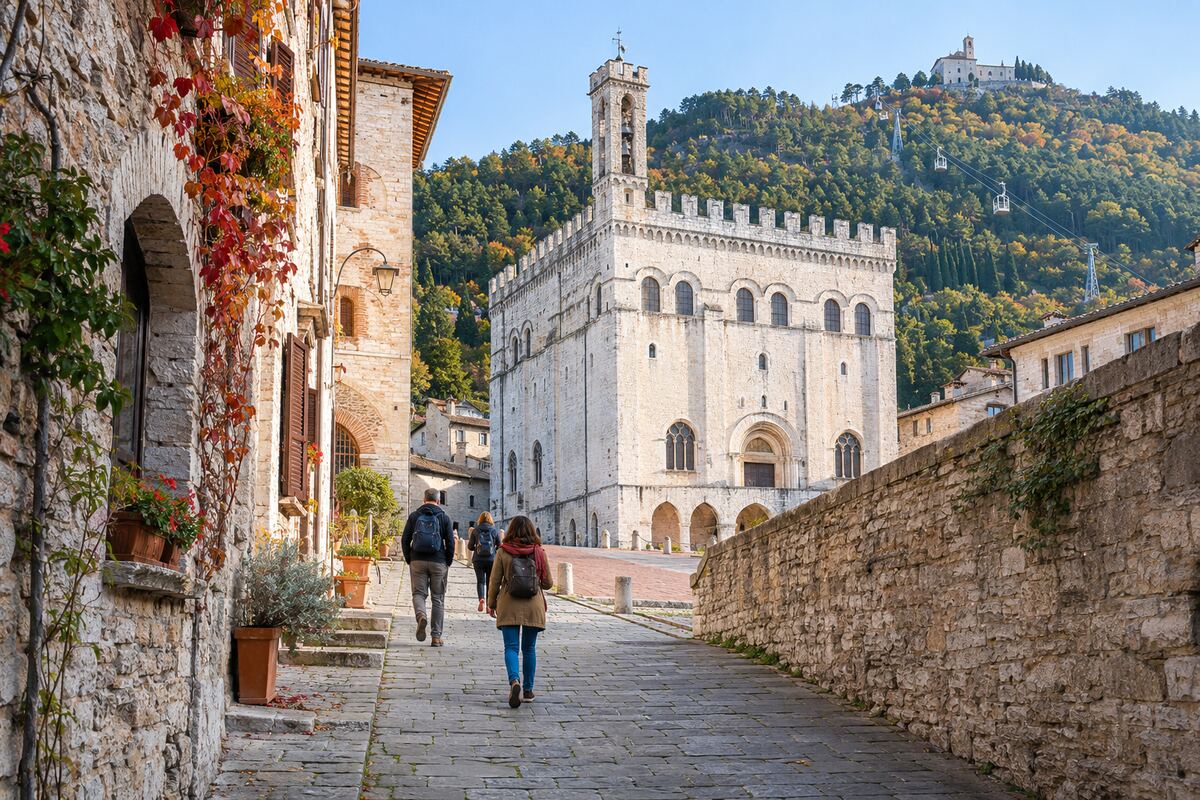
Gubbio is a city built in layers: Roman remains lie on the plain, medieval streets climb the lower slopes of Monte Ingino, and the Basilica of Sant’Ubaldo watches from above. This self-guided route follows that vertical story from the Roman Theatre to Piazza Grande and the cable car. It is rewarding, but it should be planned rather than improvised.
The urban section covers about 3 kilometres and takes roughly one hour without visits. Add two to four hours for museums, viewpoints and the return cable-car journey. Before setting out, open the Gubbio city page and check the funivia’s official operating notice for the day.
Why Gubbio is a vertical city
The historic centre rises sharply from the Roman archaeological zone toward Monte Ingino. Piazza Grande is not a conventional ground-level square but a monumental suspended terrace begun in the fourteenth century. Above it, streets continue toward the cathedral, Palazzo Ducale and the lower cable-car station. The gradients make the city dramatic, yet they also require sensible pacing.
Public lifts connect Via Baldassini with Piazza Grande and Via XX Settembre with the cathedral area. A free urban shuttle normally runs from Piazza 40 Martiri. These services are useful alternatives, but hours can change; treat them as planning aids rather than guarantees.
Gubbio vertical route at a glance
- Start: Roman Theatre
- Urban finish: Funivia Colle Eletto lower station, Via San Girolamo
- Optional summit: Basilica of Sant’Ubaldo, Monte Ingino
- Distance: about 3 km before the cable car
- Walking time: about 60 minutes, excluding stops
- Main challenge: steep stone streets and steps
- Easier option: public lifts and shuttle for selected sections
Step-by-step self-guided walk
1. Roman Theatre and the Guastuglia
Begin in the open archaeological area below the medieval town. Construction of the Roman Theatre started in the first century BC, and its cavea could hold more than six thousand spectators. The surviving arches frame one of Gubbio’s most useful views: ancient masonry in the foreground, the compact stone city rising behind it.
The paid archaeological visit can include the Antiquarium and nearby remains. Official municipal information lists accessible parking, toilets and entrance facilities, but check current opening days before relying on a museum visit.
2. Piazza 40 Martiri and the lower town
Walk toward Piazza 40 Martiri, a broad transition between modern access routes and the historic centre. This is a practical place to decide how much climbing you want to do. Continue on foot through the old streets, or use the local shuttle and public lifts to reduce the steepest sections.
3. Via dei Consoli and the Bargello quarter
Enter the medieval fabric through streets that narrow as they rise. Via dei Consoli is lined with grey limestone façades, small arches and workshops. Near Palazzo del Bargello, look for the fountain traditionally associated with Gubbio’s playful “madman’s licence”; enjoy the custom without obstructing residents or doorways.
4. Piazza Grande: the suspended civic stage
Arrive at Piazza Grande, the city’s spectacular suspended terrace. Work began in 1321 to create a civic centre between Gubbio’s historic districts. One side opens toward the countryside, making the engineering of the square as impressive as its view. Wind can be stronger here than in the narrow streets below.
If the climb is difficult, the public lift from Via Baldassini provides an alternative approach. Check its daily service hours locally.
5. Palazzo dei Consoli and the Iguvine Tablets
Palazzo dei Consoli dominates the square. Built in the fourteenth century, the Gothic palace rises more than sixty metres and now houses the Civic Museum. Its most important objects are the seven Iguvine Tablets, bronze inscriptions that preserve the longest surviving ritual text in the ancient Umbrian language.
Allow at least an hour for the museum if archaeology and civic history interest you. Otherwise, study the fan-shaped staircase, the tall façade and the relationship between the palace and the open terrace.
6. Cathedral and upper historic centre
Continue uphill toward the cathedral and Palazzo Ducale. The second public lift, reached from Via XX Settembre, can shorten this ascent. The upper streets are quieter and reveal how closely the town presses against Monte Ingino. Keep to the edge when service vehicles pass.
7. Funivia Colle Eletto
Descend slightly toward the lower cable-car station in Via San Girolamo. Gubbio’s funivia uses small open baskets rather than enclosed cabins. The official operator states that the ride takes about six minutes, climbing from roughly 532 to 803 metres above sea level. It is a memorable experience, but it is not suitable for everyone: travellers uncomfortable with heights or open cages should skip it.
Operating days and hours vary by month, and service may stop for maintenance or weather. Verify the official page on the same day before walking to the station.
8. Basilica of Sant’Ubaldo and Monte Ingino
At the top, follow the short approach to the Basilica of Sant’Ubaldo, where the city’s patron saint is venerated and the three great Ceri are kept during the year. The terrace provides a broad view over Gubbio and the Umbrian landscape. Remember that this is an active religious site: dress appropriately, speak quietly and give services priority.
How to return without repeating the whole climb
Ride the funivia back down if it is operating, then descend through the historic centre using the public lifts where useful. If the funivia is closed, treat the lower station as the end of the urban walk; the road ascent to the basilica is much longer and should not be added casually late in the day.
Guided, audio and compatible options
Compare local guided walks through the Best Free Tour city finder. For an independent or audio-ready plan, try the AI Tour Matcher. You can also browse free tours in Italy and check compatible experiences before choosing museum and transport times.
Practical tips
- Wear shoes with grip; polished stone can be slippery after rain.
- Check the funivia and museum schedules on the day of your visit.
- Carry a light layer: Monte Ingino can be cooler and windier than the lower town.
- Use the lifts if you need to protect knees or conserve energy.
- Do not plan the summit section close to the last cable-car departure.
Frequently asked questions
Is the Gubbio cable car an enclosed cabin?
No. It uses small open metal baskets. The journey is short but exposed, so it may not suit people with vertigo or anxiety about heights.
Can I visit Gubbio without taking the funivia?
Yes. The Roman Theatre, Piazza Grande, Palazzo dei Consoli and upper historic centre make a complete urban route. The funivia and basilica are optional additions.
Is the route wheelchair accessible?
Not as one continuous walking route. The Roman archaeological site lists accessible facilities and public lifts help with selected levels, but steep streets, steps and uneven paving remain. Confirm lift operation and individual monument access before travelling.
How much time should I allow?
Allow at least three hours for the urban walk with one museum. Four to five hours is more comfortable if you add the cable car, the Basilica of Sant’Ubaldo and long viewpoint stops.