
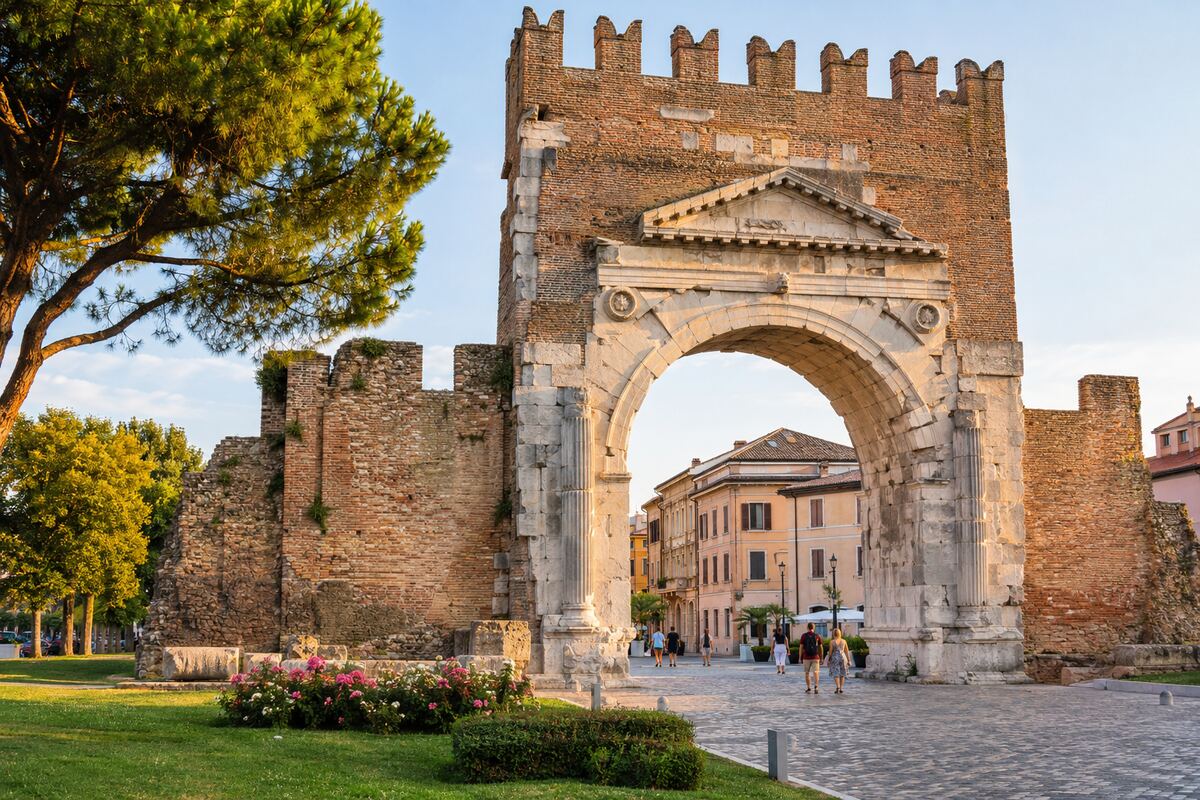
Rimini is better known for its beach, but its historic centre preserves one of northern Italy’s clearest Roman city walks. Ancient Ariminum was founded in 268 BC at a strategic junction of roads. Today you can still follow its main urban axis from the Arch of Augustus to the Tiberius Bridge, then examine everyday life at the Surgeon’s House.
This self-guided route covers about 3 kilometres and takes 60–75 minutes without visits. Allow three to four hours for the Visitor Center, City Museum and archaeological site. Open the Rimini city page before setting out and check the museum timetable on the day.
Roman Rimini route at a glance
- Start: Arch of Augustus
- Finish: Roman Amphitheatre
- Distance: about 3 km
- Walking time: 60–75 minutes without interiors
- Recommended total: 3–4 hours with museums
- Main paid stop: City Museum and Surgeon’s House combined ticket
Step-by-step Roman walk
1. Arch of Augustus: the Flaminian entrance
Begin at the Arch of Augustus, erected in 27 BC where the Via Flaminia reached Ariminum. It is the oldest surviving Roman arch in northern Italy. The unusually wide opening could not be closed by doors, a deliberate image of peace after the civil wars. Look for the divine figures in the roundels: Jupiter, Apollo, Neptune and Roma. The crenellated top is a medieval alteration.
2. Porta Montanara and the city edge
Walk west to Porta Montanara, a first-century-BC sandstone gateway once formed by two arches. Its position helps reconstruct the Roman perimeter and the road toward the hills. Pause without climbing on the masonry, then turn toward Piazza Tre Martiri.
3. Piazza Tre Martiri: reading the forum
The modern square covers part of the Roman forum, where the cardo and decumanus met. Small exposed sections of paving make the ancient level visible. A later tradition linked the square with Julius Caesar after the Rubicon crossing, but the official route carefully notes that Caesar’s own account places his speech to the troops at Ravenna. Treat the story as civic memory, not proven fact.
4. Rimini Caput Viarum Visitor Center
Near the square, the visitor centre uses multimedia displays to explain Ariminum and the roads that converged here. It is a useful orientation stop before continuing along Corso d’Augusto, the line of the Roman decumanus. Check current opening times before relying on an interior visit.
5. Tiberius Bridge: engineering still in use
Continue to the five-arched bridge in Istrian stone. Augustus began it in AD 14 and Tiberius completed it in AD 21. Its piers are angled to reduce the force of the current, while timber piles support the structure below. The bridge marked the beginning of the Via Aemilia toward Piacenza and the Via Popilia toward Ravenna and Aquileia.
Walk down to the waterside viewpoint for the full profile, but remain behind barriers and avoid slippery edges after rain.
6. City Museum: objects from ancient Ariminum
Head to Via Tonini for the archaeological section of the City Museum. Here finds from the Surgeon’s House gain context, including a reconstruction of the medical taberna. The collection turns the street monuments into evidence of trade, domestic life and professional practice.
7. Surgeon’s House: a third-century medical world
In nearby Piazza Ferrari, a protective glass-and-steel structure shelters remains spanning Roman times to the Middle Ages. The house takes its name from its last owner, a Greek-trained physician. An exceptionally rich set of surgical and pharmaceutical instruments was preserved after a fire destroyed the building around the middle of the third century.
The site and City Museum share one ticket. Official information updated in May 2026 lists opening from Tuesday to Sunday, with Monday closures outside holidays, but always verify before travelling. Roof-maintenance works begun in 2026 were designed to keep the site safely open.
8. Roman Amphitheatre: finish near the ancient shore
End at the surviving sector of the second-century amphitheatre. It once stood close to the ancient shoreline and could hold at least twelve thousand spectators. Much has disappeared beneath later development, so this stop requires imagination: use the surviving brickwork and the official route map to understand the original ellipse.
Audio and guided options
Rimini Turismo provides a free downloadable audio guide for the historic-centre route. For more local options, compare walks through the Best Free Tour city finder. Build an independent or audio-ready plan with the AI Tour Matcher, browse free tours in Italy, and check compatible experiences.
Practical tips
- Start early in summer: shade is limited around several monuments.
- Do not schedule the museum section on a non-holiday Monday.
- Wear shoes with grip for wet stone near the bridge.
- Use crossings carefully along the urban sections.
- Download audio and maps on Wi-Fi before leaving.
Frequently asked questions
Can I see Roman Rimini for free?
The arch, bridge, forum area, gate and amphitheatre exterior are free to view. The City Museum and Surgeon’s House require a combined ticket.
How long does the route take?
Allow about 75 minutes for the walk alone. Three to four hours is more realistic with the museum, archaeological site and audio stops.
Is the Surgeon’s House still open during roof works?
The municipal museum stated that the 2026 roof-maintenance project would keep the site open and safe. Check the official hours page for the day of your visit.
Is the route accessible?
Much of the outdoor route follows level city streets, but surfaces, crossings and individual archaeological areas vary. Contact the museum for current lift, entrance and companion information.