
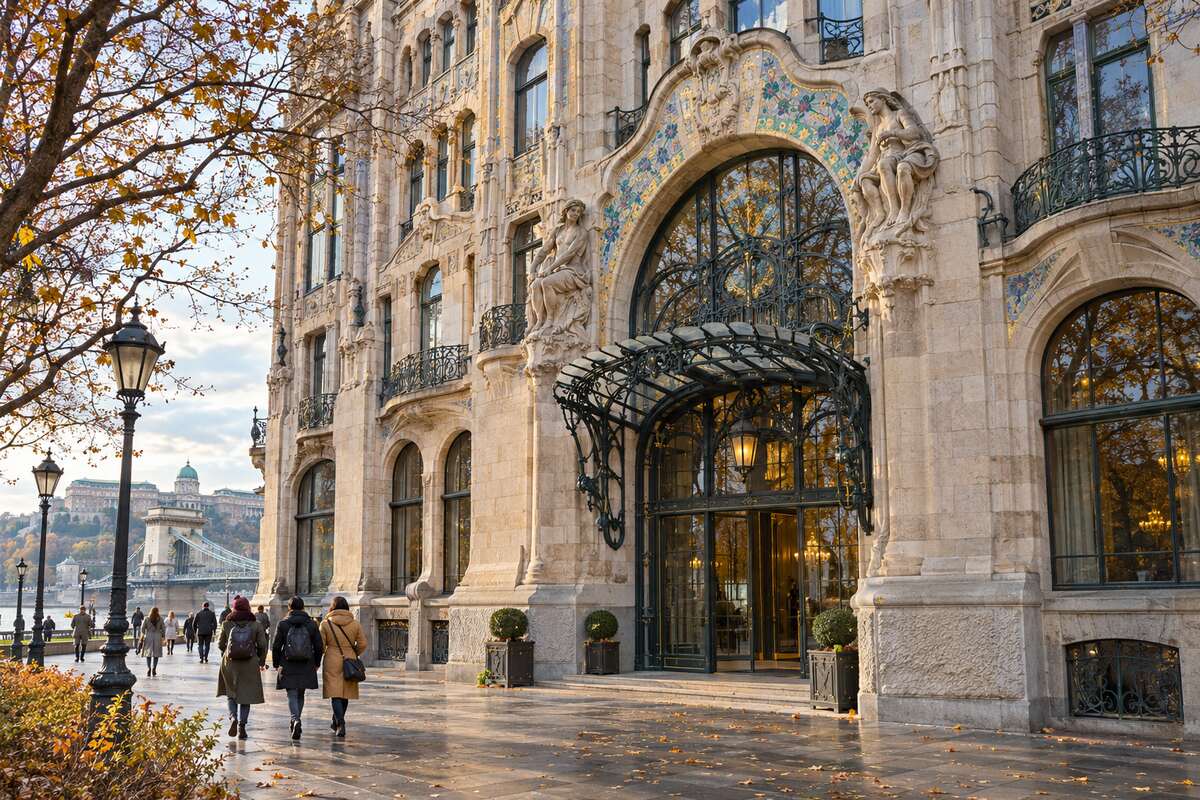
Budapest’s turn-of-the-century architecture rewards anyone willing to slow down and look up. This Budapest Art Nouveau walk links four landmarks that show different faces of the city’s Secession style: cosmopolitan luxury, a private collector’s house, Ödön Lechner’s distinctly Hungarian ornament and a concert hall built as a complete work of art.
The route is about 3 km and takes 75–120 minutes for exterior stops. Add time if you visit the Hungarian Art Nouveau House or book a Liszt Academy tour. It pairs naturally with a free walking tour, while Best Free Tour’s independent audio guides can help you explore at your own pace.
What makes Budapest Art Nouveau distinctive?
Across Europe, Art Nouveau replaced strict historicism with curves, plants, stained glass and integrated craft. In Budapest, architects also drew on Hungarian folk motifs and colourful Zsolnay ceramics. The result is not one uniform style: Gresham Palace feels international, Bedő House recalls Belgian and German currents, and the Postal Savings Bank turns roofs, bees and flowers into a national architectural language.
Budapest Art Nouveau walking route
1. Gresham Palace and Széchenyi Square
Start at Széchenyi István tér, facing the Chain Bridge. Budapest’s official visitor site identifies Gresham Palace as one of the city’s finest Art Nouveau buildings. Completed in 1906 for a London insurance company, it combines sculpture, ironwork, mosaics, stained glass and glazed ceramics. Today it is a working luxury hotel, so treat the entrance as private hospitality space and rely on the public square for the clearest exterior view. Read the building history on Visit Hungary.
2. Walk toward Liberty Square
Follow the inner-city streets north toward Szabadság tér. This transition is useful: ornate insurance-company architecture gives way to the monumental banking district. Pause at safe crossings and notice how late nineteenth-century façades frame the newer Secession buildings.
3. Bedő House: the Hungarian Art Nouveau House
At Honvéd utca 3, Bedő House was designed by Emil Vidor after the site was acquired in 1903. Its asymmetrical façade, curved windows and floral Zsolnay decoration make it easier to read than many larger buildings. Inside, the Hungarian Art Nouveau House displays period furniture, paintings, porcelain and domestic objects across more than 600 square metres. Opening days can change, so consult the official national tourism profile and the venue itself before visiting.
4. Former Postal Savings Bank
Continue to Hold utca 4. Ödön Lechner and Sándor Baumgarten completed the former Postal Savings Bank in 1901. Look for bees and beehives, symbols of diligence and saving, plus colourful ceramic ornament high above street level. The building now houses the Hungarian State Treasury, so it should be approached as a working government office rather than a museum. The roofline is easiest to appreciate by stepping back where traffic and pavements allow.
5. Along Bajcsy-Zsilinszky út and Andrássy Avenue
Head south-east toward Andrássy út. This middle section is less about a single monument and more about urban context: shopfronts, apartment blocks and theatres reveal how Budapest expanded during the Dual Monarchy. If you need a break, use the public spaces around the Basilica or Liszt Ferenc tér rather than blocking building entrances.
6. Liszt Ferenc Academy of Music
Finish at Liszt Ferenc tér 8. Opened in 1907, the Academy combines education and performance inside an exceptional Art Nouveau concert palace. Its façade is impressive, but the great hall, mosaics, stained glass and the “Fountain of Art” fresco make the interior especially rewarding. The institution’s official guided-tour page lists current bookable visits; tours are separate from concert admission and schedules vary.
Details worth looking for
Glazed Zsolnay ceramics
These weather-resistant ceramics bring saturated colour to façades and roofs. At Bedő House, seek floral pieces around windows; at the Postal Savings Bank, look high above the cornice.
Nature translated into iron and glass
Gates, balconies and window frames bend into stems and whiplash curves. Rather than treating decoration as an added layer, Art Nouveau designers aimed to coordinate architecture, furniture and craft.
Symbols of each institution
Gresham projects commercial prestige, the savings bank uses bees and hives, and the Liszt Academy surrounds music-making with allegorical art. The details explain what each patron wanted the building to communicate.
Practical planning
- Start: Széchenyi István tér, near the Pest end of the Chain Bridge.
- Finish: Liszt Ferenc tér; Oktogon metro and tram stops are nearby.
- Distance: approximately 3 km, mostly level, with busy crossings.
- Best time: weekday morning for quieter pavements; late afternoon for warm façade light.
- Weather: roof and ceramic details are easier to see in clear conditions; carry binoculars only if convenient.
- Transport: Budapest has four metro lines and a dense city-centre tram network. Check live changes and tickets with BKK.
Plan the rest of your Budapest stay
Continue with the Hungary destination page, compare free tours in Budapest and other cities, and browse compatible experiences. A Danube-side walk or evening concert at Liszt Academy makes a logical follow-up.
Frequently asked questions
Is the Budapest Art Nouveau walk free?
The route and exterior viewing are free. Bedő House, Liszt Academy tours and concerts may require tickets.
Can I enter Gresham Palace?
It operates as a hotel, not a public museum. Respect guest areas and current staff guidance; the façade is fully appreciated from Széchenyi Square.
How long should I allow?
Allow 75–120 minutes for the walk. Add about an hour for one interior visit and more if you attend a concert.
Is the Postal Savings Bank open to tourists?
It is the Hungarian State Treasury’s working headquarters. Plan for exterior viewing unless an official public programme specifically grants access.
Is the route accessible?
The route is mostly level, but kerbs, construction and crowded pavements vary. Check accessible transport information with BKK and confirm venue access directly.