
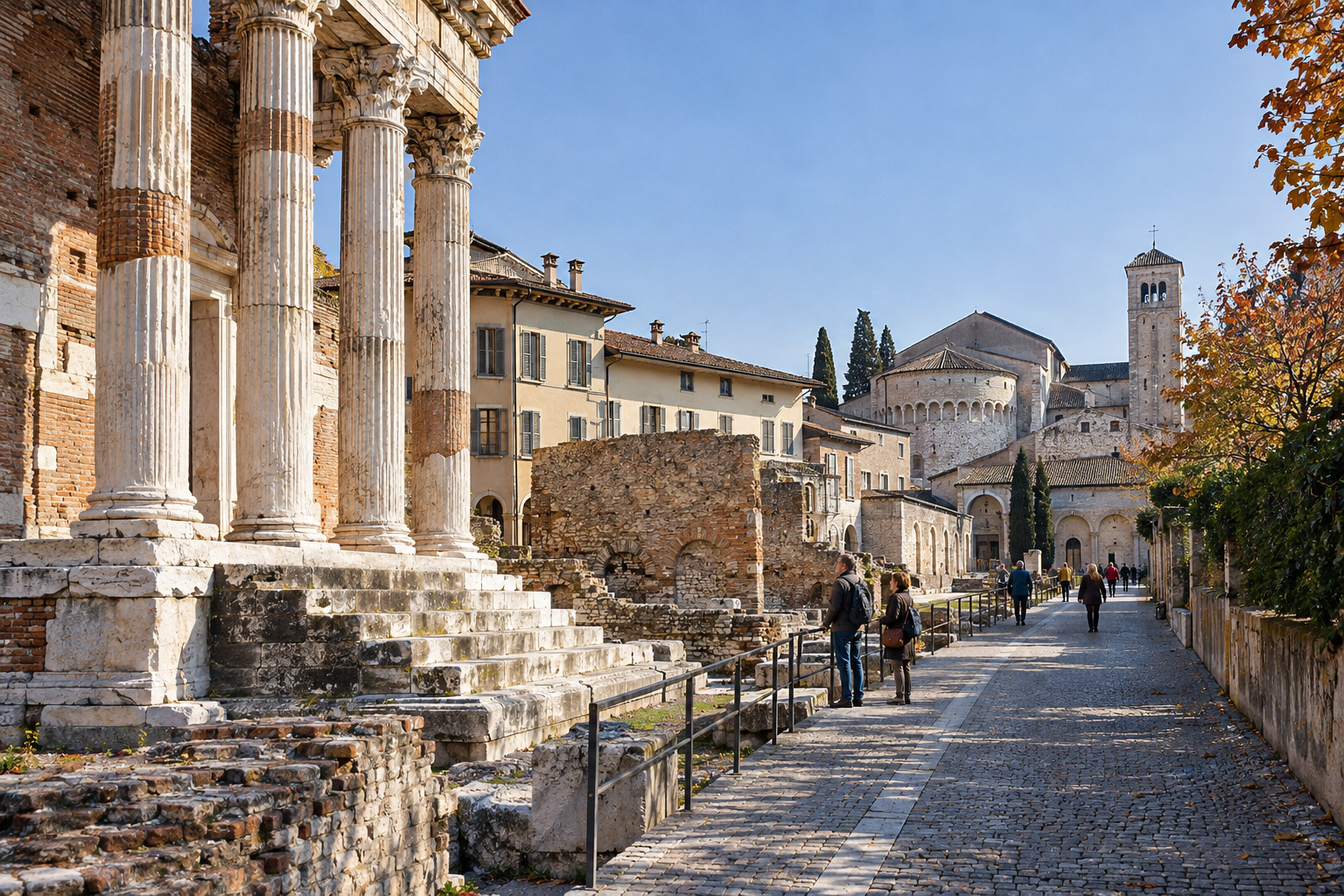
Brescia compresses 2,500 years of urban history into a remarkably short distance. Along Via dei Musei, Roman temples, a theatre, medieval churches and a former monastery form one continuous cultural landscape. The UNESCO Corridor makes the connection visible: a free pedestrian route of about one kilometre linking the Archaeological Park of Roman Brescia with the Santa Giulia complex.
This self-guided walk takes about 90 minutes outdoors. Add at least two hours if you enter the Capitolium and Santa Giulia Museum. Start with the Brescia city page, save the official pages offline and use headphones if you follow an independent audio guide.
Why Brescia’s UNESCO route is unusual
The archaeological area and the monumental complex of San Salvatore–Santa Giulia were inscribed on the UNESCO World Heritage List in 2011 as part of “The Longobards in Italy. Places of Power”. The route is not simply Roman and not simply medieval. It shows how later communities reused, covered and reinterpreted the same ground.
The Comune di Brescia describes the corridor as a freely accessible monumental walk through 2,500 years of history. Paid admission is required for the interiors of Brixia Archaeological Park and the museum, but the connecting outdoor path itself is free.
A self-guided walk along Via dei Musei
1. Piazza del Foro and the lower Roman city
Begin in Piazza del Foro, where today’s street level sits above ancient Brixia. Fragments of the Roman basilica and porticoes reveal the scale of the civic and commercial center. Pause before climbing: the difference in ground levels is the easiest way to understand how centuries accumulated here.
2. Capitolium and the Winged Victory
The Capitolium was commissioned under Emperor Vespasian in 73 CE and dedicated to Jupiter, Juno and Minerva. Its white Botticino marble contrasts with later restoration materials. Inside, the bronze Winged Victory has become the symbol of Brescia. The statue was discovered in 1826, making 2026 the bicentenary year of its recovery.
Entry to the temple and Republican Sanctuary requires a ticket. Check current hours and prices directly with Brescia Musei; the city page explicitly directs visitors to the museum operator because schedules can change.
3. Roman Theatre and the open archaeological view
Beside the Capitolium, the Roman Theatre once used the slope of Cidneo Hill and could hold thousands of spectators. Restoration means access can be limited, but much of the setting is legible from the public route. Do not cross barriers: the view from the corridor already explains the relationship between temple, forum and entertainment space.
4. The free UNESCO Corridor
Continue east toward Santa Giulia. The corridor is more than a shortcut: it is designed to keep visitors immersed in historic architecture while connecting sites that were once visited separately. Interpret the walk slowly. Stone, brick, church walls and former monastic spaces show the transition from Roman Brixia to medieval Brescia.
5. San Salvatore and Santa Giulia Museum
The former monastery contains the Lombard basilica of San Salvatore, the Nuns’ Choir, Santa Maria in Solario and the Roman Domus dell’Ortaglia. The museum holds more than 11,000 objects and works, so a complete visit is not a quick add-on. The official Visit Brescia museum guide recommends following the new Roman section and UNESCO connection as part of the same story.
Tickets, timing and accessibility
- Outdoor corridor: free and open to pedestrians; verify temporary restrictions before travel.
- Interiors: ticketed. Consult Brescia Musei for the current integrated ticket and booking options.
- Time: 90 minutes outdoors; three to four hours with both major interiors.
- Accessibility: natural barriers and level changes exist, but lifts provide alternative access in parts of the archaeological park and museum.
- Best light: morning makes the Capitolium marble easier to read and leaves time for the museum.
The Roman Theatre may open only partially or on special occasions. Treat official live information as authoritative rather than relying on old travel blogs.
Continue the day in Lombardy
Compare guided visits through Best Free Tour and browse free walking tours in Italy. For a second Lombardy destination, the Pavia university and Romanesque walk offers a different historical rhythm, while the Bergamo route focuses on Venetian walls and hill views.
FAQ
Is the UNESCO Corridor really free?
Yes, the outdoor pedestrian connection is free. Tickets are required for the archaeological and museum interiors.
Can I see the Winged Victory without a ticket?
No. The statue is displayed inside the Capitolium, within the ticketed archaeological park.
Is the route suitable for children?
Yes. The short outdoor distance works well for families, but supervise children around archaeological drops and barriers.
Do I need to book?
The outdoor route does not require booking. For interiors, exhibitions and busy dates, check Brescia Musei and reserve when recommended.