
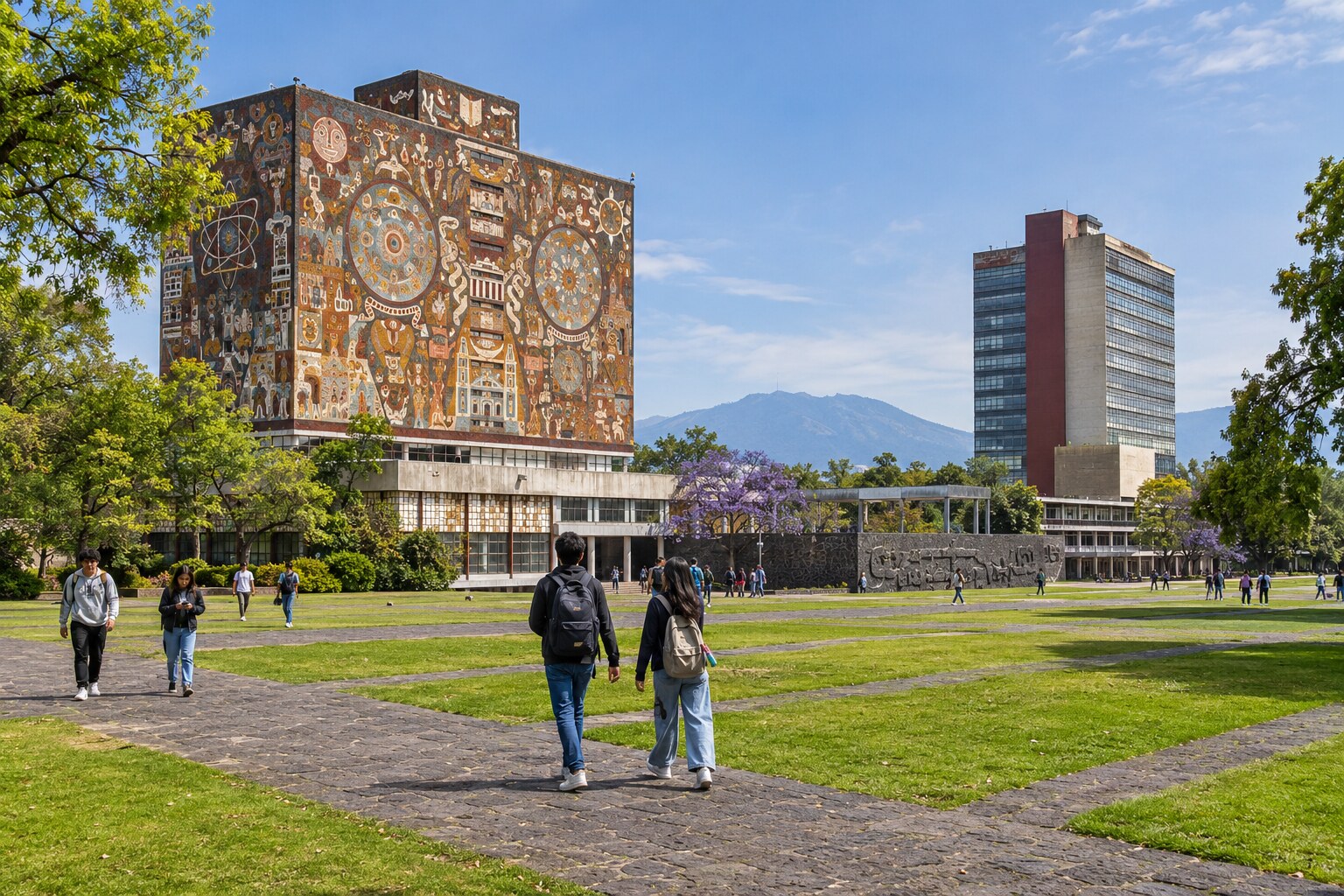
Mexico City’s UNAM campus is not simply a collection of university buildings. It is a bold experiment in which 1950s modernism, volcanic landscape and monumental art were designed as one urban ensemble. This self-guided UNAM campus walk links the Central Library, Rectoría and the Olympic Stadium through the open spaces of Ciudad Universitaria.
Allow 90–120 minutes for roughly 2.5 km, excluding museums. The campus is active, not an open-air theme park: classes, events, maintenance and security arrangements can alter access without notice.
Why is UNAM’s central campus a World Heritage Site?
UNESCO describes the core campus as a major Latin American example of twentieth-century modernism, built from 1949 to 1952 by more than sixty architects, engineers and artists. Its importance lies in the integration of architecture, engineering, landscape and fine art with references to Mexico’s pre-Hispanic past. Read the official UNESCO listing for UNAM before your visit.
For wider city planning, start with our Mexico City historic-centre walk, compare guided options in the free walking tour hub, or build a flexible independent route with the AI Tour Matcher and self-guided audio options.
Self-guided UNAM walking route
1. Rectoría and the central esplanade
Begin on the broad lawns of the central campus. The slender Rectoría tower introduces the idea of integración plástica: art is part of the architecture rather than decoration added later. Look for the exterior works associated with David Alfaro Siqueiros, then step back to understand how the tower, low faculty buildings and open space form one composition.
2. Central Library
Walk toward the Biblioteca Central, the campus’s most recognisable building. Juan O’Gorman’s vast mosaic skin turns the four façades into a visual account of Mexican history: pre-Hispanic, colonial, modern and university themes. Do not rush to the closest wall. Circle the building at a respectful distance so the relationship between images, geometry and landscape becomes clearer.
3. Faculty façades and volcanic stone
Continue across the pedestrian areas between the library and the university faculties. Dark volcanic rock from the Pedregal appears in walls, paving and landscape edges, grounding the modern buildings in their site. Use marked paths and crossings; service roads and internal traffic interrupt some pedestrian routes.
4. Olympic Stadium exterior
Finish at the Estadio Olímpico Universitario. Opened in 1952 and later the main venue of the 1968 Olympic Games, its low profile follows a natural depression in the lava terrain. From public areas, look for Diego Rivera’s unfinished mosaic relief on the stadium exterior. Entry depends on sporting and university schedules, so plan the walk around the outside rather than assuming access.
How to look at the campus
- Scale: alternate close views of mosaics with long views across the lawns.
- Landscape: notice how lava stone, planted areas and buildings share the same plan.
- Art and structure: murals are conceived as part of façades, not as framed pictures.
- Movement: paths, roads and open space reveal a campus designed as a small city.
Practical tips
- Visit in daylight; the sun can be strong even when the air feels cool.
- Bring water, sun protection and shoes suitable for long paved and stone surfaces.
- Metro and Metrobús approaches vary by starting point; check the current official network map before departure.
- Pumabús routes are useful but may change during holidays or special events.
- Respect teaching spaces, security barriers and student privacy; do not enter restricted buildings for photographs.
Extend your Mexico City day
Continue with the Classic Mexico City Food Guide or fit the campus into our three-day Mexico City itinerary. For bookable museums and compatible activities, browse Mexico City experiences. The official Mexico City UNAM campus guide is useful for checking additional venues.
FAQ
Is the UNAM campus walk free?
Yes. The outdoor route uses public campus spaces. Museums, events and stadium access may have separate tickets or restrictions.
How long does the route take?
Plan 90–120 minutes for the core walk, or half a day if you add a museum or the cultural circuit.
Can visitors enter the Central Library and Olympic Stadium?
Access depends on university operations, events and current visitor rules. The route is designed to work from public exterior spaces.
Is the route accessible?
Many central paths are broad and paved, but distances, road crossings and uneven volcanic-stone sections can be demanding. Check current campus accessibility information before travelling.