
Welcome to the Neptune Fountain Complete Guide, your friendly and easy introduction to one of Florence’s most striking landmarks in Piazza della Signoria. Whether you are visiting the city for the first time or simply love Renaissance art, this article explains who created it, why it was built, the artists involved, how the work progressed, and the meaning behind every important statue. Moreover, you will discover useful tips that make the fountain even more enjoyable when you stand in front of it.
The Origins and Reasons Behind the Fountain
The idea for a grand public fountain in Florence began around the middle of the 16th century. Cosimo I de’ Medici, the powerful duke who later became the first Grand Duke of Tuscany, wanted to celebrate a major achievement: bringing clean, reliable water into the heart of the city through a new aqueduct. At the same time, he wished to show Florence’s growing strength on the seas, thanks to improved ports and the Order of Saint Stephen. As a result, the fountain also became a symbol of Medici power and was later linked to the marriage of Cosimo’s son Francesco to Joanna of Austria in 1565.
Who Designed and Built the Monument
The original design came from Baccio Bandinelli, a well-known sculptor of the time. However, Bandinelli died in 1560 before serious work could begin. Consequently, the commission passed to his student Bartolomeo Ammannati, who became the main artist responsible for the Neptune Fountain Complete Guide’s central subject. Ammannati worked with a team of skilled assistants that included Giambologna, Vincenzo de’ Rossi, and others. The large block of white Carrara marble for Neptune arrived after some delays, and the sculptors had to join several pieces together rather than carve from a single block. Progress was not always smooth, yet the fountain was partially unveiled in December 1565 for the royal wedding, using temporary stucco elements that later disappeared. The full marble and bronze work continued and reached completion around 1574–1575.
The Central Figure and Its Powerful Meaning of Neptune Fountain Complete Guide
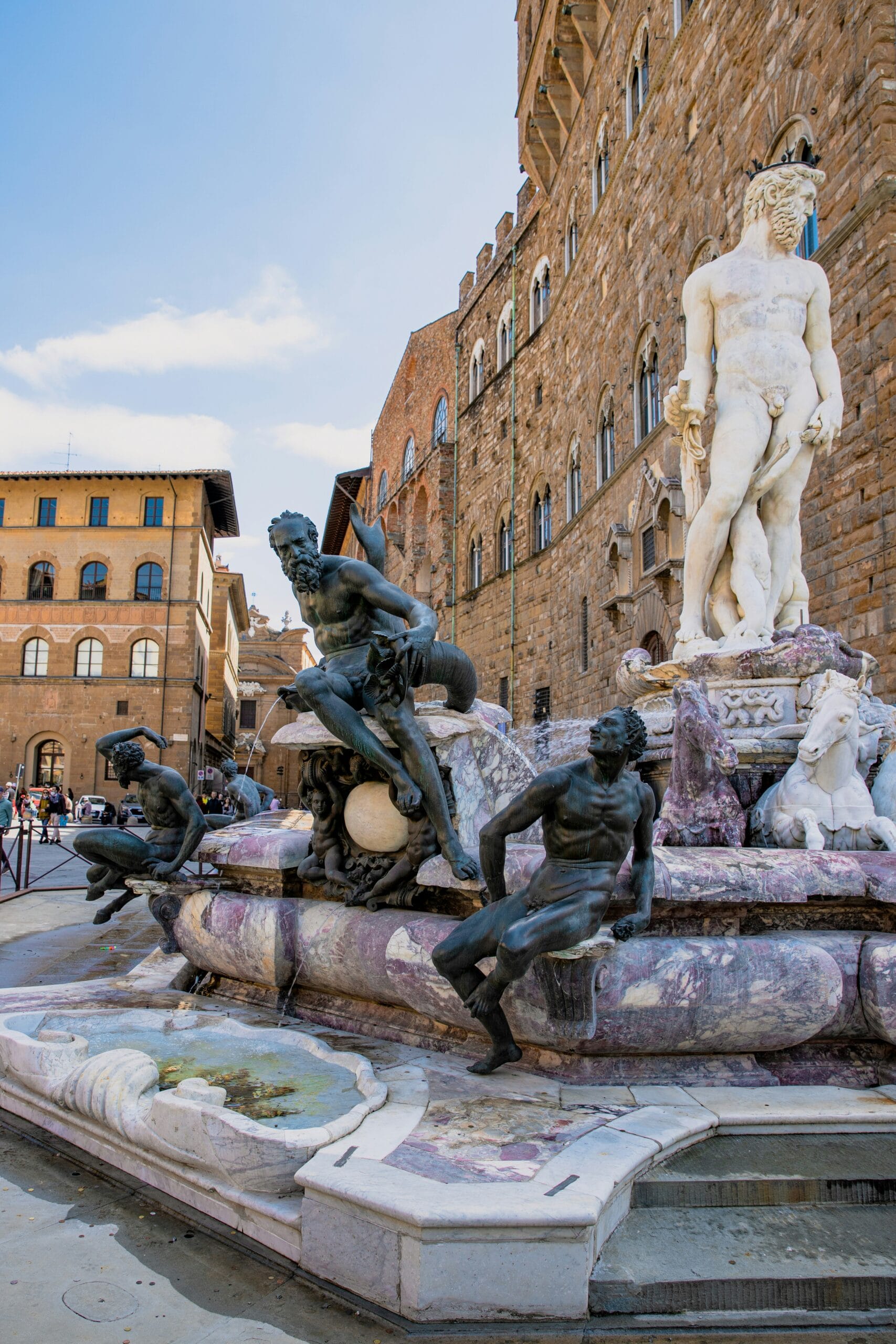
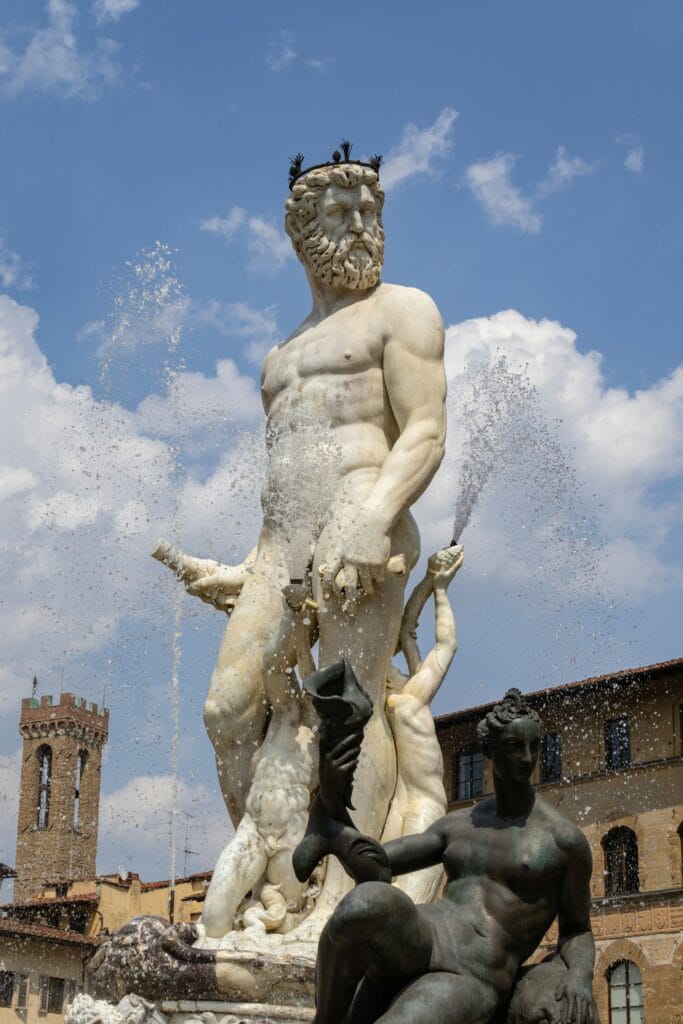
At the heart of the fountain stands the imposing marble statue of Neptune, the Roman god of the sea. Locals quickly nicknamed him “Il Biancone” (the White Giant) because of the bright Carrara marble. His face was deliberately modeled after Cosimo I himself, creating a clear link between the ruler and the divine master of the waters. Neptune stands on a shell-shaped chariot pulled by four horses that rise from the water — two in white marble and two in pinkish stone. Three tritons play instruments at his feet, sending jets of water into the air. Furthermore, the pedestal below shows the mythical sea monsters Scylla and Charybdis, reminding viewers of the dangers of the ocean and the power needed to control them. In this way, the central group celebrates Cosimo’s control over both water supplies and maritime trade routes.
The Bronze Figures Around the Basin
The large octagonal basin is made of a special mixed marble from Seravezza, a quarry controlled by the Medici. Around its edges you will find lively bronze sculptures created mainly by Ammannati and his workshop. These include satyrs, fauns, and nereids (sea nymphs). Two of the female figures represent Thetis and Doris (or Amphitrite), goddesses connected to the sea. Other bronze groups show river gods, young men with dolphins, and playful putti. In addition, these smaller figures add movement and contrast to the calm, hierarchical presence of Neptune. Together they form a rich allegory of water in all its forms — rivers, seas, and the life-giving streams that Cosimo brought to Florence.
Helpful Resources and Visiting Tips
If you would like to explore further, the detailed page on Wikipedia offers solid historical background. For a clear visitor overview, visit the page on Visit Tuscany. You can also read a modern description of the fountain’s symbolism on The Traveler, and find additional artistic notes on Florence RockinArt.
Of course, the best experience is to see the fountain in person. When you are in Florence, join a free walking tour that includes Piazza della Signoria — you can discover excellent options right here on www.bestfreetour.com. Standing beside the flowing water, with Palazzo Vecchio rising behind and the copy of Michelangelo’s David nearby, brings the whole story to life.
In the end, the Neptune Fountain Complete Guide reveals far more than a beautiful marble statue. It is a celebration of water, Medici ambition, and Renaissance artistry that still shapes the square today. Next time you look at Neptune rising above the basin, you will recognize Cosimo’s face, understand the maritime message, and appreciate the many bronze figures that complete the scene. That deeper knowledge turns a simple stop in Piazza della Signoria into a richer and more memorable moment.